.svg)

.png)
.svg)
.svg)
.svg)
Eight initiatives to increase efficiency in an economic downturn
The SaaS recession is here and it’s time to optimize with decisive action.
Tech markets have experienced a paradigm shift, swinging from 2021’s record-setting funding activity at sky high valuations to a sharp market correction in 2022. Growth at all costs has been replaced by a return to SaaS fundamentals: revenue durability, growth efficiency, and healthy unit economics.
Throughout 2022, Craft held several talks with founders about the new economic realities and how to best operate during a downturn.
and
’s latest discussion covered the demand slowdown and the importance of acting fast, extending runway >24 months, and retooling businesses to operate with hyper-efficiency. Here I drill down on how to do that.
Eight Initiatives for Operational Efficiency
In early January, I hosted a talk covering eight actions SaaS companies can take to drive operational efficiency and navigate the strong headwinds. These are lessons learned from my experiences joining companies to quarterback growth and ‘strive for efficiency’ turnarounds.
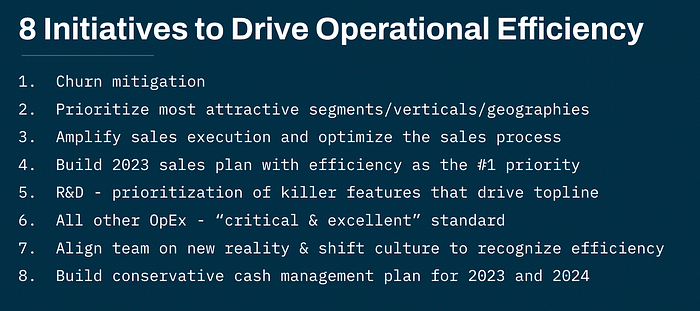
All eight of these initiatives may not be immediately relevant to your business, but they should inspire strategic conversations among your executive team. If your goal is to exit the downturn in a position of strength, be hyper focused on conserving cash, deepen your relationships with customers, do more with less, and seriously sweat the details of execution and process optimization.
1) Churn Mitigation: A churn problem is a burn problem (7:32)
Churn is the Achilles’ heel of a SaaS company’s growth and efficiency. Logo churn or downsell (seat contraction, discounts) is particularly damaging because on average it’s 5x more expensive to acquire versus retain customers. Managing churn is a critical indicator of a SaaS company’s health and it impacts all the key SaaS metrics. Companies must be maniacal about keeping their ideal customer profile (“ICP”) customers healthy and happy.
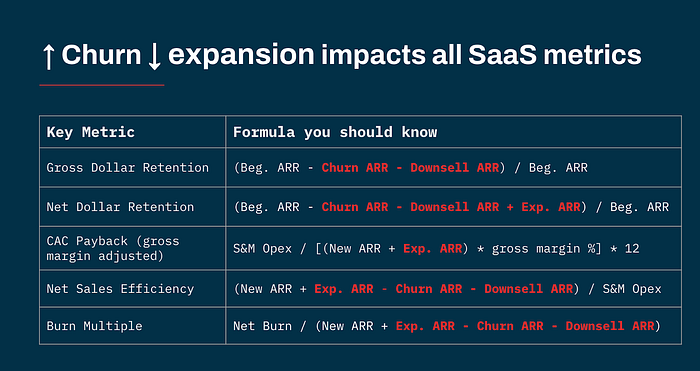
Additionally, up for renewal logo, dollar and net dollar retention metrics are critical to track. These metrics offer the most accurate view of retention characteristics because they remove the noise from multi-year contracts. Below are the formulas to know:

Economic downturns test whether products are “need to have” versus “nice to have.” In these tougher times, high gross retention is not only critical for maintaining efficient growth, but is a strong indicator of customer love for your product and tangible ROI. Expanding with existing customers will be harder given headwinds but is still a much cheaper option than new acquisition. The “Churn Mitigation Playbook” below has proven to be very effective.
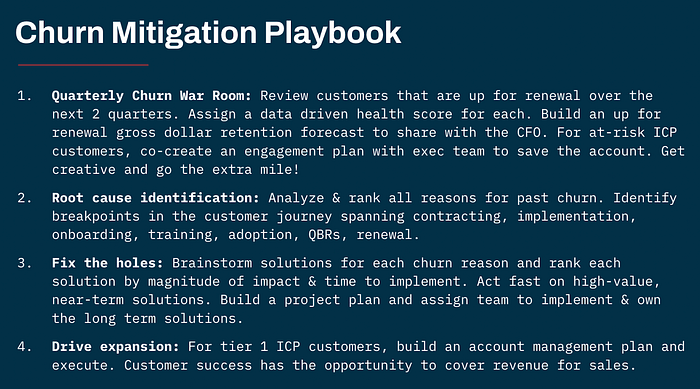
Improving retention feels like the sum of many small gains, but given the compounding effect, it makes a huge difference. Go all-in on minimizing churn!
2) Customer Prioritization: Re-evaluate your ICP and focus on your best verticals, segments and geographies (12:12)
All customers are not created equal. In the early days during product-market fit experimentation, acquiring customers — regardless of vertical, segment, geography — is a win. As a company matures, the go to market (“GTM”) engine develops focus, repeatability, and standardization. During the “growth at all costs” era, it’s likely your ICP definition broadened; now it’s time to reel it back in. Sales reps chasing prospects outside of the ICP is highly inefficient.
In my January talk, I shared three real-world examples where SaaS companies drove efficiency by revisiting their ICP and GTM focus towards verticals (13:19), segments (14:43) and geographies (15:53) with the most attractive unit economics.
To do this for your business, analyze your customer data across verticals, segments, and geographies. Review a broad range of important metrics including growth, gross and net dollar retention, win rate, sales cycle duration, gross margins, average selling price, sales efficiency metrics, etc.
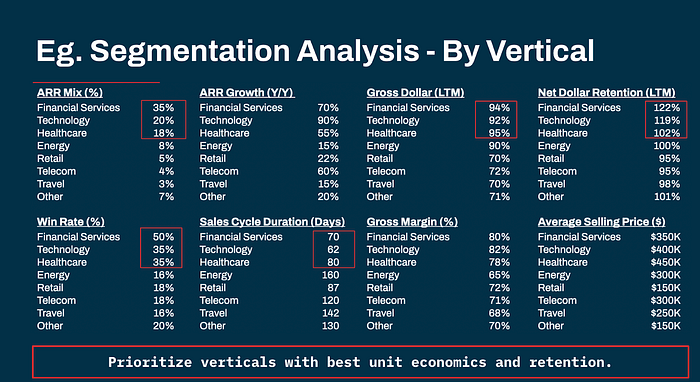
Once the data is pulled, discuss the “why” behind the metrics with your executive team. Rank the verticals, segments, and geographies from most to least attractive. Below are some key questions to discuss:
- Verticals: What verticals have the fastest growth rates, largest markets, fastest sales cycles, lowest churn rates and largest expansion opportunities? Where should we double down? Which should be deprioritized if any?
- Segments: Do all segments have attractive gross margins, customer acquisition cost (“CAC”) payback metrics, gross and net retention rates? Do we have an enterprise GTM motion and onboarding process for smaller customers? What segments will be most durable in tougher times?
- Geographies: Which geographies and territories have the strongest product market fit? What is the CAC payback for each region and are certain geographies dragging down our efficiency?


.png)