Why we built Un_prompted
At Craft, we spend a lot of our time inside our portfolio companies, working next to the teams doing the growth work. Over the last year, founders, marketers and growth leaders have all been asking the same question:
How do you grow a company when you're marketing to agents and humans at the same time?
Agents now research, compare, shortlist, sign up for, and run products on someone's behalf. People still decide, still own the relationships, and still set the bar for what's good. The playbooks we’ve been building for the last decade assumed a human on the other side of every touchpoint. That's no longer true, and the new playbooks are being written right now and are evolving in real time.
So Craft identified the people and products at the forefront – the founders and executives rewriting the playbooks and building the foundational tools in today’s stack – and brought the conversation to life at Shack15 in San Francisco. We brought together 19 founders and operators from Supabase, LinkedIn, ClickHouse, ElevenLabs, Anthropic, Apostra, ClickUp, Clay, WorkOS, HubSpot, Vercel, AWS, Braintrust, SpaceXSI, and Replit. Two keynotes, three panels, and two rounds of lightning talks.
We had 200+ people in the room, and every attendee was intentionally selected. We created a forum where leaders and operators would share what's actually working, not postulate or present repurposed slides. That's what we got.
David Sacks, Partner at Craft Ventures, said it perfectly: "This AI boom has completely changed what we think is possible."
The day in seven takeaways
We've written this up the way the day ran: one takeaway per session, in order, from the opening keynote to the final session. Over the next few weeks, we’ll release each full session plus an in-depth analysis – stay tuned to unprompted.craftventures.com.
- Agents follow your best builders. Opening keynote: Ant Wilson with Michael Robinson.
- Earn attention twice. The Execution panel, presented by LinkedIn.
- Codify your taste. Lightning talks: performance marketing.
- Lead by doing. The Workflows panel, powered by Clay.
- Treat agents as a customer. The Systems panel, powered by HubSpot for Startups.
- Give agents a front door. Lightning talks: developer marketing.
- The math hasn't changed. Closing keynote: Amjad Masad with David Sacks.

1. Agents follow your best builders
Keynote 1: Ant Wilson (Co-Founder & CTO, Supabase) with Michael Robinson (Partner, Craft Ventures)
The day opened with Supabase’s Ant Wilson and Craft partner Michael Robinson, who led our Series C and subsequent investments in Supabase. Supabase never set out to market to agents, and that turned out to be the lesson. "All the work we did making Supabase easy for developers translated super well to agents," said Ant. Years of tutorials and community content became training data: "the models just slurped it up."
Ant's framing was simple:
"If you just think of an agent as an elite-level software engineer, they look for the same things."
Great docs. An API that can do anything the dashboard can. A fast path to the first "wow." The team timed onboarding with a stopwatch: roughly 25 minutes to a first query on legacy cloud, about 40 seconds on Supabase, and now around three seconds with an agent.
Then came the best story of the morning. "Lovable integrated Supabase but didn't tell us." Thousands of databases a minute showed up, and the security team thought it was an attack. It was the moment the funnel changed, as Ant put it: "From signup to activation just disappeared. The agent comes in, signs up and immediately activates."
The other lesson was about choosing the hard path. Early on, nobody would hand two founders in Singapore their production data, so Supabase hosted the databases itself. Ant's advice: "do the hard thing because that's eventually going to be your moat." When anyone can generate a feature in an afternoon, the hard parts are the ones that last.

What to do
- Run the stopwatch test this week. Time your signup to first value twice: once yourself, once by handing it to an agent. Every place the agent gets stuck goes on the roadmap.
- Close the API gap. List everything the dashboard can do that the API can't. If an agent can't do it programmatically, it can't do it.
- Treat community content as training data. Tutorials, examples, and answers written by real users are how models learn your product. Make them easy to read and easy to find.
- Keep talking to users yourself. As Ant put it, "it's really easy to build the wrong thing really quickly."
2. Earn attention twice
Execution panel: Earning attention from agents · Presented by LinkedIn
Hilary Batsel (VP, Marketing, LinkedIn, moderator), Tanya Bragin (VP, Product & Marketing, ClickHouse), Bridget Ferris (Partnerships, ElevenLabs)
If the first session was about how agents pick tools, the Execution panel was about how they pick vendors. Search used to give you a broad shelf. Now you get an answer, and it's a lot shorter.
Hilary Batsel laid out the stakes: 94% of B2B buying groups now use LLMs in their research, and the "digital shelf" has shrunk from about 40 organic listings to around five recommendations. If you're not in the agent's five, you don't exist for that buyer.
What gets you into the five mostly isn't on your website. Tanya Bragin put it plainly:
"That third-party evidence ranks actually higher than anything you would put out on your domain."
Which is why your homepage is now the least trusted page about your company, by LLM standards. Hilary shared one of the most useful numbers of the day: on LinkedIn, about 75% of a company's citations in LLM answers come from its employees, and only 7–10% from the CEO and founders. Small teams have the edge here, because you can get 40 people posting faster than 40,000. Bridget Ferris described how ElevenLabs does it: an ambassador program publishing weekly use-case videos and contests that leave hundreds of real projects on other people's sites. Creators "train the audience, but they also train the LLMs."
But the agent only gets you onto the shortlist. As agents recommend ClickHouse more, its branded search goes up, and Tanya shared that "humans still close the loop." Hilary added that models can tell when you're making it up. If a claim isn't credible, it won't get cited.

What to do
- Pick the one question you most want to be the answer to. Point every channel at it.
- Track it like you used to track keywords. Run the same task-based prompts across the major AI assistants every week and log who gets recommended.
- Make it easy for employees to post. Give them an opt-in way to share every launch in their own voice.
- Fund many small creators over one big one, each answering your one question with a real project.
- Only claim what the product backs up. Unbelievable claims don't get cited.
3. Codify your taste
Lightning talks: Performance marketing
Nino Medina (Growth & Demand, Anthropic), Brian O'Kelley (Founder, Apostra), Chris Cunningham (Head of Social, ClickUp)
Three performance marketing lightning talks addressed the next question: when everyone has the same models, what makes your marketing yours?
Nino Medina, who leads growth and demand at Anthropic, had the line of the session:
"Marketing will have its Claude Code moment."
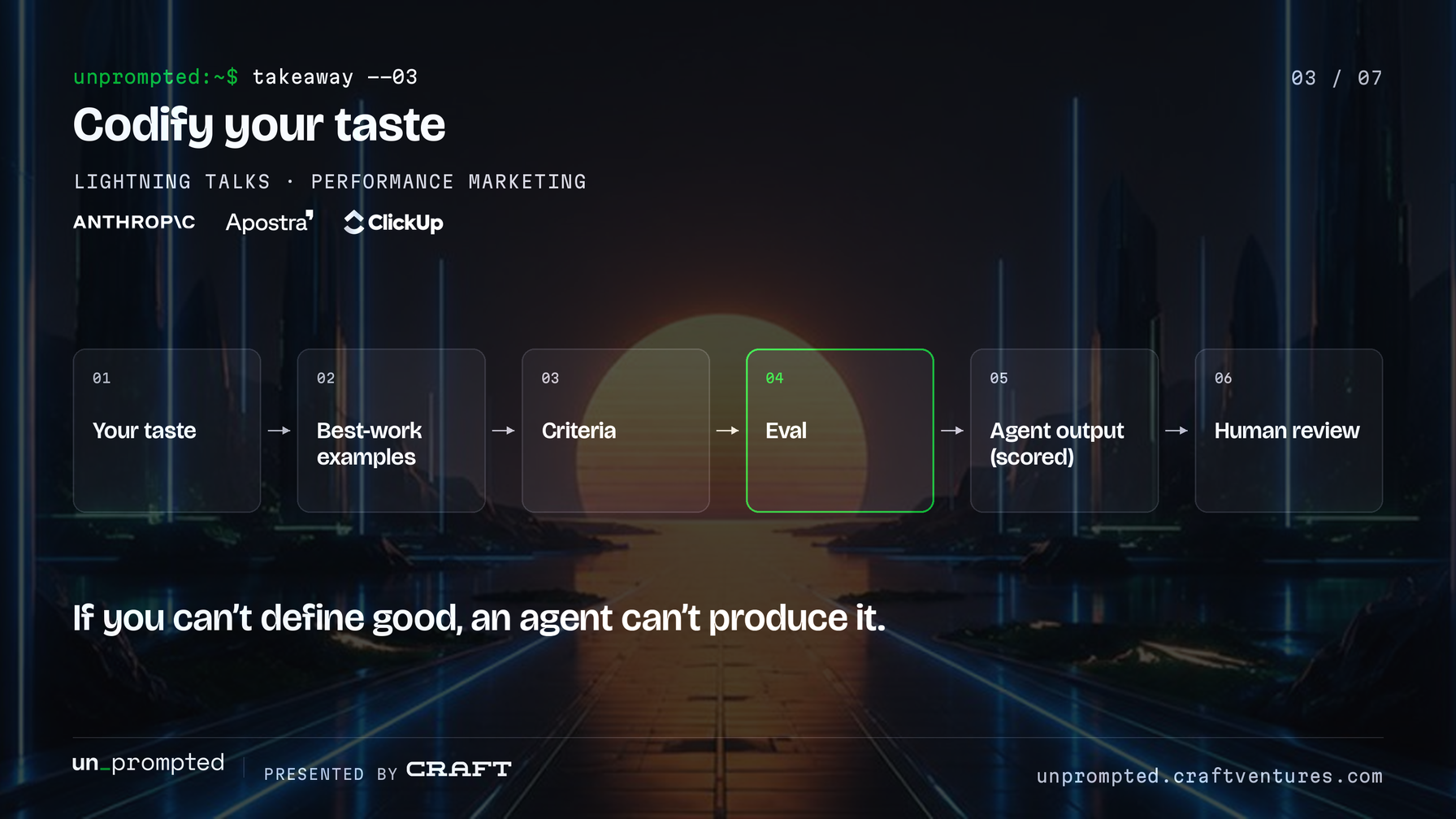
At Anthropic, a single command turns a product doc into a multi-channel campaign that's about 90% ready to ship. The work moves from making every asset to defining what good looks like and judging the output. The tool for that is an eval: what good looks like, written down precisely enough to score against, with golden examples, clear criteria, and checks for what went wrong.
Brian O'Kelley, who built AppNexus and now leads Apostra, walked through how agents are starting to plan and buy media across channels. His caveat mattered more than the tech: agents only scale what you give them. The idea still has to be great.
Chris Cunningham, who runs social at ClickUp, brought it back to attention. People still spend far more time on social than in AI assistants, and launches only buy you a moment. "People need to think of you before they go search."
What to do
- Write your first eval. Take one past campaign that worked. Write down why, with three golden examples and clear criteria.
- Score before you review. Run new agent output against that eval before a person ever looks at it.
- Put your brand and voice rules in a form a model can follow. If you can't define good, an agent can't produce it.
- Plan the weeks between launches, not just the launch. Decide what keeps you in people's feeds so they think of you before they search.
4. Lead by doing
Workflows panel: AI productivity & connectivity · Powered by Clay
Bruno Estrella (Head of Marketing, Clay, moderator), Zeb Evans (Founder & CEO, ClickUp), Michael Grinich (Founder, WorkOS)
The Workflows panel took the question inside the company. Adding a chat box to every tool isn't the same as changing how work gets done. So how does a team actually become AI-native?
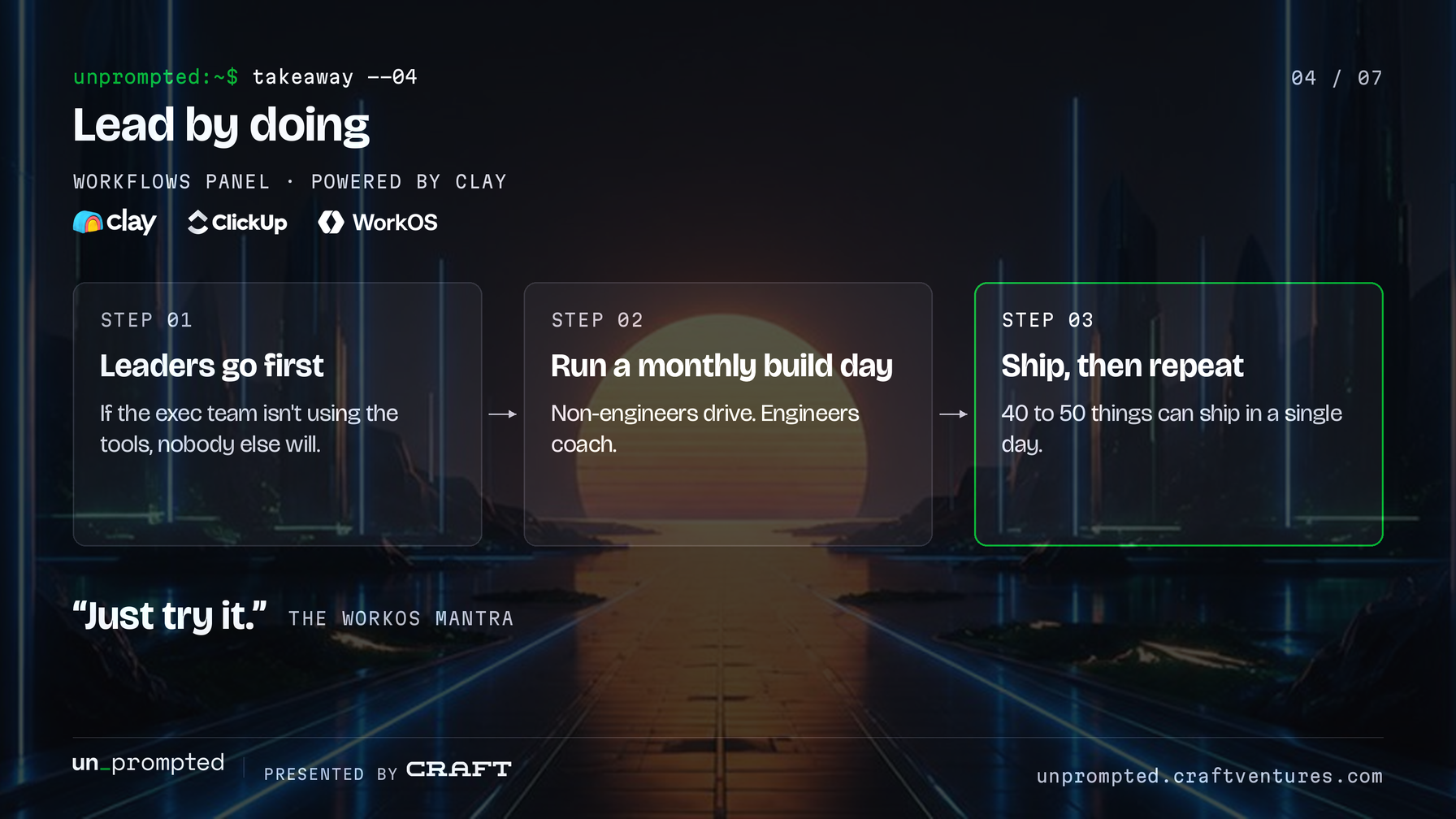
Zeb Evans and Michael Grinich gave the same answer: leaders go first. Zeb's view is that "the best thing that AI has done is democratized opportunity and knowledge," which means every team has the same tools and the edge comes from how you lead. Michael showed what that looks like at WorkOS. Once a month they run "Claude Days," where non-engineers drive and engineers coach, and 40 to 50 things ship in a day. The mantra is two words: "Just try it."
Michael also turned the lens outward. He put his own spin on YC's classic motto: "Make something agents want," and made the case on stage:
"Not having a way for agents to sign up and use your product will be kind of like not having a website."
What to do
- Put a build day on the calendar this month. Non-engineers drive, engineers coach, and the goal is to ship something by the end of the day.
- Go first. Each leader ships one real workflow with AI this month and shows the team how they did it.
- Make trying safe. Judge the output, not the attempt. "Just try it" only works if nobody gets punished for a miss.
- Then test the outside. Can an agent sign up for and use your product today? If not, that's the next build day.
5. Treat agents as a customer
Systems panel: Agentic systems of record · Powered by HubSpot for Startups
Sarika Garg (GM, HubSpot, moderator), Jeanne DeWitt Grosser (COO, Vercel), Nate Slater (Head of Startup Solution Architecture, AWS)
The content so far has assumed agents have accurate information and permission to act. Sarika Garg opened the Systems panel with the line that framed the afternoon: "For the last several decades, all our enterprise systems were built with basically one fundamental assumption... that the user is a person."
Jeanne DeWitt Grosser gave the room a name for what replaces PLG and SLG:
"We also now talk about ALG at Vercel, so Agent Led Growth... think of agents actually as a customer."
Agent Led Growth is a go-to-market motion where AI agents, not just people, discover, evaluate, sign up for, and use your product. Vercel builds for it by making the CLI and MCP first-class and exposing every capability through both the UI and MCP. Underneath sits a semantic layer over the warehouse that "increasingly has become our system of record," and an AI support agent that handles 91% of cases, with every miss turned into new documentation. Jeanne’s rule for outbound: don't let a model draft it. Write the template the way you want it and let the model fill in the blanks. As she put it, "company building is agent building."
Nate Slater added the rule nobody gets to break: agent permissions "have to be deterministic. You can't let the LLM read the policy."

What to do
- Expose every capability twice, once in the UI and once through an API or MCP server, and make your CLI first-class.
- Name one source of truth per function that agents can read and write, with people reviewing bulk changes.
- Template anything deterministic. Outbound, follow-ups, and reports get templates. The model fills in the blanks.
- Hard-code permissions. Put a human checkpoint on anything that spends money, sends an external message or changes a system of record.
- Turn every support miss into documentation that people and agents can both read.
6. Give agents a front door
Lightning talks: Developer marketing
Morgane Palomares (VP, Marketing, Braintrust), Martin "Gonto" Gontovnikas (Growth Advisor, Supabase), Shub Gaur (GrokBot Advocate, SpaceXSI)
The developer marketing lightning talks were the most tactical 15 minutes of the day. Gonto's opening point stuck with a lot of people:
Your website "is already used and seen more by agents than by humans."
So build it for them. Publish an llms.txt, serve a clean Markdown version of every page, add agent-only guidance to your docs, and swap "Sign up" for "Build with agents": a prompt someone can paste straight into their agent.
Morgane Palomares, who led marketing through hypergrowth at Vercel and GitHub and now leads it at Braintrust, covered what happens once you're open for business. For years most marketing work was planned. "The ratio has completely flipped." When a model drops, the team should decide that day whether to act, to say something or stay quiet. Shub Gaur from SpaceXSI pointed to where it goes next, persistent agents that own outcomes instead of tasks: "Instead of having your company staffed, you will actually have outcomes staffed."

What to do
- Publish an llms.txt that maps your most important pages for agents.
- Serve Markdown. Give agents a clean Markdown version of every page at the same URL people visit.
- Add a "Build with agents" prompt next to your sign-up button.
- Write a same-day response plan for model drops and competitor moves: who decides, by when and on which channels.
- Staff one outcome, not a task. Pick one recurring result and give an agent the volume work, with a named person who owns it.
7. The math hasn't changed
Keynote 2: Amjad Masad (Co-founder & CEO, Replit) with David Sacks (Partner, Craft Ventures)
The day closed with Amjad and David, and they brought everything back to fundamentals. Replit went from a $2M to a $500M run rate in under two years, and Amjad is already looking past "everyone can ship." The most interesting new thing he's seeing is "collaboration across agents," or agents handing work to other agents.
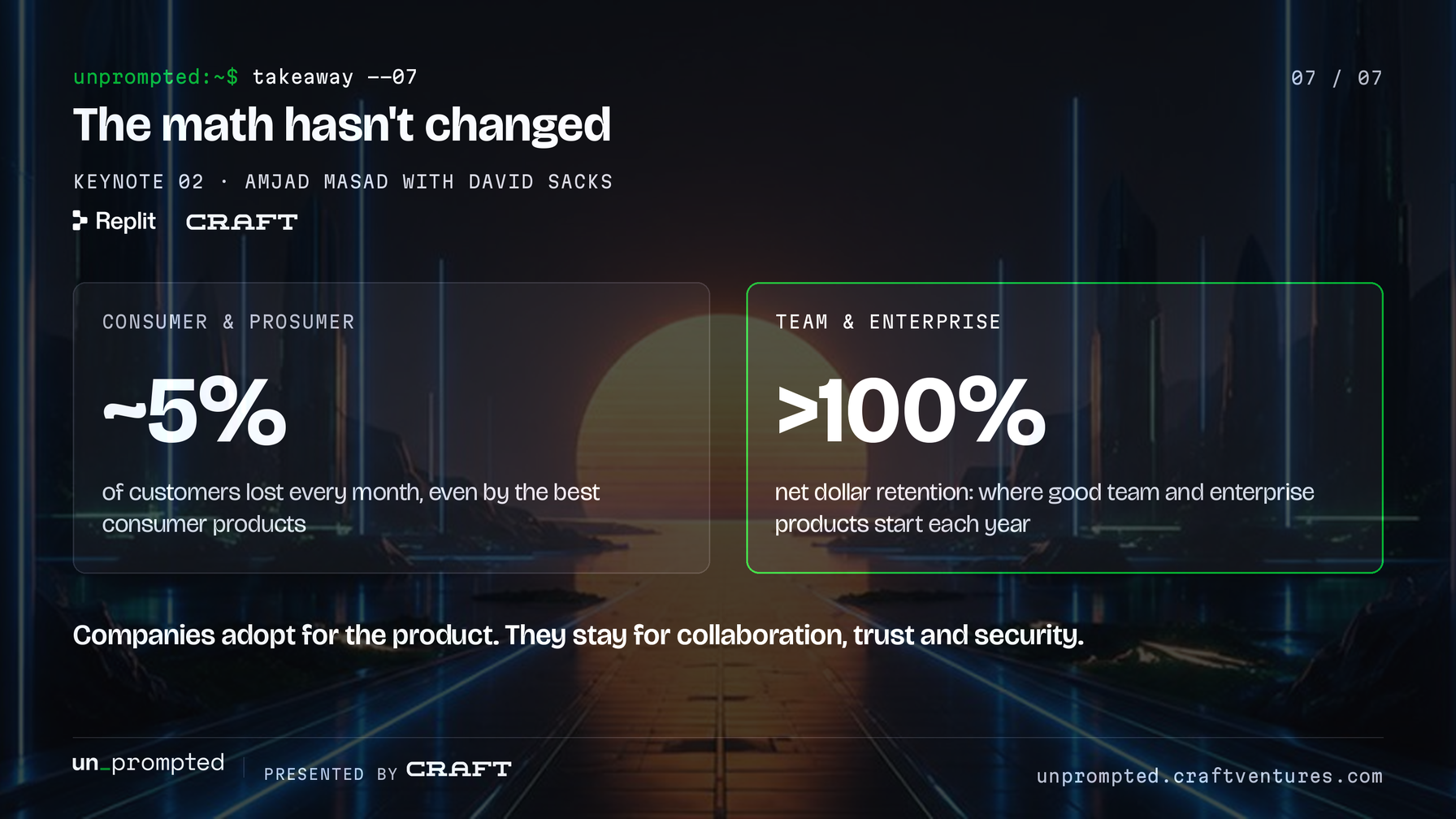
David brought it back to the numbers every founder with a hit consumer or prosumer product eventually runs into. The best consumer products lose about 5% of their customers a month. Good team and enterprise products start each year above 100% net dollar retention. Companies adopt for the product, and they stay for collaboration, trust, security, and infrastructure.
"Whenever I've met a founder who's built a great consumer or prosumer product, they always end up at the same place."
Agents change who finds you, who signs up and who does the work. They don't change what keeps a customer.
What to do
- Find your teams early. Count how many of your accounts already have several people from the same company. That's your enterprise pipeline.
- Build the team features before you need them: sharing, admin, security, and billing that a company can sign off on.
- Measure retention next to signups. Put net dollar retention on the same dashboard as growth, so a viral month doesn't hide a leaky bucket.
- Plan the team motion now if you have a prosumer hit, not after the first big customer asks for it.
Thank you
Thank you to every speaker for being so candid about what's working (and what isn't). And thank you to the partners who made Un_prompted possible: LinkedIn, Clay, Goodwin, Amazon Web Services (AWS), HubSpot for Startups, 3FORTY3 and Brickell Digital. See you at the next one.