

One fateful day, the Supabase team watched new databases appear faster than anyone could explain. Not hundreds a day. Thousands a minute, all from the same place.
“We started getting thousands of new databases every minute… we thought it was a DDoS attack,” Ant Wilson told the room. It wasn’t an attack. “Lovable integrated Supabase but didn’t tell us.”
That was the moment vibe coding showed up in Supabase’s metrics. It’s also the best answer we heard all day to the question every developer company is asking right now: how do you get agents to choose you?
Supabase never set out to market to agents. There was no agent strategy deck, no agent team, no launch. They spent years building for great engineers, and when agents arrived they wanted exactly the same things. The work that won the last era turned out to be the work that won the agent era.
We opened Un_prompted with this keynote for a reason. Every session after it, from the Execution panel to the closing keynote, built on the same idea: agents are now a real audience for your product, and the companies that earn their trust already earned the trust of the right people in their market.
Below are the five ideas every founder and operator should take, and what to do about each.
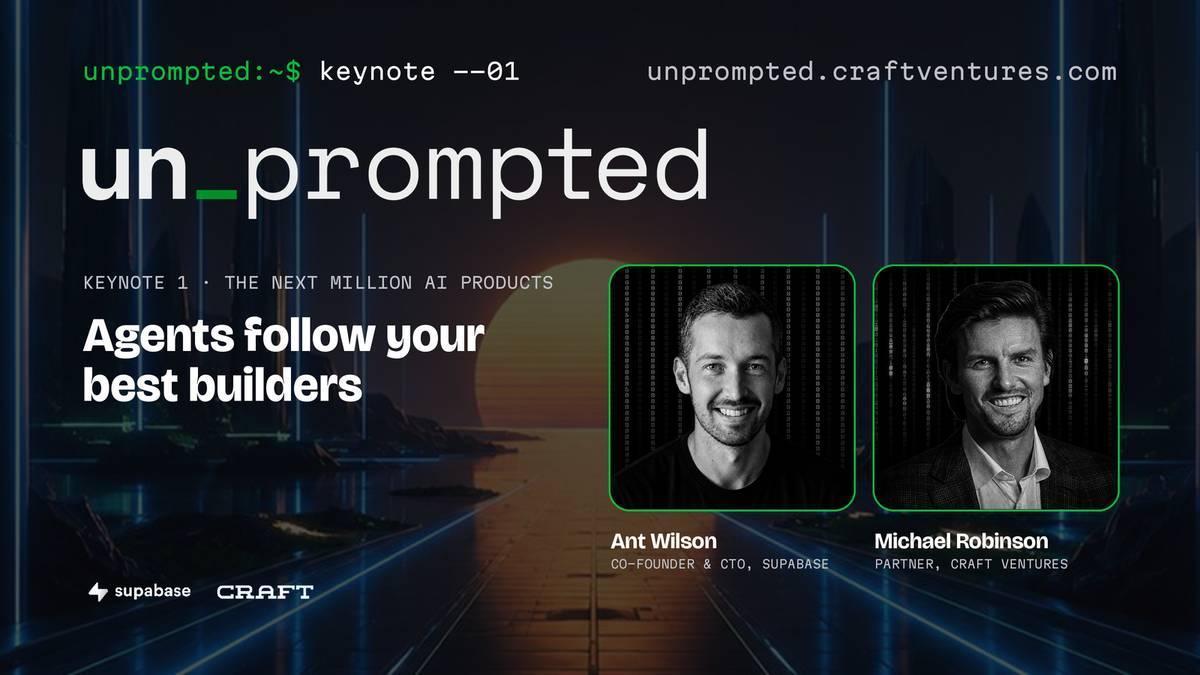
Who was on stage
Ant Wilson, Co-Founder & CTO, Supabase
Michael Robinson, Partner, Craft Ventures
Michael led Craft’s Series C and subsequent investments in Supabase, and he pushed Ant on what actually caused the breakout, not just what it looked like from the outside.
In addition to investing, several of Craft's team members have been embedded in the Supabase team. Zao served as interim VP Finance, and Aaron has worked with the Supabase team on marketing, growth and go-to-market since September 2024 (we wrote about that work in Inside Supabase's Breakout Growth, also on Medium). Needless to say, the Craft team knows the Supabase product, vision, and company trajectory inside and out.
1️⃣ An agent is just a very good engineer
Ant’s core point was simple:
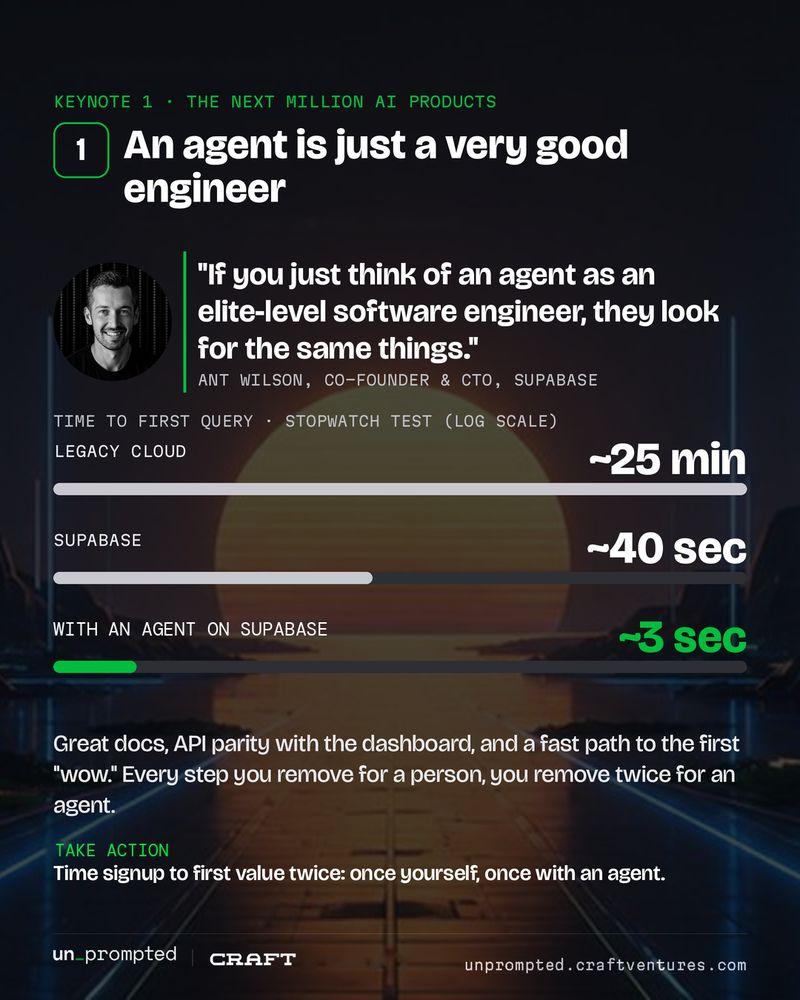
“If you just think of an agent as an elite-level software engineer, they look for the same things.”
That is: Great documentation. An API that can do anything the dashboard can. A fast path to the first “wow.” There’s no separate agent strategy here. “All the work we did making Supabase easy for developers translated super well to agents.”
This is the most freeing idea in the keynote, because it means you don’t have to guess what agents want. Think about the best engineer you’ve ever worked with. They don’t want a sales call or a 12-step onboarding wizard. They want to read something accurate, try it, and see it work. Agents behave the same way, only faster and with less patience.
The Supabase team didn’t just say they cared about this. They measured it. “We did this with a stopwatch.” They timed how long it took to get from zero to a first query: roughly 25 minutes on a legacy cloud database, about 40 seconds on Supabase, and now around three seconds when an agent does it on Supabase.
Look at that last jump. Going from 25 minutes to 40 seconds was years of product work: removing steps, cutting config, writing better defaults. Going from 40 seconds to three seconds came almost for free, because all that earlier work had already made the path short and predictable enough for an agent to run it without help. Every step you remove for a person, you remove twice for an agent.
The other half of this is parity. If something can be done in the dashboard but not through the API, an agent simply can’t do it. For a human, a missing API endpoint is an annoyance. You click through the dashboard instead. For an agent, it’s a dead end. Most companies have never checked how big that gap is, because for years nobody needed them to.
There’s a lesson here about who owns this work, too. Docs, onboarding, and API coverage usually sit with product and engineering. In the agent era, they’re also your most important marketing surface.
What to do
- Run the stopwatch test: time signup to first query (or first value) yourself, then hand the same task to an agent and time it again. Write down every place either of you got stuck.
- Audit your docs as if an elite engineer were reading them cold. Fix the first place they would get stuck, then the second.
- List every action the dashboard can do that the API can’t, and close the top gap this quarter.
2️⃣ Your community wrote the training data
The second lesson is the one you can’t buy.
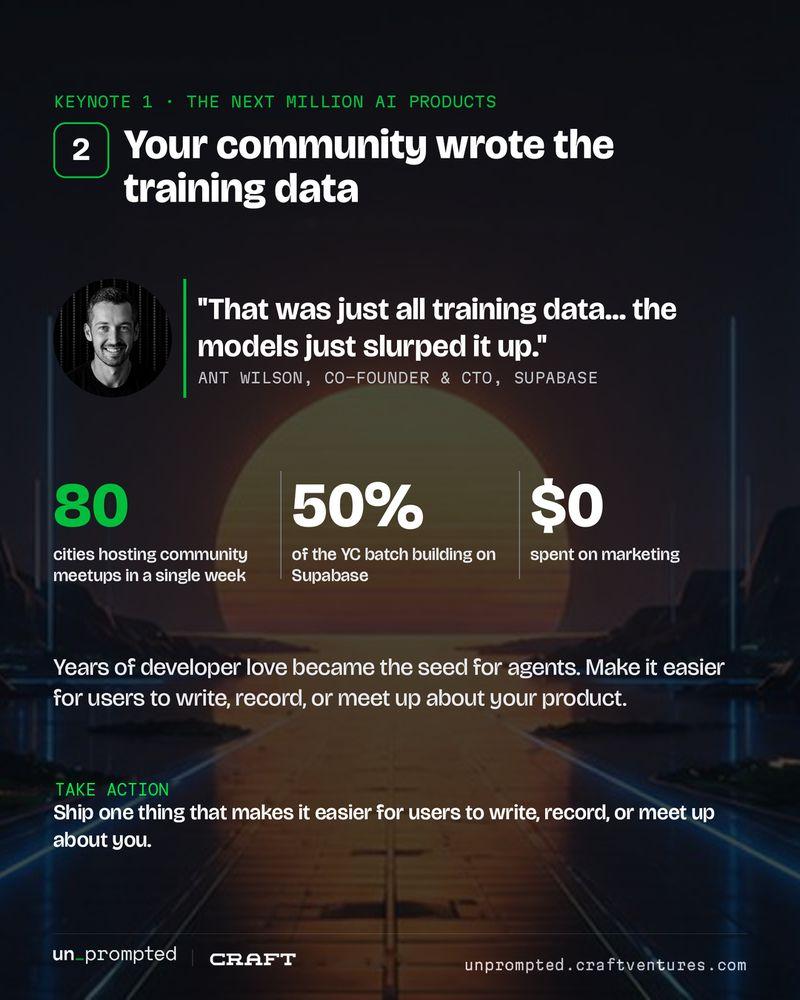
For years, developers who loved Supabase wrote tutorials, recorded videos, and answered each other’s questions. The company leaned into it. Supabase ran community-led meetups in 80 cities in a single week. At the time, that looked like classic developer marketing: build goodwill, help people help each other, be part of the culture.
Ant’s view now: “That was just all training data… the models just slurped it up.”
Every blog post about building an app on Supabase, every forum answer, every video walkthrough became part of what models learned about how to build software. So when a model is asked to spin up a new app, Supabase is already in its head as a normal, sensible choice. Not because anyone optimized for that, but because thousands of real people had already written about doing exactly that.
Michael framed Supabase’s story in chapters: chapter one was winning developers with the product, chapter two was the community that grew up around it, and chapter three is the agent era. Then he asked the question we’d all been thinking: “Did doing chapters one and two well lead to winning chapter three?” Ant didn’t hesitate. “If we hadn’t spent so much time working with developers, it would be difficult to seed all of that for the agents today.”
Michael added the number that made the room sit up. When Craft did diligence, “50% of the YC batch was building on Supabase.” And: “There was $0 spent on marketing, yet a huge global brand and massive awareness.” He described the love from developers as “12 out of 10.” Ant’s explanation: “It’s honestly just having a great product.”
Ant was candid about how that worked in practice. With no marketing budget, the team tried channels until one stuck. “One of the things that works really well for us now is Twitter.” He was half joking when he gave his best launch advice: “The best advice for launching a startup is: be Twitter famous already.” The other half was a real tactic. “We didn’t just go out and talk about Supabase.” They talked about developer culture, the jokes and frustrations every engineer recognizes, and slipped the product in. “If you can make a meme that also announces a product feature, that really hits.”
It got personal, too. “A new model dropped, and it was more capable of using Supabase.” Soon after, “I had family members texting me: ‘Claude Code told me to use Supabase.’” After five years of trying to explain his job, one of them added: “I finally know what you do for work.”
That’s the whole flywheel in one family text thread. Developers wrote about Supabase. Models learned from it. Models recommended it to people who had never heard of it.
If you don’t have years of community behind you, that isn’t bad news. It just means the clock is ticking. Every honest tutorial, answer, and example your users publish today is part of what tomorrow’s models will know about you.
What to do
- Make it easy for users to write, record, or meet up about your product. Ship one thing this month that helps: a template repo, a starter kit, a meetup-in-a-box, or a place to share what they built.
- Collect the tutorials, answers, and examples your users already wrote and put them where people and models can find them, on public pages, not behind a login.
- If you don’t have a community yet, pick the one place your builders already gather and show up there consistently. Talk about their world, not just your launches.
3️⃣ When agents arrive, activation disappears
Back to Lovable. When AI builders started showing up, the classic funnel didn’t just get faster. It collapsed.
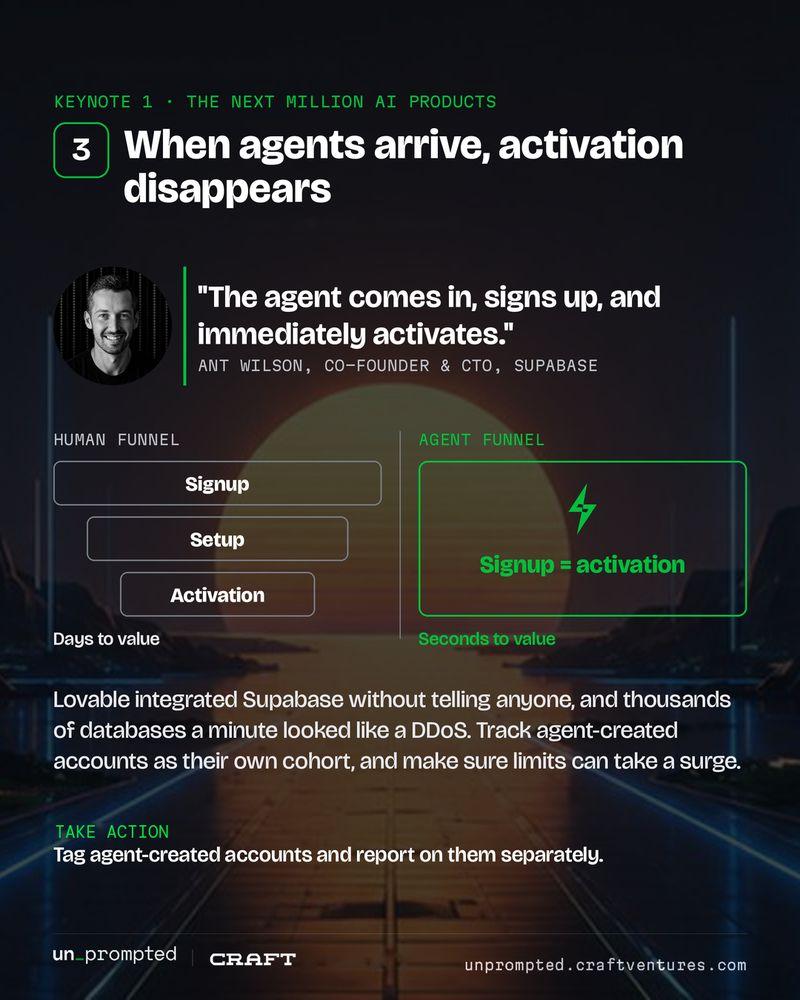
“One thing that really shocked us: our activation funnel changed in a very weird way,” Ant said. “From signup to activation just disappeared. The agent comes in, signs up and immediately activates.”
For a human developer, signup and activation are separate moments, often days apart, and growth teams spend enormous energy on that gap: nurture emails, checklists, in-product tips. An agent signs up because it’s already in the middle of building something. It needs the database right now, so it uses it right now. The agent does the activating.
That creates a real strategic question, and the team had to answer it fast. “Is this a 12-month thing, or is it going to change the way software is built forever?” They bet on forever. Ant described a world where someone can spin up a product with an agent, “integrate Stripe in four minutes and start charging.” When going from idea to revenue takes an afternoon, the number of new projects explodes, and every one of them needs a backend.
Two practical lessons came out of it for every company, not just databases.
First, agent-created accounts behave differently, so track them as their own cohort. Blend them into your human funnel and your activation rate will look amazing and tell you nothing. Humans may still need the nurture emails. Agents need reliable limits, clear errors and great docs.
Second, partner surges can arrive without warning. Lovable didn’t call ahead. The first sign was a wall of signups that looked like an attack. If a platform integrates you tomorrow, can your signup flow, rate limits, abuse detection and provisioning handle it? Can your team tell a good surge from a bad one quickly?
What to do
- Tag accounts created by agents or AI builders and report on them as their own cohort, with their own activation and retention numbers.
- Load-test signup, rate limits and provisioning for a partner surge, so a spike doesn’t look like an attack, and so your team knows who to call when it happens.
- Decide early whether a new usage pattern is a moment or a shift, and staff for it once you know.
4️⃣ Agents have to run your product, not just set it up

Setting up a database is the easy part. “Agents need to not only deploy a database but operate it.”
This is where a lot of “agent-ready” talk stops too early. Provisioning makes a great demo, but the projects agents start don’t stay demos. They get users, hit limits and break at 2 AM. If the agent that built the app can’t help run it, the human is left holding a system they didn’t write.
So Supabase’s focus has moved past the buying decision to whether models can run the product well over time and fix problems when they come up. It publishes evaluations of how well models operate the product, so the labs can see where their models fall short and improve.
It’s a move worth copying: give the people building the models a clear, public picture of what “good” looks like on your product.
It also means giving agents something to see. “If they can’t see what’s happening in your database, they don’t know what to fix.” Observability isn’t just for your on-call engineer anymore. Logs, metrics, status, and error messages are now inputs for an agent trying to diagnose a problem. If those live only in a dashboard, or come back as vague errors, the agent is guessing.
And when agents get it wrong? Ant was relaxed about it. “Anytime I see an agent do something stupid with a database, I’m like, just wait three months.” He reminded the room how fast things move: “Remember Will Smith eating spaghetti?” The early AI videos were a joke. Now they aren’t. The models keep getting better, so your job is to make sure your product is ready when they do, not to design around today’s mistakes.
Ant was also clear about focus. “Our core competency is operating databases.” Supabase partners with the platforms agents already use rather than trying to build everything agents ask for. The companies that win will be the best at their core job and the easiest for every agent platform to plug into.
What to do
- Make sure agents can operate your product after setup, not just deploy it: logs, status, usage and errors through the API.
- Give agents visibility into what’s happening, with error messages specific enough that they know what to fix.
- Partner with the platforms agents run on instead of rebuilding what they do. Stay focused on your core competency.
5️⃣ Do the hard thing, and stay close to users

The most quoted line of the morning came from Supabase’s early days.
Nobody wanted to hand their production data to a tiny startup. “We were just two random guys in Singapore with weird accents,” Ant said (in his beloved English accent). The easy path would have been to build tooling that sat on top of someone else’s database and let customers keep their data where they trusted it. Instead, Supabase hosted the databases itself. That was much harder. It meant owning uptime, backups, security, and every scary operational problem that comes with other people’s data.
“We just went headfirst into it… do the hard thing, because that’s eventually going to be your moat.”
That decision is a big part of why the agent era went the way it did. A backend taking thousands of new projects a minute has to be run by someone who actually operates databases at scale. The hard thing Supabase chose years ago is the thing agents now depend on.
This matters more now, not less. When anyone can generate a feature in an afternoon, features stop being a moat. What lasts is the stuff that’s hard to copy: running infrastructure people trust, owning a hard operational problem, earning a reputation over years.
Ant’s last warning is the one we’d tape to every founder’s monitor. “Because you can build things so fast now, it’s really easy to build the wrong thing really quickly.” Agents can do a lot, but “you can’t skip really getting to know the user.”
It’s tempting to hand everything to an agent, including research. Ant’s point is that talking to users is the one part of the job you shouldn’t automate. Speed makes the wrong thing cheaper to ship, not more useful.
He also put timing first. “We need to be there at the exact moment someone starts a new project.” That’s Supabase’s whole developer marketing strategy in one sentence. Be so present in a builder’s world that when they start something new, you’re “floating in the back of their mind.” Now that agents start a lot of those projects, being in the model’s mind matters just as much.
What to do
- Pick the hard problem in your market that customers can’t easily trust to anyone else, and own it.
- Talk to five users yourself this week. Not a survey. Not an agent summary.
- Ask where you need to be at the exact moment someone starts a new project, for people and for agents, and show up there.
The thread that ties it together
Put the five ideas next to each other and they tell one story.
Supabase built for the best engineers it could find. It made the product fast to start and complete through the API. It helped its community write and share everything they learned. It took on the hardest operational job in its market. And it kept talking to users the whole time.
None of that was an agent strategy. All of it turned out to be one.
That’s the reassuring part. You don’t need a new playbook for agents. You need to check whether you’ve actually run the old one well. Agents are just very fast, very honest judges of whether you did.
The less reassuring part is that gaps show up faster now. A confusing doc used to cost you a few frustrated developers a week. Now it can cost you every agent that tries your product and quietly picks something else.
What to do, right now
If you only do five things after watching this keynote, do these:
1️⃣ Run the stopwatch test. Time signup to first value twice: once yourself, once by handing it to an agent. Every place the agent gets stuck goes on the roadmap.
2️⃣ List the parity gaps. Write down everything the dashboard can do that the API can’t, and rank the gaps by how often agents would hit them.
3️⃣ Split your funnel. Tag accounts created by agents or AI builders and report on them separately from human signups.
4️⃣ Make community content easy. Pick one thing that makes it easier for users to write, record or meet up about your product, and ship it.
5️⃣ Talk to five users yourself. Not a survey. Five conversations, this week.
Thank you
Thank you to Ant for opening Un_prompted with so much candor, and to Michael for asking the questions everyone in the room wanted answered. And thank you to the partners who made Un_prompted possible: LinkedIn, Clay, Goodwin, Amazon Web Services (AWS), HubSpot for Startups, 3FORTY3, and Brickell Digital.
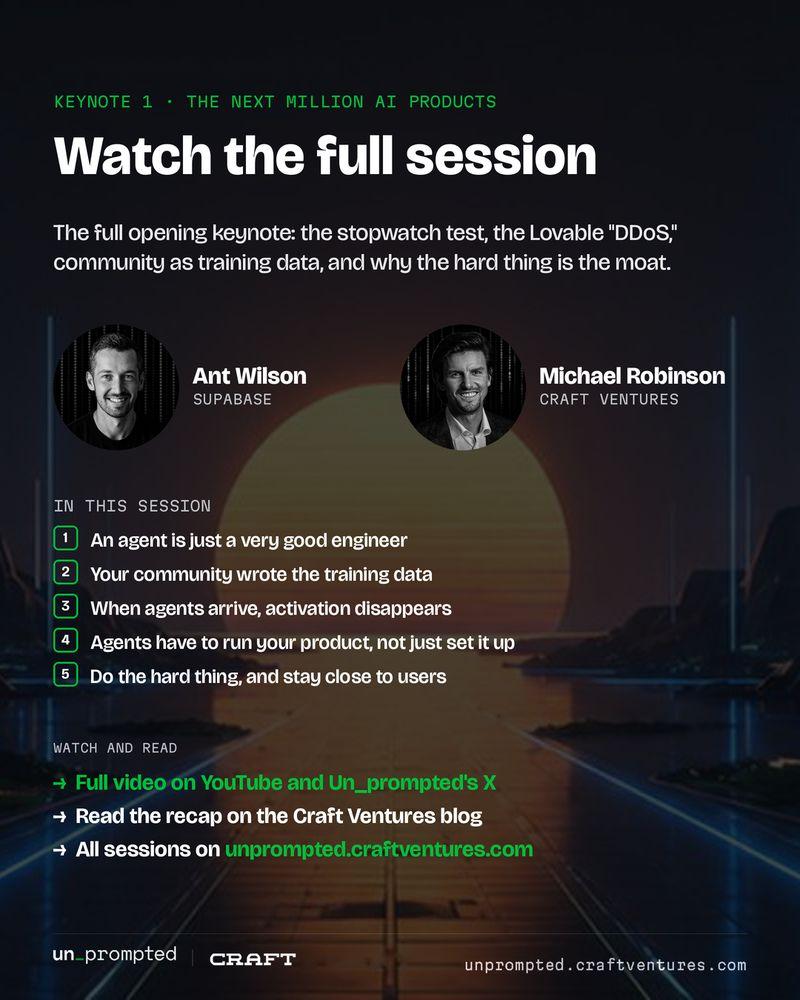
Watch the full session: https://youtu.be/NxzzRLhaHoU
All sessions: https://unprompted.craftventures.com
Follow Un_prompted: X https://x.com/unpromptedcraft · LinkedIn https://www.linkedin.com/showcase/unpromptedcraft/
Read the full recap here.
Next session: The math hasn’t changed: Amjad Masad and David Sacks close Un_prompted (coming Tuesday, Nov 3).