

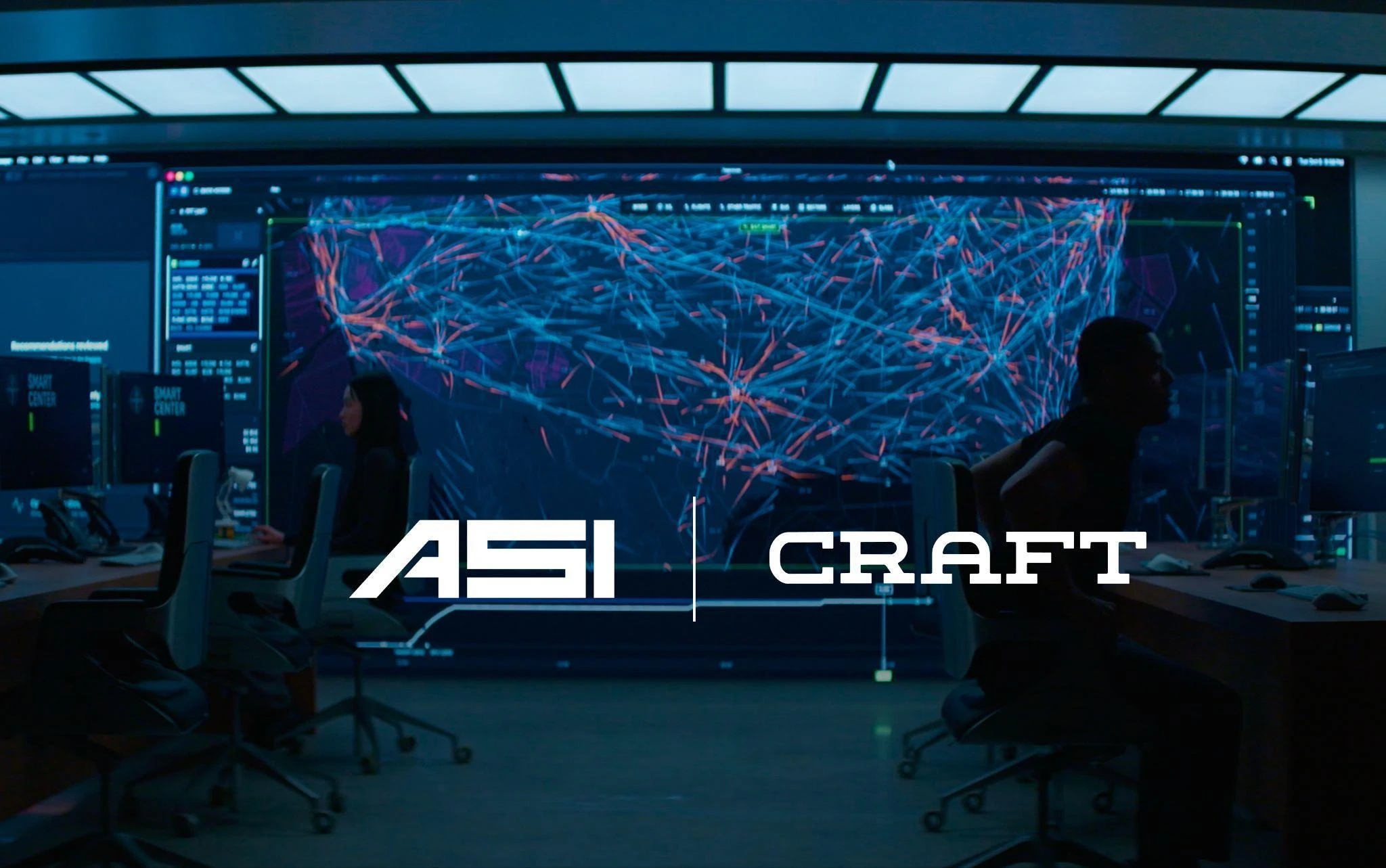


The world’s most critical infrastructure has become too complex for the software it runs on. Across aviation, defense, energy, and logistics, operators are responsible for thousands of interconnected assets in increasingly dynamic environments, yet still rely on outdated software and fragmented systems to manage them. They’re left piecing together information manually and reacting to problems after they’ve already started, with limited ability to anticipate what comes next or how best to respond.
Advances in AI create the opportunity to fundamentally change that equation. Phillip Buckendorf and his team at ASI are building toward that future. Their ambition is to build the operating intelligence behind the world’s most important physical systems, what Phillip calls the “automated nervous system” for critical infrastructure.
When we first met Phillip in 2025, we were immediately struck by the scale of his ambition and his decision to tackle one of the most complex and high-stakes industries first: aviation. Safety is paramount, reliability is nonnegotiable, and even small disruptions can cascade across thousands of flights and passengers. Phillip began by deploying ASI’s technology with major airlines, including Delta, Alaska, and United, proving its capabilities in real-world operations. That commercial foundation helped ASI win the FAA’s $875 million program of record to modernize air traffic management, beating Palantir and Thales. ASI is one of only four technology companies founded since 2000 to win a federal program of record of this magnitude, joining Palantir, SpaceX, and Anduril. The scale of the challenge is enormous. Every day, the National Airspace System manages roughly 45,000 flights and 2.9 million passengers. The image above shows ASI’s SMART system in Washington, D.C., which analyzes flight schedules, weather, and airspace capacity to anticipate congestion and recommend adjustments before delays cascade across the network.
As we spent more time with Phillip, it became clear that aviation was just the beginning. The same technology that helps airlines anticipate disruptions and optimize aircraft movements can be applied to virtually any complex physical system. ASI’s platform continuously models how thousands of interconnected assets interact, predicts how changes ripple through a network, and helps operators make better decisions in real time. Whether coordinating aircraft, military operations, or electric grids, the underlying challenge is remarkably similar: managing enormous complexity, anticipating what happens next, and optimizing outcomes.
We spoke with customers across ASI’s core industries who consistently praised the exceptional team, the strength of the technology, and its game-changing impact on their operations. That customer enthusiasm is matched by significant commercial and government traction. ASI is already working with the U.S. Army, U.S. Air Force, and U.S. Pacific Command. The Army recently awarded ASI a $99 million contract to scale its technology across modernized command and control efforts, including the Next Generation Command and Control program. In energy, National Grid has partnered with ASI on electric grid planning and operations.
The combination of Phillip’s leadership, the exceptional customer feedback, and demonstrated execution gave us deep conviction that ASI is the company to build the decision making engine for the world’s most critical industries. We’re proud to have invested in ASI’s $325 million Series C alongside Spark Capital, Meritech Capital, Andreessen Horowitz, Energy Impact Partners, and Citadel Securities. We’re thrilled to back Phillip and the entire ASI team as they fundamentally transform how the world’s critical infrastructure operates.