

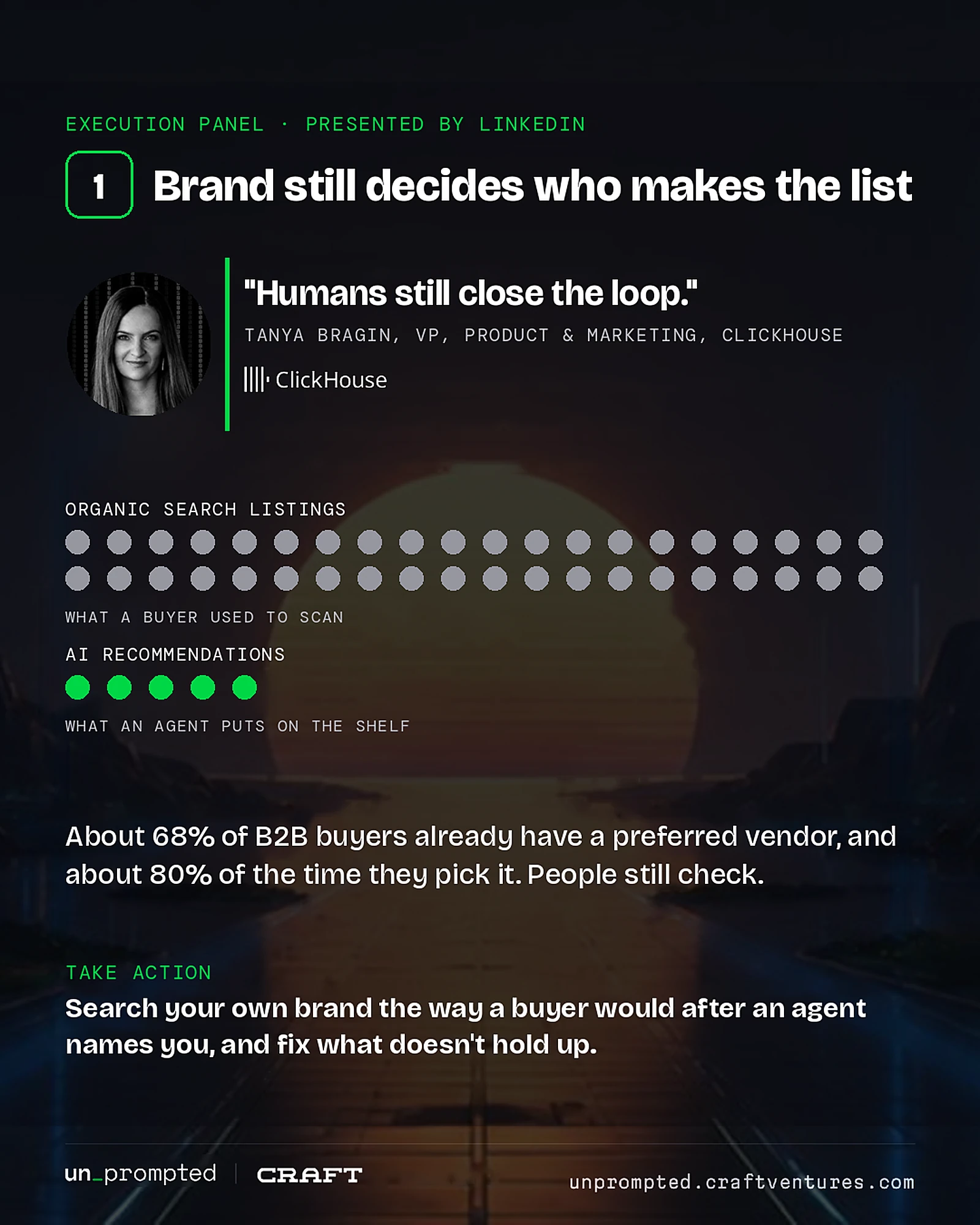
Think about how a B2B buyer used to find you. They’d search, scroll a page of results, click around. Hilary Batsel of LinkedIn called it the “digital shelf,” and a normal search results page has about 40 different places where your brand can show up.
But the digital shelf is shrinking. “Now with LLMs, it’s about five or so on average in terms of what is being recommended.”
Forty spots became five, and buyers move fast. According to the research Hilary shared, 94% of B2B buying groups now use tools like Copilot, ChatGPT, and Gemini in their research. If you’re not in the agent’s five, you don’t exist for that buyer.
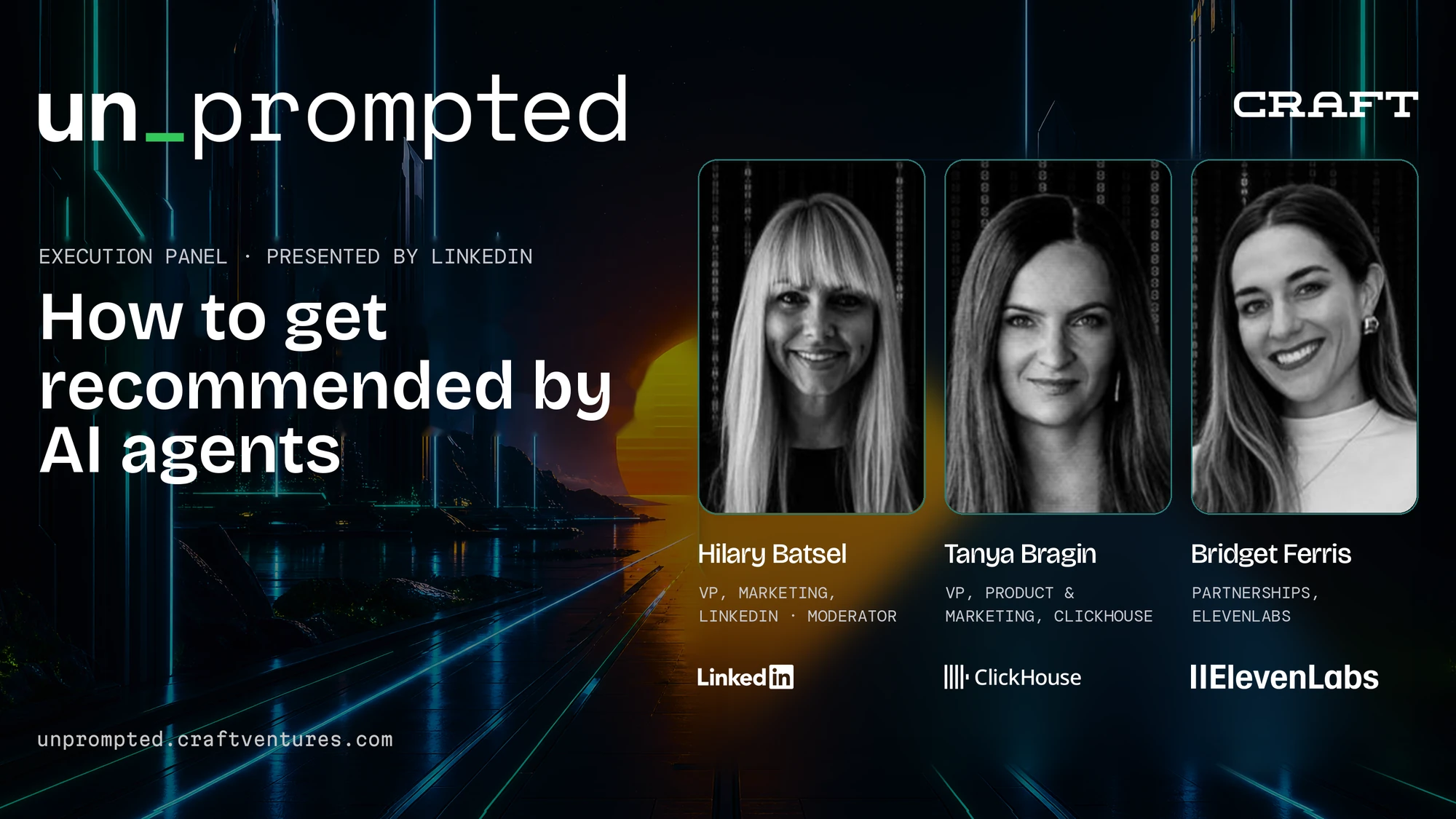
That was the starting point for the Execution panel at Un_prompted, presented by LinkedIn. Three marketing leaders who live this shift every day took on the question every company is asking: how do you get an AI agent to recommend you? The answer was more interesting than “do more SEO.” You have to earn attention twice: once from the agent that builds the shortlist, and once from the person who makes the call.
Below are the five ideas every founder and operator should take from the panel, and what to do about each.
Who was on stage
Hilary Batsel, VP, Marketing, LinkedIn (moderator)
Tanya Bragin, VP, Product & Marketing, ClickHouse
Bridget Ferris, Partnerships, ElevenLabs
ClickHouse is one of the most-used open source products we see both in the Craft portfolio and outside it, and Tanya came to marketing from product. ElevenLabs is arguably the market leader in AI audio. And LinkedIn, as Hilary pointed out, is the number one cited B2B platform in LLMs.
1️⃣ Brand still decides who makes the list
The first surprise from the panel was how much the old work still matters.
It’s tempting to think agents replace the buyer’s judgment. They don’t. They replace the first few hours of research. Tanya from ClickHouse described the new path clearly: an agent answers a question, names a few vendors, and then a person goes and checks.
“But then what’s really interesting is humans still close the loop,” she said. ClickHouse’s branded search is up well beyond what the team expected, because people hear the name from an agent and then come looking.
Hilary added the data behind it. About 68% of B2B buyers already have a preferred vendor in mind, and about 80% of the time they pick that vendor. So the agent may build the shortlist, but brand still decides who makes it and who wins it.
That changes what brand is for. It isn’t only about getting noticed. It’s about being the name buyers already trust when an agent puts you on the shelf, and holding up when they come to check.
Bridget from ElevenLabs added a second layer: being usable inside the agent. ElevenLabs offers connectors, so a buyer can create audio from inside the AI tool they already use, without visiting a website or starting a trial. That shortens the path to the moment that matters, the first real result. When ElevenLabs announced it, the post was the company’s most successful on X since it started.
Our read: brand and product experience now have to work in two places at once, on your own site and inside someone else’s agent.
There’s a practical test hiding in this. Ask an assistant the questions your buyers ask, then click through to whatever it names, including you. If your own pages don’t confirm what the agent just said, in plain words and with current facts, you’ve earned the mention and lost the buyer. The companies doing this well treat the agent’s answer as the start of the sales conversation, not the end of the marketing one.
What to do
- Search your own brand the way a buyer would after an agent names you. Fix the first page that doesn’t hold up.
- Ask your sales team how many buyers already had you in mind before the first call.
- Keep investing in brand, and measure it by whether buyers arrive already familiar with you.
2️⃣ Proof lives off your domain
If the agent builds the shortlist, the next question is what it reads. The panel’s answer: mostly not your website.
Agents trust what other people say about you more than what you say about yourself. Tanya has doubled down on developer relations at ClickHouse for exactly that reason, because third-party evidence ranks higher than anything on your own site. And the things marketers obsess over, like a beautiful, interactive homepage, matter less to agents that mostly just read text.
Bridget sees the same thing at ElevenLabs, where community ambassadors publish use case and workflow videos every week, and a dedicated team keeps the website clear and accurate for how LLMs read it. In her experience, that outside content is what models weigh most.
That reshuffles the budget. At ClickHouse, content moved to the top, partly because content goes stale and you don’t control all of it. Paid search on your own brand moved to the bottom, since rising branded search means you’re mostly paying for people who were coming anyway. LinkedIn uses paid differently, funding content from credible publishers so the citations come from sources models already trust.
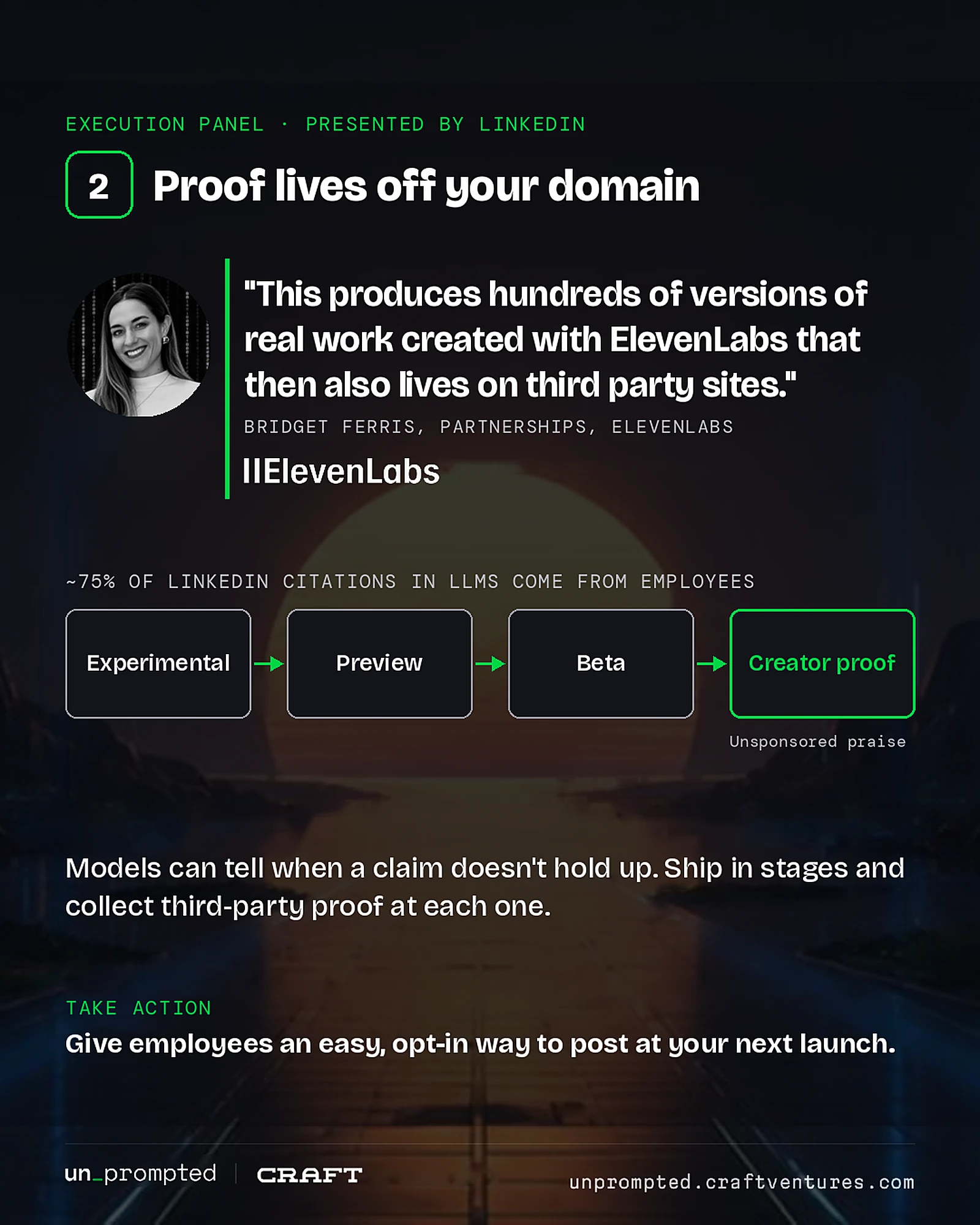
Employees are a big part of the proof. Hilary shared that about 75% of LinkedIn citations in LLMs come from employees posting and commenting, not from the company page. The teams doing this well make it easy and optional: suggested angles, a calendar reminder at launch, and no pressure.
This is good news for companies with real customers and real users. The strongest signal an agent can find is someone with no reason to praise you choosing to do it anyway. That’s hard to fake and easy to encourage, if you make it simple for happy users and employees to say what they already think.
And the proof has to be real. Models are good at noticing claims that don’t hold up. Tanya’s approach is to never call anything finished too early: experimental, then preview, then beta, collecting outside evidence at each step. She knew ClickHouse’s Postgres offering was working when a creator ClickHouse didn’t sponsor called it truly differentiated.
What to do
- Give employees an easy, opt-in way to post about your next launch, with a calendar reminder and suggested angles.
- Ship in stages (experimental, preview, beta) and collect proof from design partners at each one.
- Make the pages agents read plain text first: clear, current and easy to parse.
3️⃣ Creators train two audiences
Creators came up again and again, with a twist.
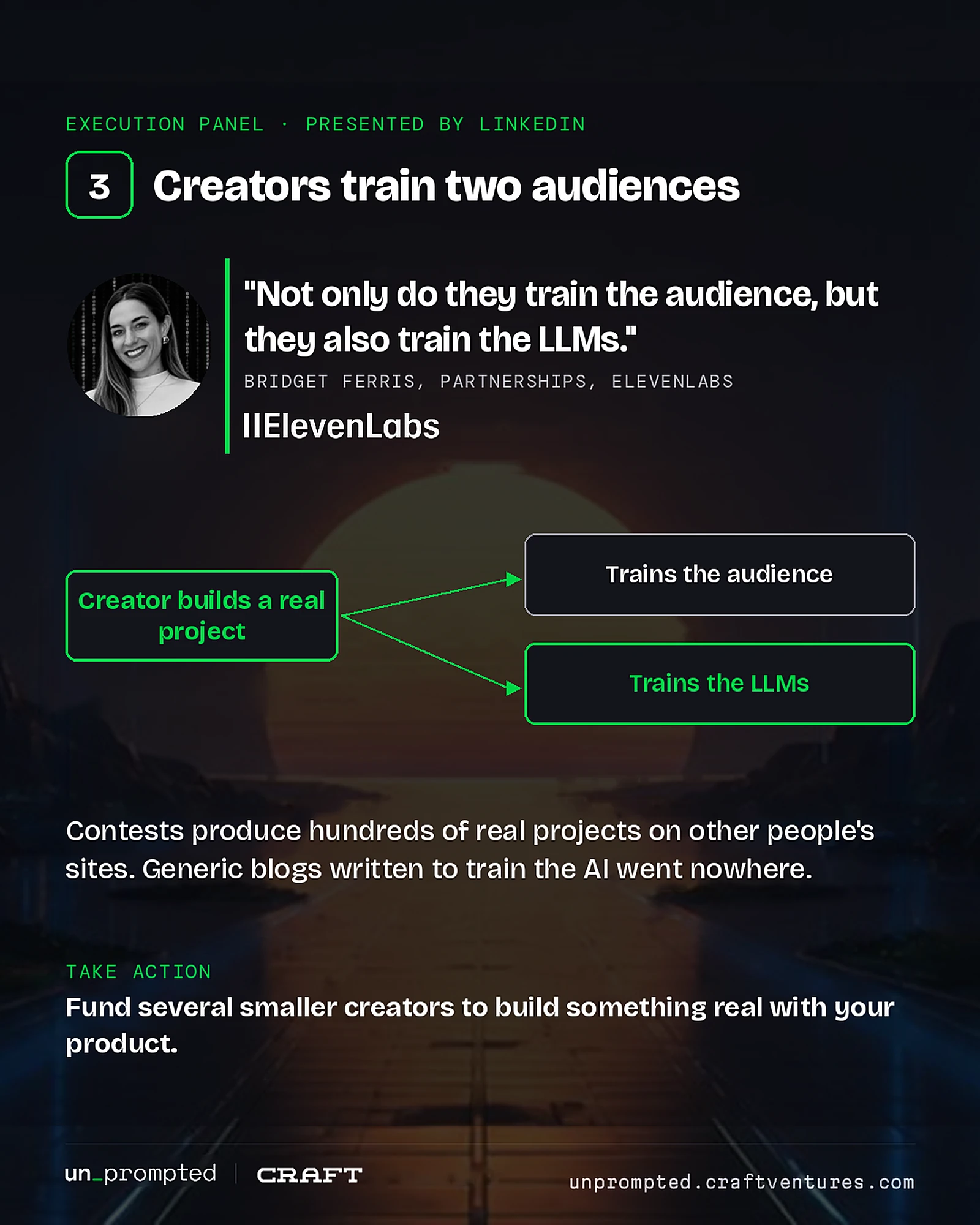
“We love creators because not only do they train the audience, but they also train the LLMs,” Bridget said.
That’s the key insight. A good creator video reaches people today and becomes source material for the models that answer questions tomorrow. Spending on creators now buys attention twice.
ElevenLabs’ best tactic goes beyond sponsorship. They run competitions where people build real projects with their tools, judged by a third party. Each contest produces hundreds of real examples that live on other people’s sites, which is exactly the kind of proof agents look for.
Real is the key word. Bridget was candid that generic blog posts written to train the AI went nowhere, because models already have meatier sources than a thin post on your own site. Specific beats volume.
Tanya treats creators like partners, not ad space. Good creators have their own brand to protect, so they’ll only take a product to their audience when it’s ready. ClickHouse leans on its own community first and brings in creators when it enters a new space where it doesn’t yet have reach.
Format matters too. Bridget called video king, because it shows the product working better than anything else, and the panel flagged YouTube as a source models lean on that many teams under-invest in.
What to do
- Fund several smaller creators to build something real with your product, not one big generic sponsorship.
- Run a contest that produces real projects, judged by a third party, that live on other people’s sites.
- Audit your YouTube channel. If it’s thin, it’s a gap in what models see.
4️⃣ Measure tasks, not superlatives
Every marketer on the panel admitted measurement is hard. Hilary was the most direct about why.
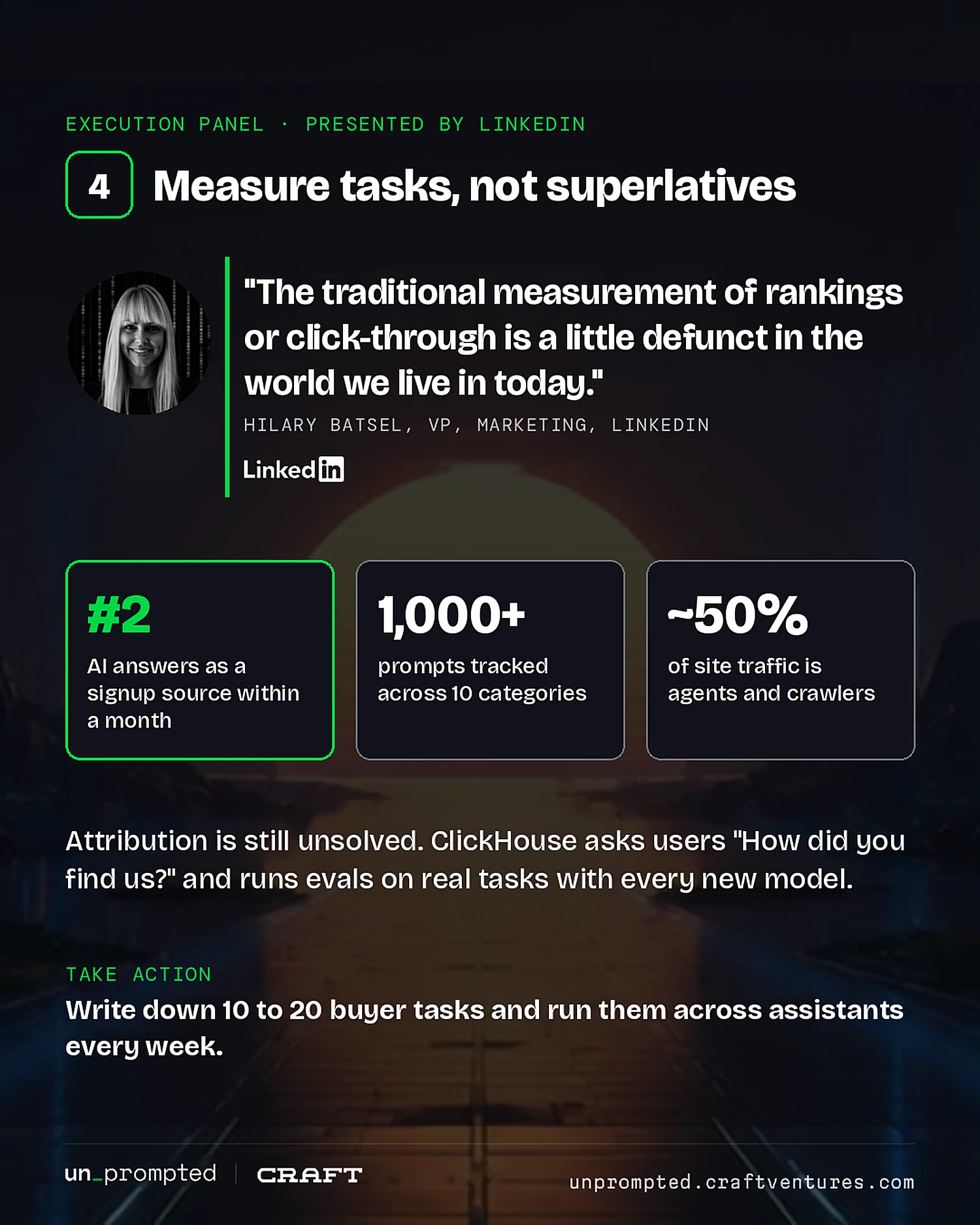
“The traditional measurement of rankings or click-through is a little defunct in the world we live in today.”
Nobody on stage claimed to have solved it. But the panel shared what does work, and none of it is complicated.
Ask your users. ClickHouse added a “How did you find us?” question to its signup. Within a month, AI answers were the number two source, behind organic search and ahead of word of mouth, and the extra question didn’t hurt signups at all.
Count the bots, and want them. Tanya used to think of crawler traffic as noise. Now almost half of ClickHouse’s traffic is bots, and she treats it as its own line, because it’s the audience that feeds the answers.
Run evals on real tasks. ClickHouse tracks more than a thousand prompts across 10 categories and reruns them with every new model, watching sentiment, not just mentions. ElevenLabs learned the hard way that tracking superlative prompts, like asking for the best AI audio company, misses how people actually use assistants. They ask for help with tasks. Now ElevenLabs tracks the same 20 task questions week to week.
The common thread is humility about the data. None of these methods gives a perfect number. Together they give a direction, and direction is what a marketing team needs to decide where the next dollar goes. The mistake is waiting for perfect attribution before acting. By the time it exists, the shortlists will already be set.
The payoff is real. ElevenLabs sees buyers from AI-assisted search arrive about four times more qualified than organic, because the agent has already narrowed the field.
What to do
- Add a “How did you hear about us?” question to your signup this month.
- Write down 10 to 20 real buyer tasks and run them across assistants every week.
- Report crawler and agent traffic as its own line, and track sentiment, not just mentions.
5️⃣ Make it everyone’s job
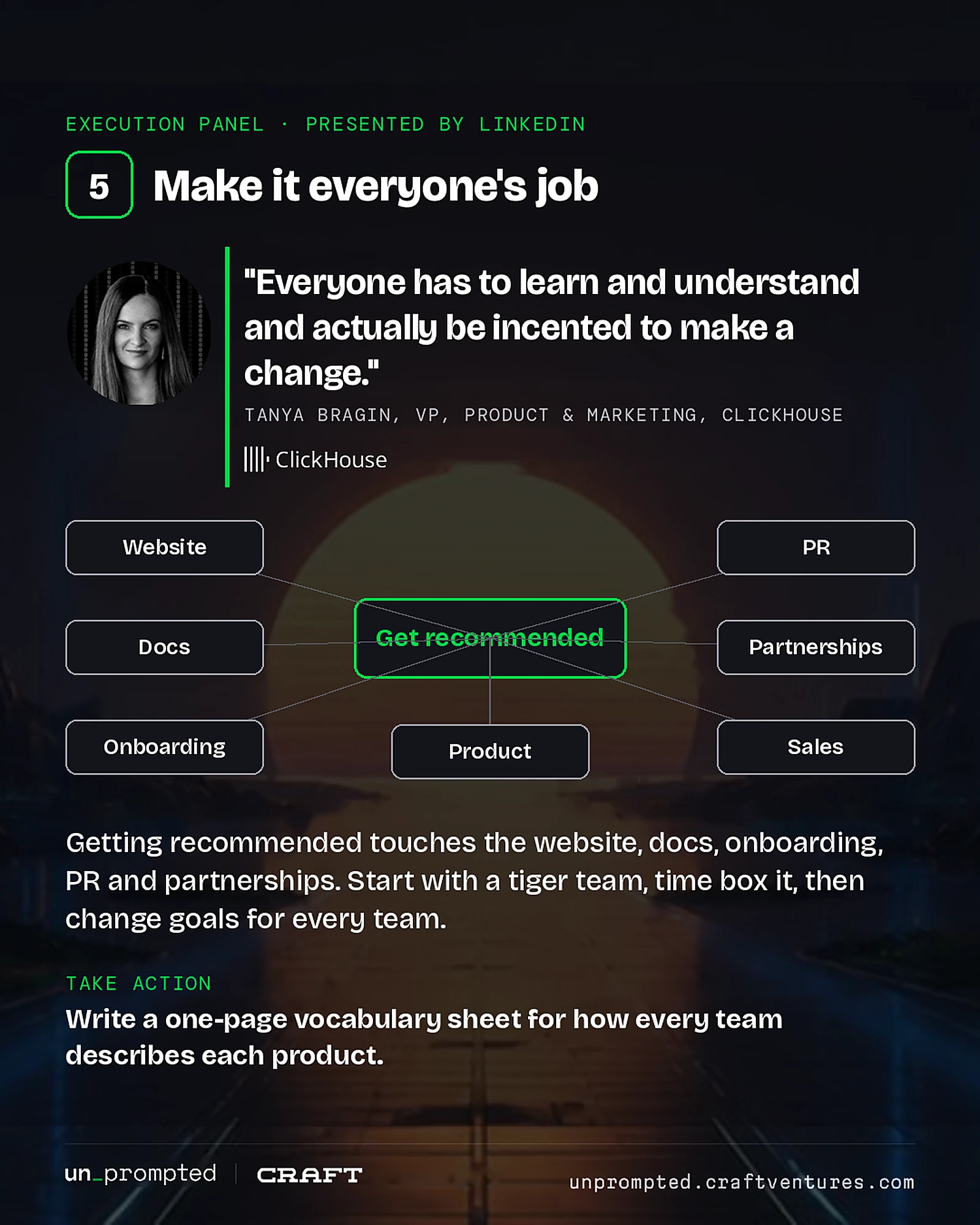
Tanya got candid about one of her regrets. ClickHouse started with a tiger team, which was the right way to build skills and tooling fast. The mistake was keeping the learnings within the confines of that team too long. The website and other teams kept working the old way.
“Everyone has to learn and understand and actually be incented to make a change,” she said.
Her advice for anyone starting out: start with a tiger team, time box it, and then change goals across every team. The web team will change most, then documentation, and product onboarding likely needs a complete rethink for an audience that’s part human, part agent.
Bridget added the piece most companies skip: shared language. If sales, PR, partnerships and growth all describe the product differently, the models will too. One vocabulary keeps the story consistent wherever an agent reads it.
And a practical tip from Tanya for anyone using AI to write: ClickHouse built internal skills for employee posts so the tone stays credible, technical, and factual. Step one, she joked, is to remove the em dashes.
We see the same pattern across the Craft portfolio. The companies moving fastest gave the work a clear owner early, then turned it into a shared goal before the owner became a bottleneck. The ones still stuck treat agents as a project for the SEO team and wonder why nothing else changes.
Our takeaway: agent discovery isn’t a channel you hand to one team. It touches every page, doc and sentence a model might read.
What to do
- Time box a tiger team, then give every team a goal tied to agent discovery.
- Write a one-page vocabulary sheet for how every team describes each product.
- Update web pages, docs and onboarding for an audience that’s part human, part agent.
The thread that ties it together
Put the five ideas next to each other and they tell one story.
The agent builds the shortlist, but people still close the loop, so brand still matters. The agent mostly reads what other people say about you, so proof has to live off your domain, in your employees’ posts and your creators’ real work. You can’t measure it perfectly, so measure what you can: ask users, run real tasks, watch sentiment. And none of it works as a side project.
None of this replaces the old work of building a reputation. It adds a second audience that reads everything and believes very little that isn’t backed up.
What to do, right now
If you only do five things after watching this panel, do these:
1️⃣ Ask how they found you. Add “How did you hear about us?” to signup, starting this month.
2️⃣ Track real tasks. Write down 10 to 20 buyer tasks and run them across assistants every week.
3️⃣ Make posting easy. Give employees an opt-in way to post at your next launch, with a reminder.
4️⃣ Fund real work. Back creators and contests that produce real projects with your product.
5️⃣ Make it everyone’s job. Give every team a goal tied to agent discovery, and one shared vocabulary.
Thank you
Thank you to Tanya and Bridget for sharing what’s working and what isn’t, and to Hilary for moderating. A special thank-you to LinkedIn for presenting the Execution panel, and to all the partners who made Un_prompted possible: LinkedIn, Clay, Goodwin, Amazon Web Services (AWS), HubSpot for Startups, 3FORTY3, and Brickell Digital.
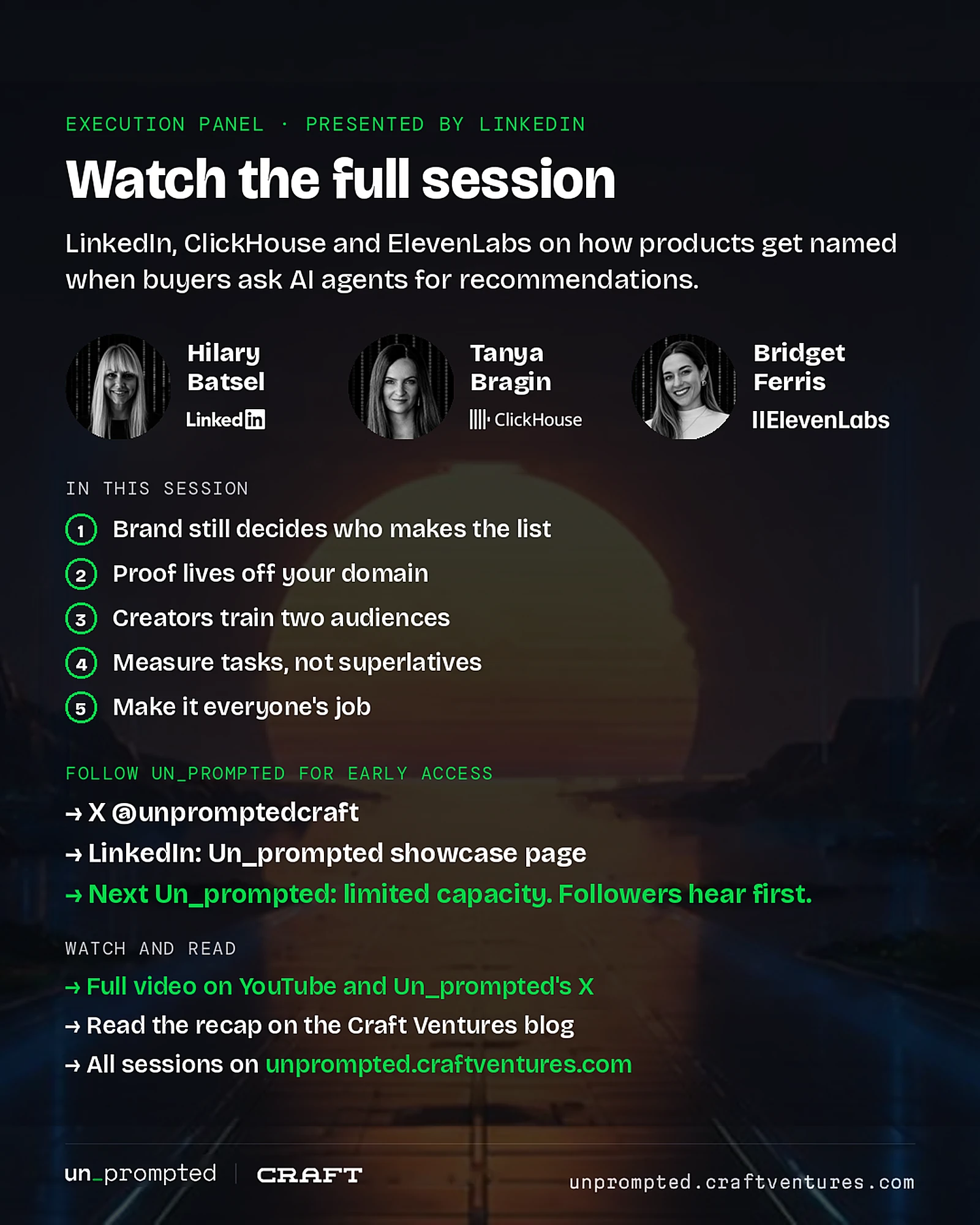
Watch the full session: https://youtu.be/DdQOggYyLHY
All sessions: https://unprompted.craftventures.com
The fastest way to get early access to news about future events and a spot on the waitlist is to follow Un_prompted: X https://x.com/unpromptedcraft · LinkedIn https://www.linkedin.com/showcase/unpromptedcraft/
Read the full recap here.
Next session: How companies become AI-native: Zeb Evans, Michael Grinich and Bruno Estrella on leading by doing.