

Two years ago, when Replit released its agent, the company was at a ~$2M run rate. The last public number shared was $500M.
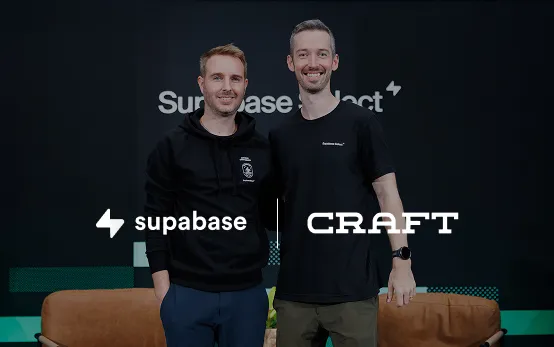
It’s not everyday you see growth like that. It’s proof the product works, the market is huge, and the team should keep doing what it’s doing. So it was telling that when Amjad Masad, Replit’s founder and CEO, sat down with David Sacks to close Un_prompted, most of the conversation wasn’t about the magic of the technology. It was about something much older than agents: the math of keeping customers.
Replit is leading the charge to create a world where everyone can ship. People who have never written code describe an app and watch it appear. That’s new. But the business question conundrum is the same that every hit consumer product has faced for years. Individuals churn, yet teams expand. Somewhere along the way, a product people love has to become a company other companies trust and rely on.
Agents change who finds you, who signs up, and who does the work. They don’t change what keeps a company alive. Amjad is living through that shift right now, and David has seen it from his time as a founder, as an operator, and now, as an investor. Their conversation is the clearest map we’ve heard of how to make the move without losing what made the product work.
Below are the five ideas every founder and operator should take from the conversation, and what to do about each.
Who was on stage
Amjad Masad, Founder & CEO, Replit
David Sacks, Co-Founder & Partner, Craft Ventures
David built Yammer, one of the original bottom-up enterprise products, and has backed many of the prosumer companies now facing the same choice. Amjad is in the middle of it, taking one of the fastest-growing software companies we’ve seen from individuals to teams to enterprises.
1️⃣ After everyone can ship, agents start working together
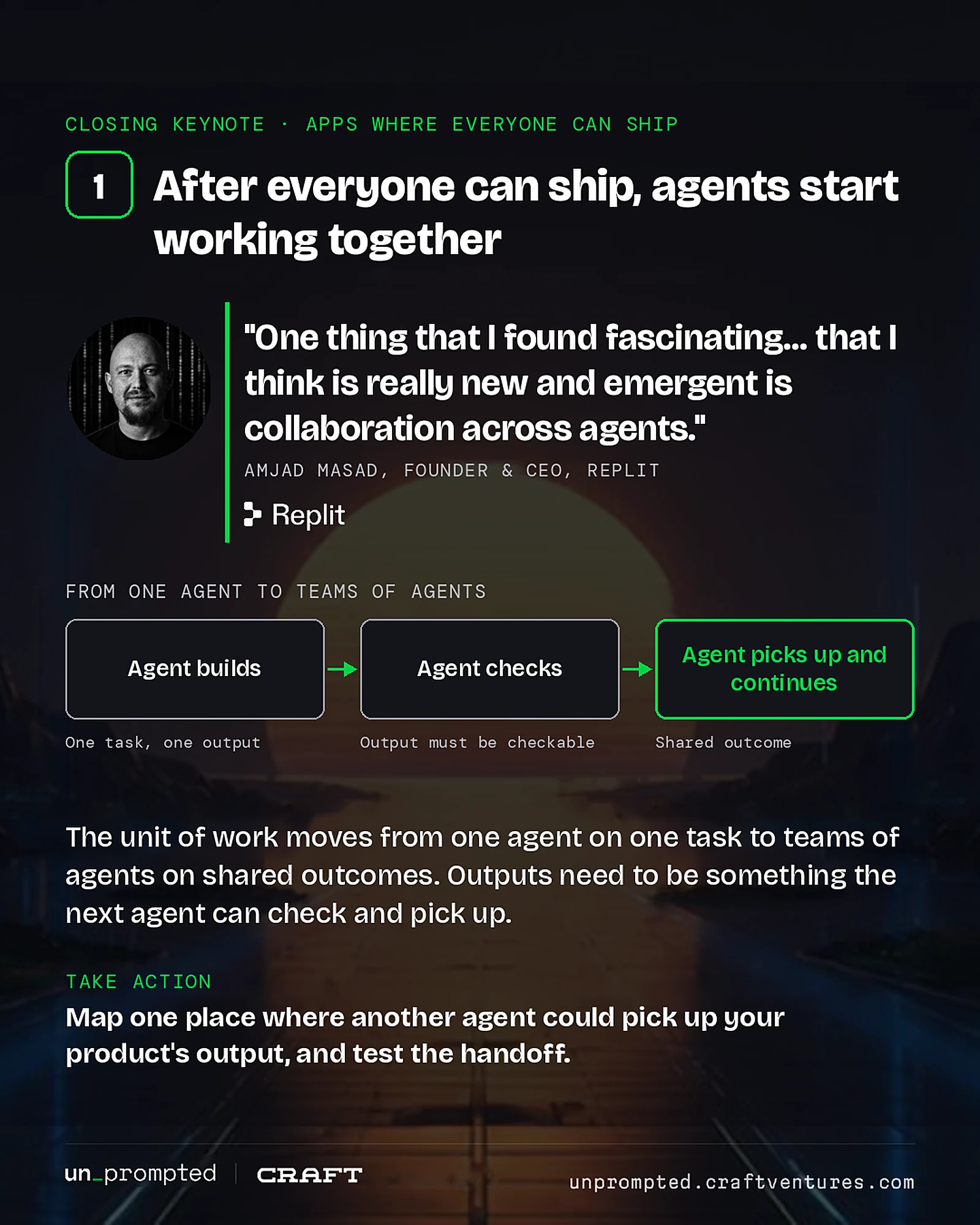
When David asked what Amjad was seeing that’s genuinely new, we expected an answer about faster code generation or evolving models. Instead, Amjad talked about agents working with each other.
“For the first time, we saw emergent coordination across agents,” he said, after years of multi-agent setups that “never worked very well.”
This is a bigger shift than it sounds. For the last couple of years, the mental model for AI at work has been one person, one agent, one task. What Amjad describes is a team of agents: one builds, another checks, a third picks up where the first left off. The unit of work stops being a single task and becomes a shared outcome.
That changes what good output looks like. If another agent will pick up your agent’s work, the output has to be something a machine can read, check, and continue. Clear structure, explicit status, and predictable formats start to matter as much as quality. It’s the same discipline that makes an API good for developers, applied to the hand-off between agents.
It also raises the bar on the environment agents run in. Amjad calls it the outer harness: sandboxes, networks between them, orchestration, durable execution, and the safety work that holds it together. Replit hit this early because it was an early adopter of agents internally, and it’s now seeing the same demand from customers. Most companies will run into it within a year, whether or not they plan for it.
Our read: the companies that win the next phase won’t just have a good agent. They’ll have products whose output other agents can trust and build on.
What to do
- Map one handoff in your product where one agent’s work could pass to another, and test it end to end.
- Design outputs other agents can check and continue, with clear structure and status, not just text a person reads.
- Treat agents collaborating in your usage data as an early signal, not an anomaly.
2️⃣ The churn math forces the move
The conversation turned to the numbers every founder with a hit consumer or prosumer product eventually runs into.
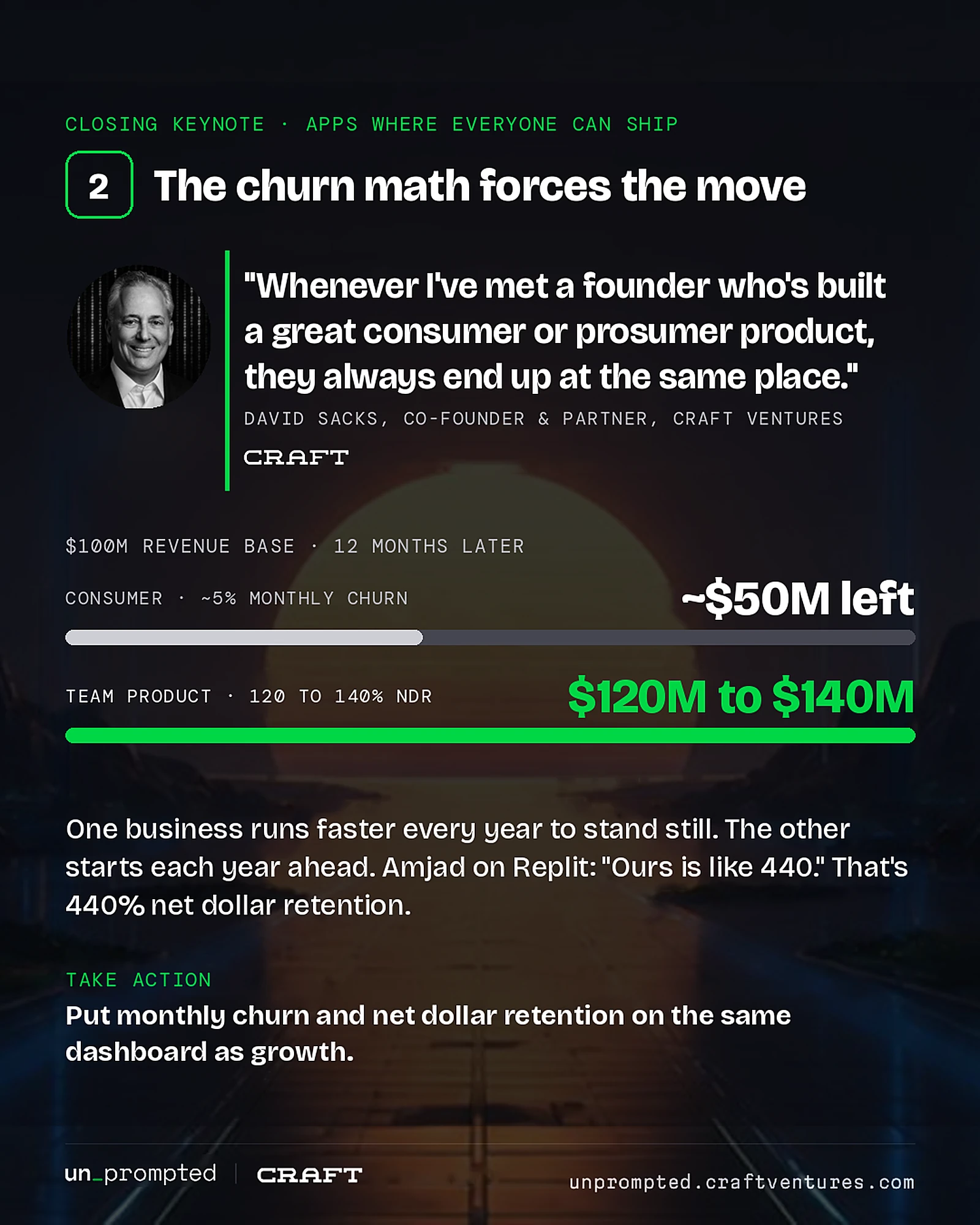
David’s framing is simple: a great consumer product loses about 5% of its customers a month. Compound that over a year and roughly half are gone. At $100M in revenue, you need about $50M of new revenue just to stand still, before you’ve grown at all.
Team and enterprise products work the other way. Good ones keep and expand their customers, with net dollar retention of 120% to 140%. You start each year with all of last year’s revenue, plus the upsell, and new customers stack on top.
Every founder David has met with a great consumer or prosumer product, he said, ends up in the same place: “trying to make it work for teams and enterprises.”
One business runs faster every year to stay in place. The other gets a tailwind from the customers it already has. That’s the whole argument, and it’s why so many prosumer companies that look unstoppable at year two look stuck at year four.
AI makes the gap even wider. When David cited 120% to 130% as the benchmark, Amjad said it needs updating for AI companies, because usage compounds in a way seats never did. “Ours is like 440,” meaning 440% net dollar retention.
The lesson for founders is to look at retention early, not after growth slows. A viral month can hide a leaky bucket for a long time, and by the time the new signups stop covering the losses, the move to teams is a rescue instead of a plan.
What to do
- Put churn and net dollar retention on the same dashboard as signups, so a great month can’t hide a leaky bucket.
- Model your customer base 12 months out at today’s churn, and how much new revenue you’d need just to stand still.
- If you have a prosumer hit, start planning the move to teams while growth is still strong.
3️⃣ Your prosumer users are your lead generation
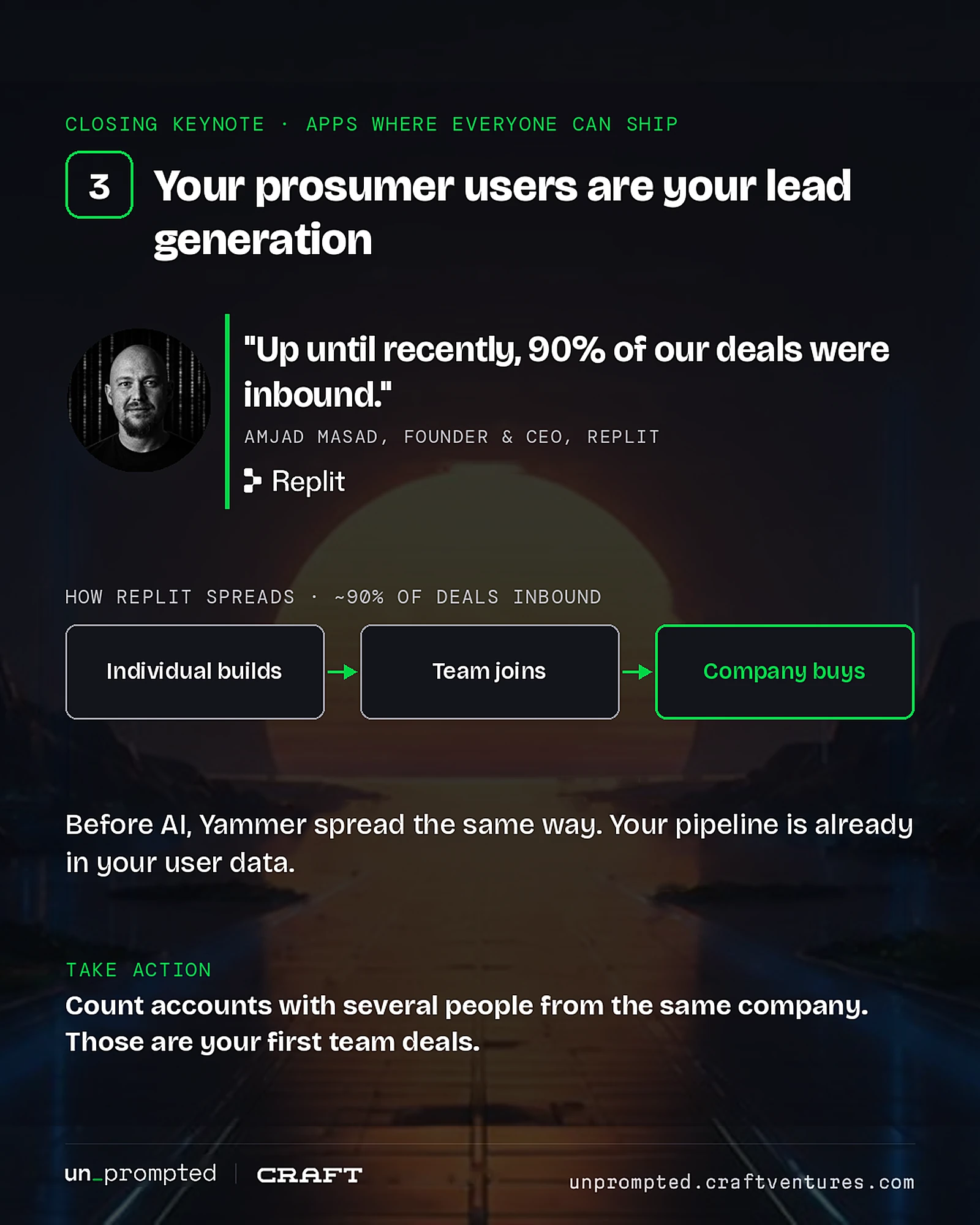
The good news is that you don’t have to find enterprise customers from scratch. If individuals love your product, they’re already inside the companies you want to sell to.
Replit is the proof. “Up until recently, 90% of our deals were inbound,” Amjad said. The company only recently added an outbound sales motion, and it got to its current scale without one.
David knows the pattern because it’s how Yammer spread. Employees pulled the product into their companies before IT knew it was there, and by the time the sale happened, it was already decided. Competitors selling top-down through IT departments called it blackmail. It was really just distribution.
That changes how you think about sales. Your pipeline is already in your user data. Which companies have several people using the product? Which have a cluster of active users on one team? Those accounts are warmer than any outbound list you could buy, and they come with internal champions who already know how to use what you’re selling.
Starting with individuals has one more benefit: it keeps the product honest. In enterprise software, the buyer often isn’t the user, which is how you end up with tools that pass a compliance review but frustrate everyone who has to use them. David’s word for the result was shelfware. When individuals choose you first, you have to build something people actually want to use. That discipline is worth protecting as you move upmarket.
What to do
- Count accounts with several people from the same company. Those are your first team deals.
- Talk to your most active users at those companies and ask what it would take to bring their team on.
- Keep building for individuals first, so the product stays good enough that people choose it themselves.
4️⃣ Companies adopt for the product and stay for trust

Getting a company to try your product and getting it to stay are two different jobs, and most founders only prepare for the first one.
“The reason we stay and expand is because of collaboration, trust, security, and infrastructure,” Amjad said.
That’s the unglamorous work: security certifications, admin controls, audit logs, and infrastructure an enterprise can rely on. None of it shows up in a demo. All of it shows up in a renewal. Amjad was blunt that most founders avoid it: “It’s kind of boring work. Most entrepreneurs don’t want to do it.”
He started earlier than most, working on SOC 2 in 2020, long before Replit needed it. That head start is part of why Replit can now sell to banks, financial institutions, and governments instead of stalling in the middle market, where a lot of prosumer companies get stuck.
The hardest part, he said, wasn’t technical. It was culture. People joined Replit to help anyone make software, and enterprise sales can look like a distraction from that mission. Replit’s answer was to show the team that the best enterprise users look like entrepreneurs, like the employee at Zillow who added about $50M of revenue by building something new. Those stories helped. Some people still left, and Amjad was candid about it.
Our takeaway: trust work has a long lead time. If you wait until a big customer asks for it, you’re already late, and the deal you lose is usually the one you wanted most.
What to do
- Start one piece of trust work, such as a security certification, admin controls, or audit logs – before the first big customer asks.
- Collect stories of customers building real things inside companies and share them with your team.
- Prepare your team for the shift early, including the people who joined for the consumer product.
5️⃣ Manage AI costs without rationing your best users
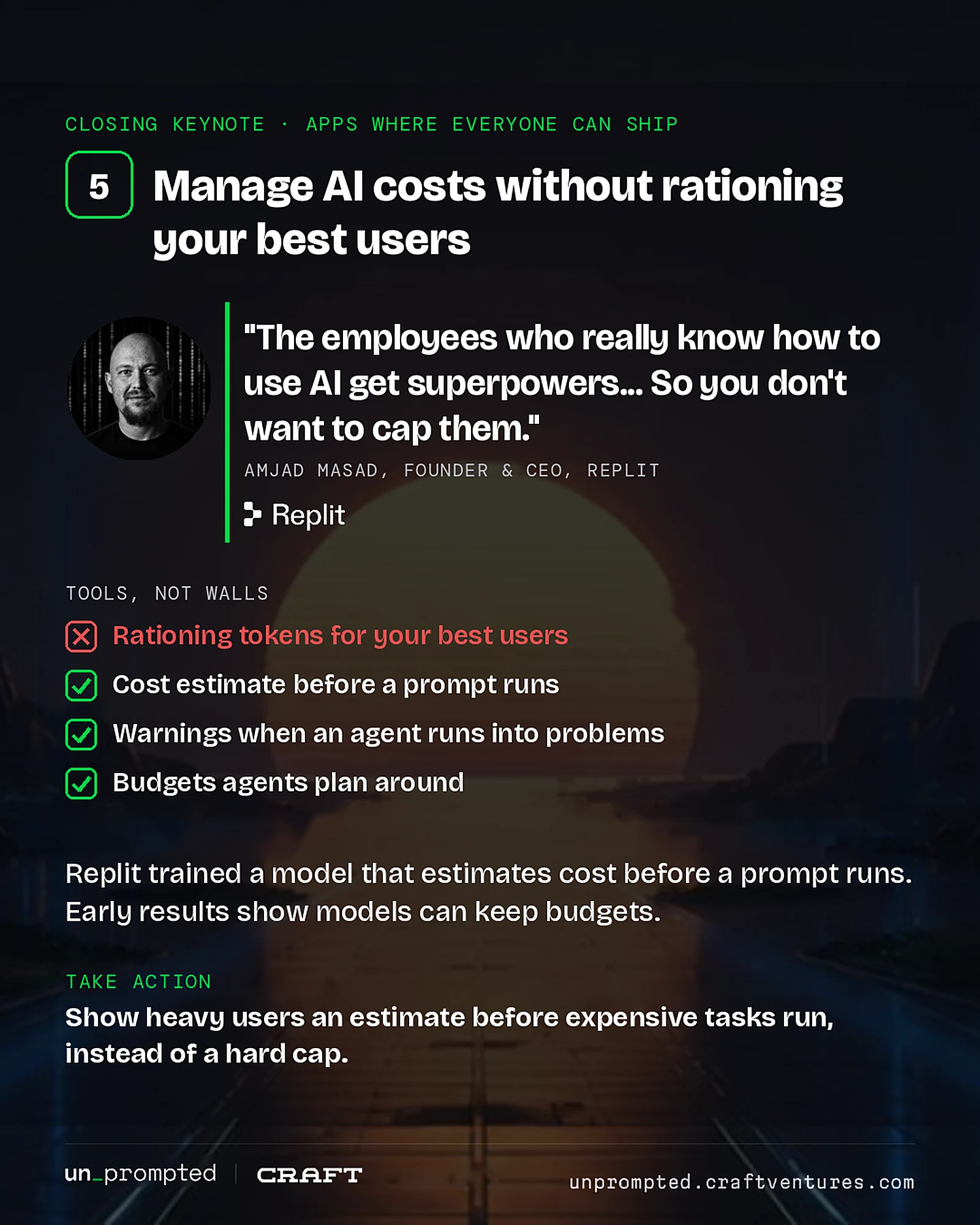
One very current problem that every AI company will recognize: AI products have real costs per use, and the most productive users are also the most expensive.
The tempting response is to ration. Amjad thinks that’s a mistake, because the gap between the best and the average user is wider than it has ever been. Where software once talked about the 10x programmer, he now sees 100x and 1,000x.
“The employees who really know how to use AI get superpowers… So you don’t want to cap them.”
Replit’s answer is tools instead of walls. It trained a model that estimates what a prompt is likely to cost before it runs, so people can narrow the request or start smaller. As the agent works, Replit warns when the estimate was off and the task is running into trouble. The goal is to make people responsible with spend without slowing down the ones creating the most value.
The next step looks a lot like advertising: give the model or the project a budget and let the agent optimize within it. Amjad said early results show models can keep budgets. David took it one step further and wondered whether enterprise budgeting simply becomes telling agents how to prioritize resources.
Routing helps too. Replit sends each task to the cheapest model that can do it well, and Amjad said gross margins are improving because of it. For any AI company with a heavy-user problem, that combination of estimates, warnings, budgets, and routing is a better answer than a hard cap that punishes your best customers.
What to do
- Show heavy users a cost estimate before expensive tasks run, instead of a hard cap.
- Warn when an agent is running away, and let people set budgets that agents plan around.
- Route simple tasks to cheaper models so your best users stay profitable.
The thread that ties it together
Put the five ideas next to each other and they tell one story.
Agents are changing how software gets built, and soon how agents work with each other. That part is genuinely new. But the business underneath hasn’t changed. Individuals churn. Teams expand. Companies adopt for the product and stay for trust. Costs have to make sense for the customers who use you most.
The jobs question came up too, and Amjad’s answer fits the same pattern. Replit is still hiring, because compute, not people, is now its biggest cost. The job is what’s changing: less writing code, more architecture, product thinking, and managing agents. His advice is to hire people who adapt, because the work will keep changing.
What’s possible has changed. What keeps a company alive mostly hasn’t. The founders who win this era will build for agents and still do the old work of earning trust, one customer, one team and one company at a time.
What to do, right now
If you only do a few things after watching this keynote, make it these:
1️⃣ Find your first teams. Count how many accounts already have several people from the same company. That’s your enterprise pipeline.
2️⃣ Put retention next to growth. Add net dollar retention and monthly churn to the same dashboard as signups.
3️⃣ Start one piece of trust work. Pick the first security, admin, or audit feature a company would need, and put it on the roadmap.
4️⃣ Give heavy users a cost view. Show an estimate before expensive tasks run, instead of a hard cap.
5️⃣ Test one agent handoff. Find one place where another agent could pick up your product’s output, and make it work.
Thank you
Thank you to Amjad for closing Un_prompted with so much candor about what the move to enterprise really takes, and to David for asking the questions every founder with a prosumer hit needs answered. And thank you to the partners who made Un_prompted possible: LinkedIn, Clay, Goodwin, Amazon Web Services (AWS), HubSpot for Startups, 3FORTY3, and Brickell Digital.
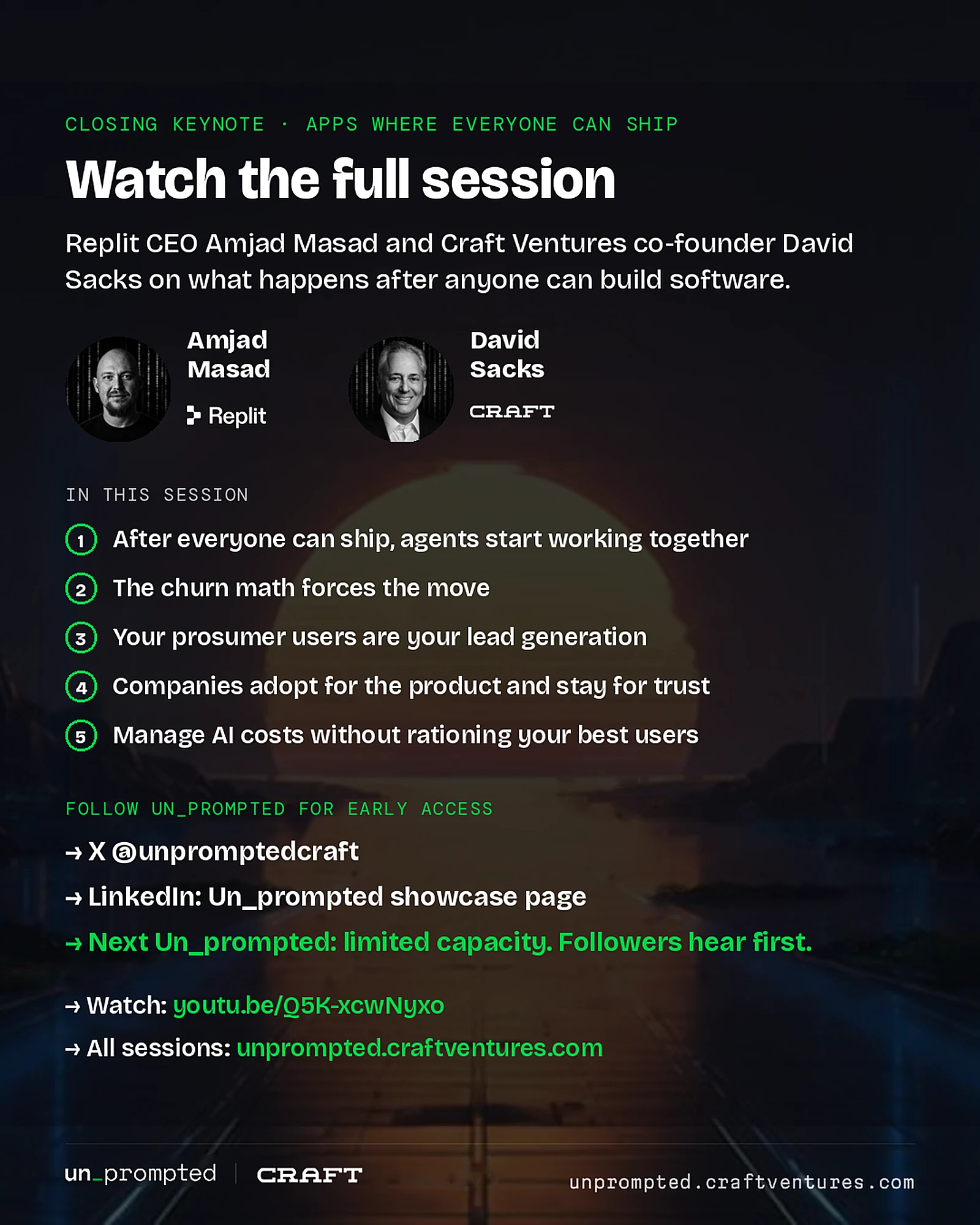
Watch the full session: https://youtu.be/Q5K-xcwNyxo
All sessions: https://unprompted.craftventures.com
Un_prompted is the highest-signal summit for marketing & growth in the Age of AI, presented by Craft Ventures. This year, 200+ intentionally selected founders, executives, operators and builders joined us in San Francisco, with hundreds more on the waitlist.
The fastest way to get early access to news about future events and a spot on the waitlist is to follow Un_prompted: X https://x.com/unpromptedcraft · LinkedIn https://www.linkedin.com/showcase/unpromptedcraft/
Read the full recap here.
Next session: How to get recommended by AI agents: LinkedIn, ClickHouse and ElevenLabs on earning attention twice.