

Not long ago, most engineers wrote every line of code by hand. Now a lot of them describe what they want, let an agent write it, and spend their time on tests and review. The work did not vanish. It moved up a level.
Nino Medina thinks marketing is next, and he put it in seven words:
“Marketing will have its Claude Code moment.”
That set up the question running through three five-minute lightning talks at Un_prompted: if every team gets the same models and the same automation, what makes your marketing yours? Nino Medina (Anthropic), Brian O’Kelley (Apostra) and Chris Cunningham (ClickUp) each came at it from a different angle. Taste, written down. Ideas worth scaling across every surface. And attention you earn before anyone searches.
Below are the ideas every founder and operator should take from the round, and what to do about each.
Who was on stage
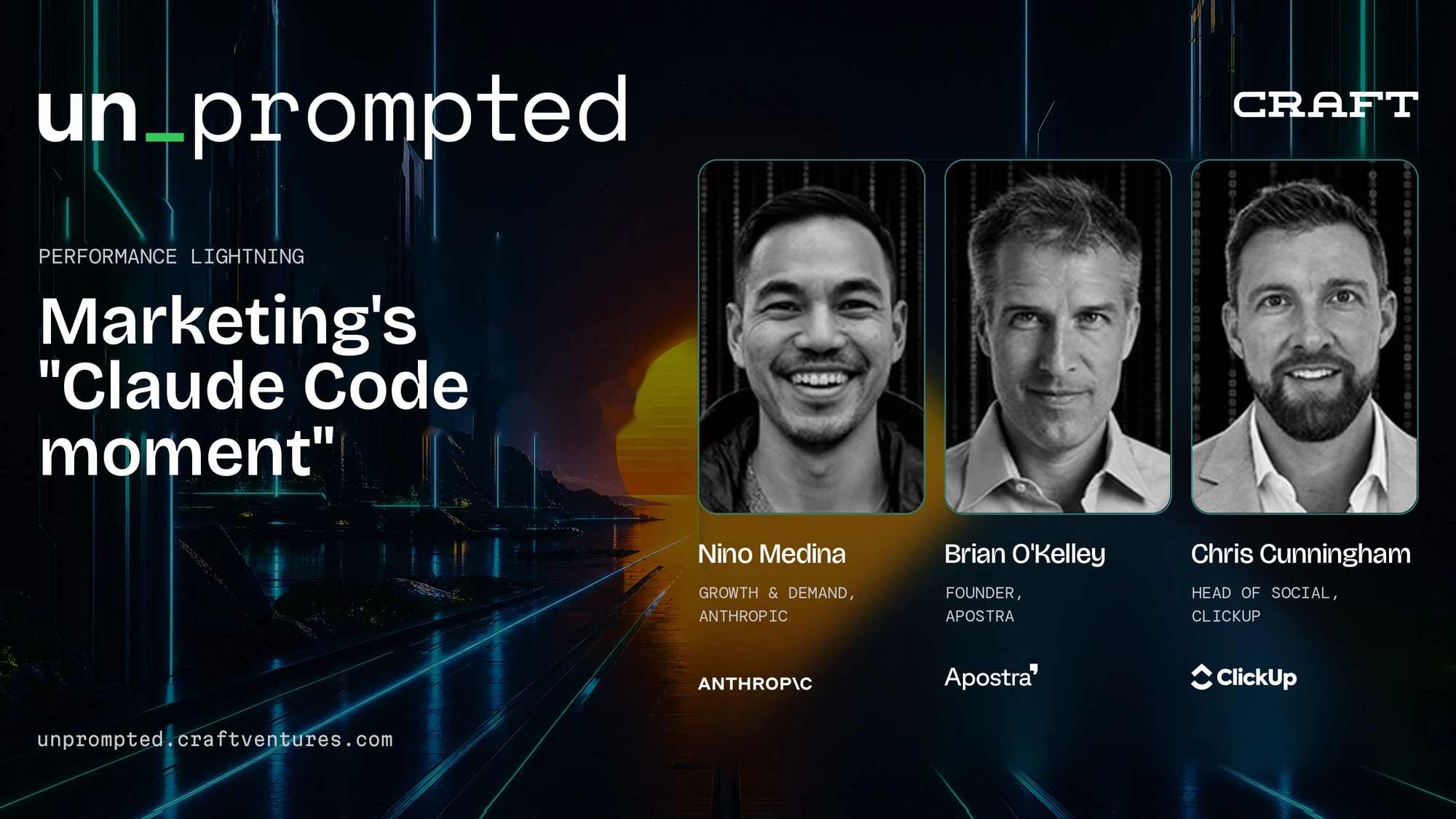
Nino Medina, Growth & Demand, Anthropic
Brian O’Kelley, Founder, Apostra (and before that, AppNexus)
Chris Cunningham, Head of Social, ClickUp
Anthropic is where a single slash command turns a product or messaging doc into a multi-channel campaign. Apostra is building the open protocol that connects agents to advertising surfaces. ClickUp runs a large organic social engine, including videos that have racked up more than 100 million views.
1️⃣ Marketing’s Claude Code moment is a taste problem
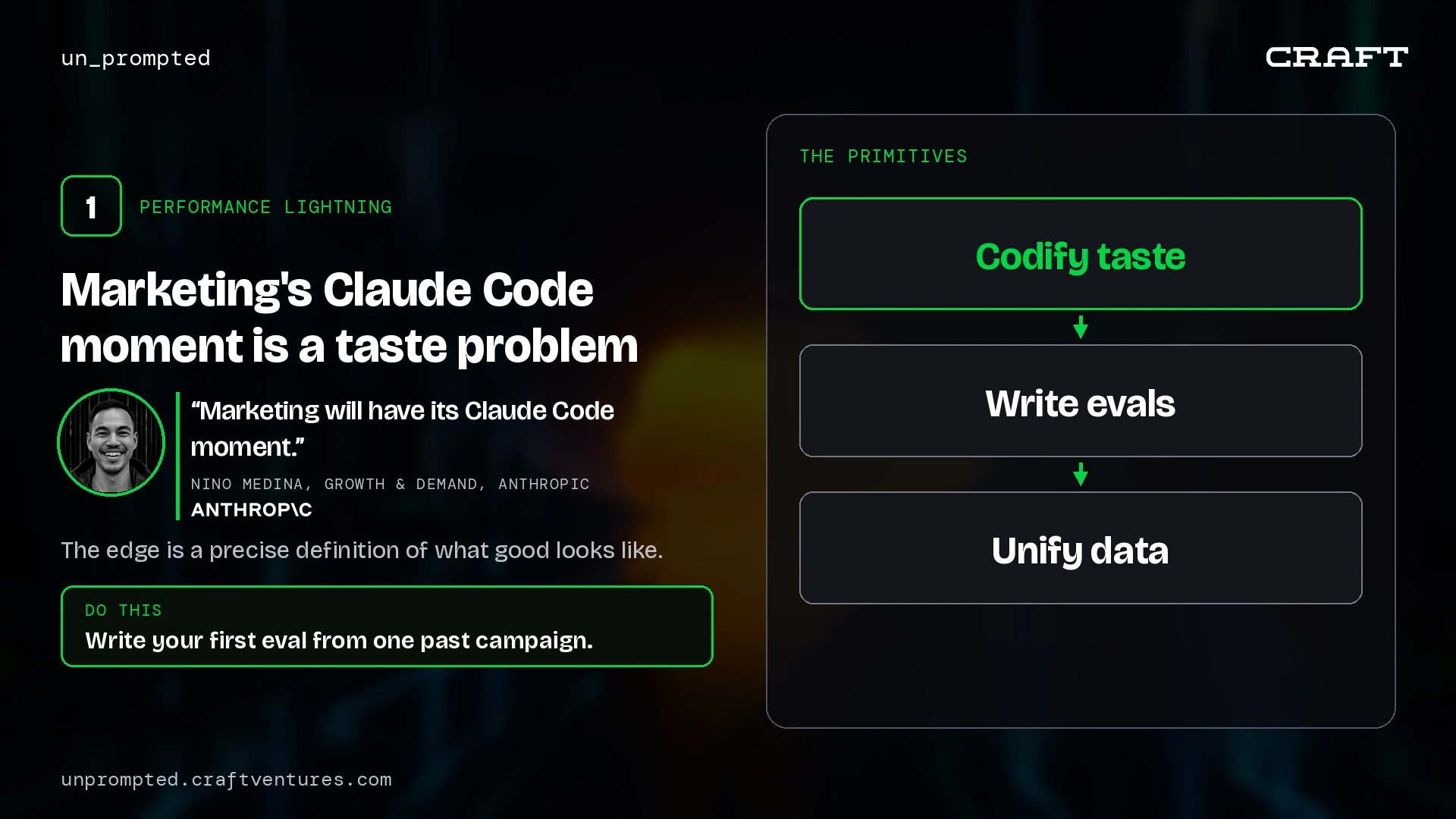
Nino described what this already looks like on his team. He has a slash command that takes a PRD, a blog post, or a messaging doc and returns a multi-channel campaign across organic social, paid social, search ads, and email, plus an internal Slack update.
“It’ll spit out a multi-channel campaign across organic social, paid social, search ads, email, all at very high quality, probably 90% ready to ship.”
When every team can do that, speed stops being the edge. The edge is a precise definition of what good looks like. Creation, ideation, launch and optimization will run through systems. Your competitors will have the same capabilities. So where is the alpha?
His answer: “Build the primitives that any future model capabilities can leverage.”
That means three things you can do now.
Codify your taste. Write brand, voice, and visual rules in enough detail that a model can follow them. Nino’s parallel for engineers is style guides and linters.
Write evals. Turn examples of your best work into a rubric and score new output against it. Code either passes a test or it does not. Marketing needs something closer to that.
Unify your data. Connect ad platforms, product data and CRM so the loop can close and the system can learn which campaigns actually worked.
What to do
- Write your first eval. Pick one past campaign. Ask your model of choice to help build a repeatable rubric from examples of work you love, and score the next piece of output against it.
- Put brand, voice and visual rules in a format a model can follow, with enough detail that “not right” becomes a checklist.
- Connect ad, product and CRM data so the system can learn which campaigns worked.
2️⃣ Stop building every campaign by hand
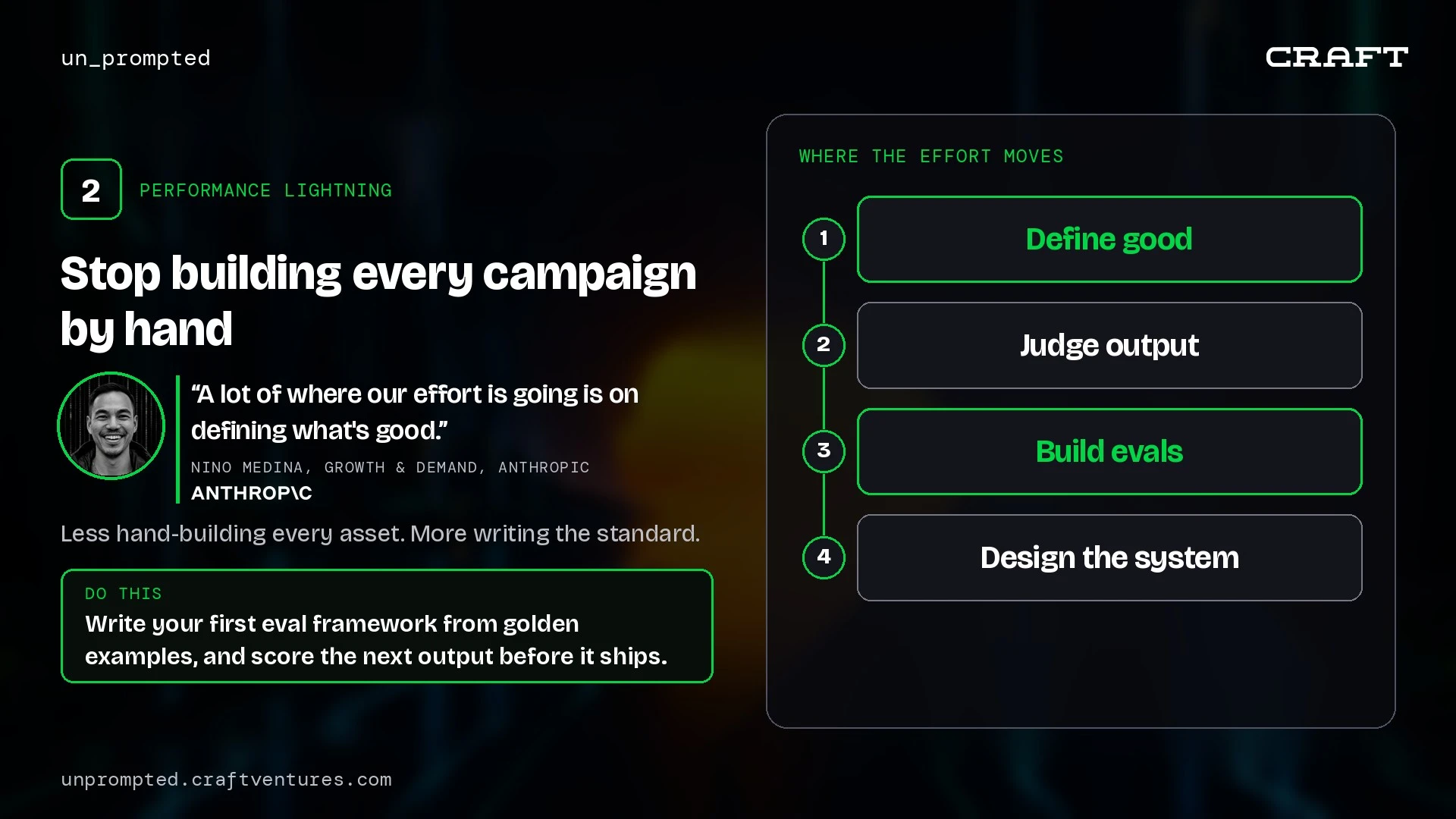
The Claude Code moment changes where marketers spend their time. Instead of building every campaign by hand, Nino put it plainly:
“A lot of where our effort is going is on defining what’s good.”
Judging the outputs, building evals on top of that output, and designing the system that gets you quality, not slop. Less hand-building every asset. More writing the standard, scoring the output, and designing the loop.
He also drew a line between work that compounds and work that does not. Prompting by hand, manually reviewing every asset, and one-off tools that never stack. That is the left column. The right column is taste written down, scored in a repeatable way, with data infrastructure that closes the loop.
The role shifts with it. Think more like a product manager. Nino’s growth marketing team at Anthropic reports into product, which is a clue about the mindset: build systems for your team the way a product manager would.
What to do
- Write your first eval framework from golden examples of work you love, and score the next agent output against it before anyone ships.
- Put the definition of good in a form a model can follow, with enough detail that “not right” becomes a checklist.
- Stop spending the week on one-off prompts. Put that energy into the standard, the eval, and the closed loop instead.
3️⃣ The creative spark still comes first
Brian O’Kelley built AppNexus and now leads Apostra. He started with a story from twenty years ago: an algorithm that found dial-up customers for AOL, and a boss who hit refresh and yelled “yeah” every time someone signed up. That yell was Brian’s eval. The next question was how to run the same idea on every website on the internet. That was the genesis of programmatic advertising.
Then the inventory walled off. Facebook, mobile apps, chat interfaces. By Brian’s estimate, only about 10% of advertising, if that, is still available for real-time bidding.
So if you want an agent to run evals across the real world of advertising, not just Meta, LinkedIn, and TikTok, you have a problem. Brian’s answer is the Ad Context Protocol, an open protocol that gives agents one way into advertising surfaces, from podcasts and newsletters to retail and out-of-home. He said the idea is already in use from South African taverns selling audio ads to Facebook campaigns in Nigeria.
But his caveat mattered more than the tech.
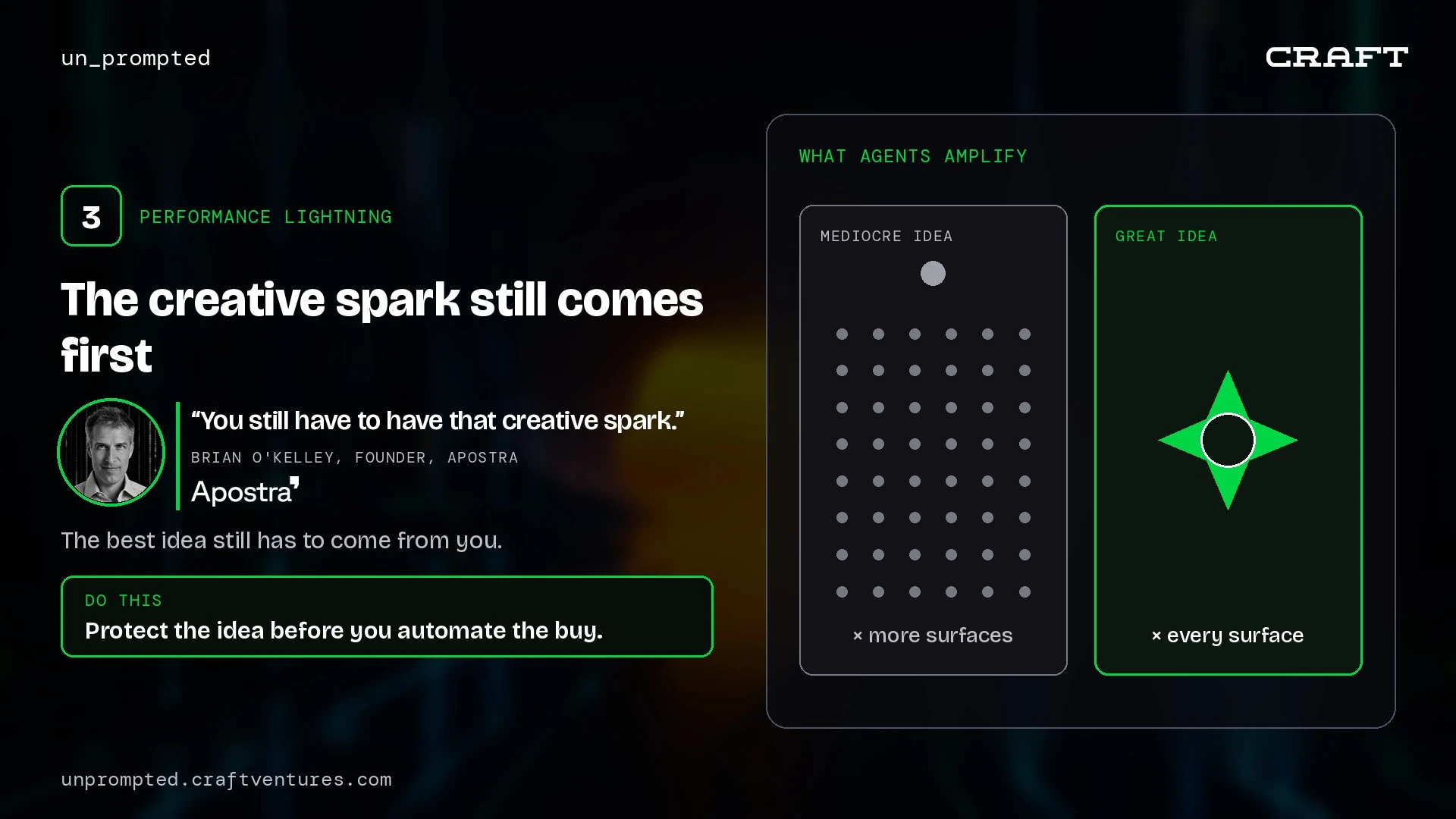
“You still have to have that creative spark.”
An agent buying across a hundred surfaces just amplifies a mediocre idea a hundred times. The best idea still has to come from you.
What to do
- Protect the idea before you automate the buy. If the creative is weak, do not scale it.
- Treat agents as amplifiers: only automate the buy once the creative is strong enough to be unmistakable.
- Watch open protocols like Ad Context Protocol if you want agents to buy beyond the walled gardens.
4️⃣ Scope beats running the same thing everywhere
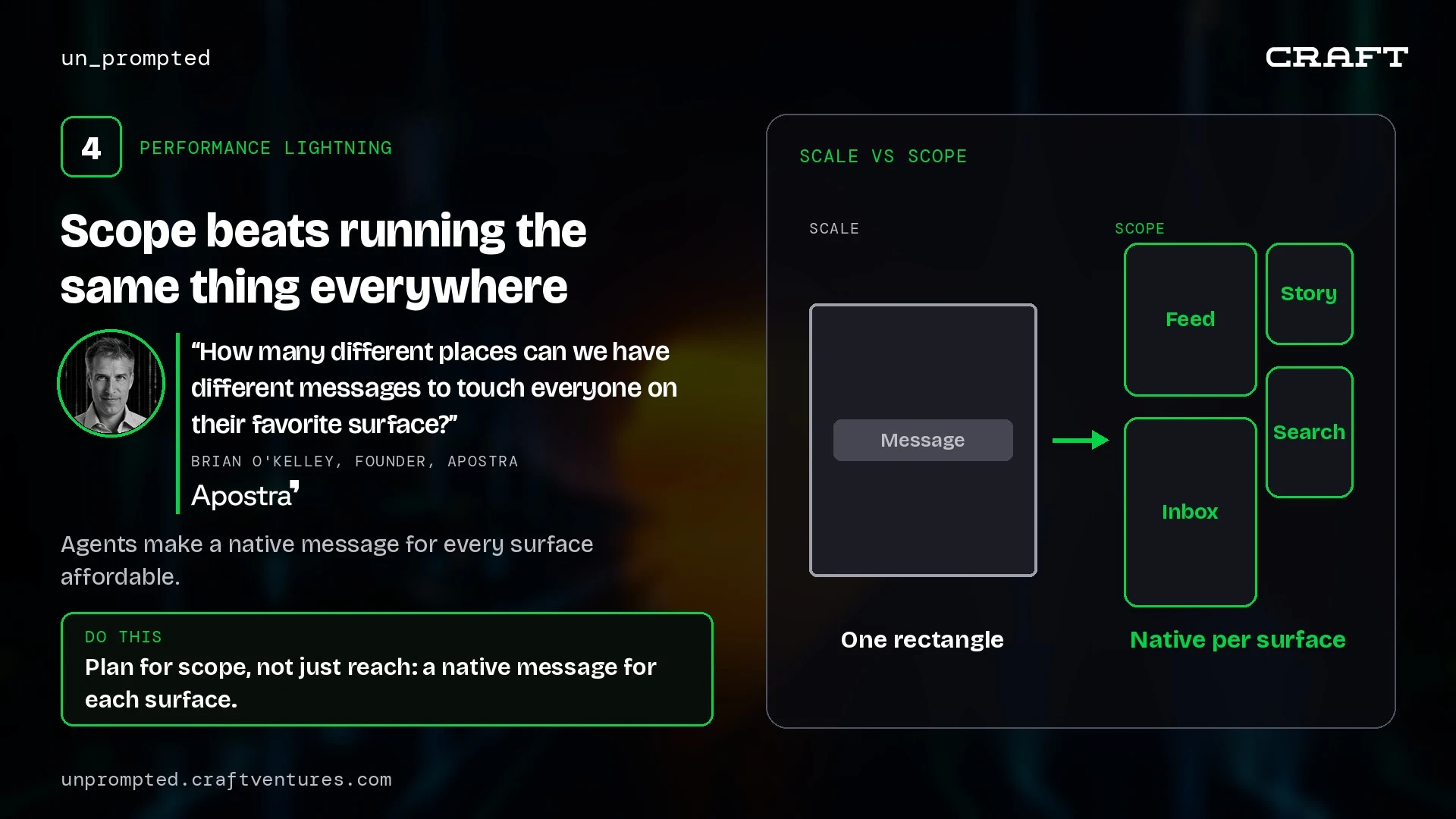
Brian’s bigger point was about scope, not scale. The old model ran one message everywhere. Jingles from TV commercials. Rectangles with cookies. Agents make it affordable to write a different, native message for every surface.
“How many different places can we have different messages to touch everyone on their favorite surface?”
On every podcast, the host might read a message that’s different. Same goes for every subreddit. The same idea can show up as a different, native line wherever people already spend time.
That is the shift he wants founders to feel. Not “run the same thing everywhere,” but how many places you can touch with a message that belongs there. Once you have the idea, agents can carry it across podcasts, newsletters, retail, out-of-home and the feed without flattening it into one rectangle. The work that used to mean scale now means scope. Creativity gets amplified. The surface gets a message that fits.
“Everywhere we go, agents can transform our best ideas into unmistakable moments that influence people all around the world.”
What to do
- Plan for scope, not just reach: different native messages for podcasts, subreddits, retail and the feed, not one rectangle everywhere.
- Write one native message for a surface you currently treat as a rectangle.
- Ask whether your next campaign is the same idea scaled, or different messages by scope.
5️⃣ Attention still starts in the feed

Chris Cunningham, who runs social at ClickUp, brought the round back to people.
“The main way you win is attention. It’s mind share.”
The room was thinking about LLMs. Chris was too. Then he shared a number he looked up with an LLM: people still spend about 50 times more time on social media than in assistants.
“People need to think of you before they go search. And if you’re not top of mind, no matter how good your product is, if they don’t know about it, they’re not going to find it.”
ClickUp’s answer is a heavy organic engine. Chris said one video cleared over 100 million views, the kind of number brands pay Super Bowl money to chase. Ramp gets the same idea with Broadway moments and stunts people keep talking about. The point is not comedy or musicals. It is giving people a reason to keep talking.
Launches alone are not enough.
“It’s very easy to be popular for a day, but there’s launches coming out every single week. How are they going to remember yours?”
What matters is the next stretch after launch day: recurring organic content your audience actually enjoys, influencers and UGC that walk through the product, and customer-led stories that prove real companies use you.
What to do
- Plan the 90 days after your next launch, not just the launch post.
- Pick a recurring format your customers enjoy watching, and ship it on a schedule.
- Fund creators and customer stories so other people say your name, not only your brand account.
6️⃣ Reverse-engineer the question you want to win
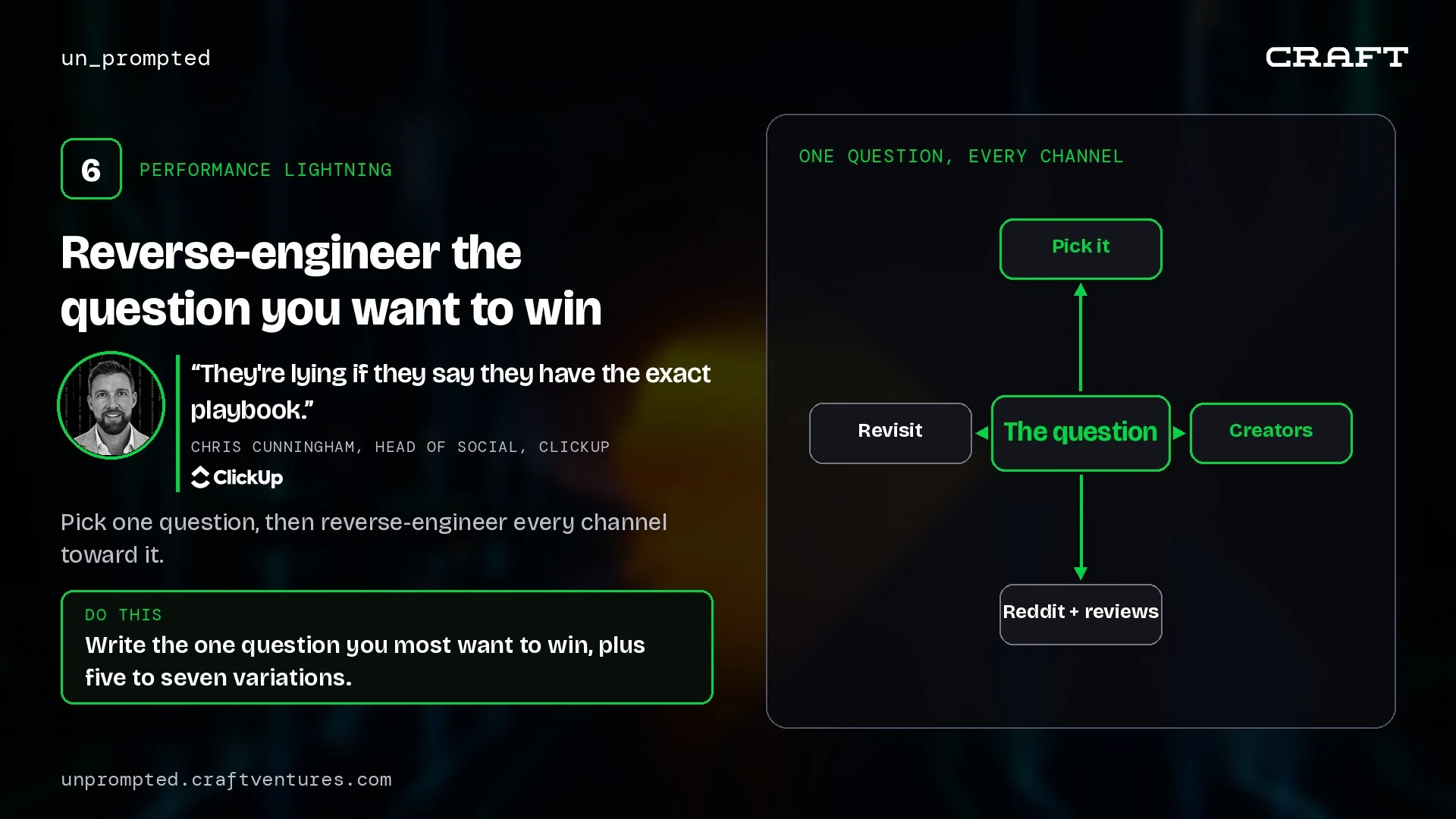
Chris closed with the part most teams skip: will AI mention you when it is time to choose?
He has asked teams at Ramp, Profound, and AirOps the same question. His honest answer:
“They’re lying if they say they have the exact playbook.”
Pick one question you most want to be the answer to, plus a few variations. His example: which AI assistant should we roll out to our 5,000 employees? Then reverse-engineer every channel toward that question.
On YouTube, do not put all the money into one expensive creator. Pay a bunch of smaller creators – or make many of your own videos – that answer the question every time. Same play on X and LinkedIn. AI is reading what everyone is saying, not only the biggest accounts.
On Reddit, you do not need a massive thread. Chris cited research that maybe over 70% of the posts that show up in answers have under 20 comments. Show up. Have a strategy. Then add customer stories and reviews on sites like G2 and Capterra.
Revisit the plan often. Chris’s last line was that everything he shared will change, and the job right now is still attention and mind share.
What to do
- Write the one question you most want to be the answer to, plus five to seven variations.
- Fund many smaller creators to answer that question on YouTube, X and LinkedIn, instead of one big sponsorship.
- Show up on Reddit and review sites with real answers and customer proof, even in smaller threads.
The thread that ties it together
Put the three talks next to each other and they tell one story.
Nino writes down what good looks like so agents can produce it and score it. Brian scales a great idea across every surface, and warns that agents will amplify junk just as fast. Chris makes sure people already know your name before the agent ever gets asked, then reverse-engineers the question you want to win.
None of this replaces the old work of building a brand people care about. It adds a second audience that reads everything and scales whatever you feed it, good or bad.
What to do, right now
If you only do six things after watching these lightning talks, do these:
1️⃣ Write your first eval. Pick one past campaign. Build a rubric from examples of your best work and score the next agent output against it.
2️⃣ Codify taste in a form a model can follow. Brand, voice, visual rules, with enough detail that “not right” becomes a checklist.
3️⃣ Protect the idea before you scale the buy. Weak creative scaled by agents is still weak creative.
4️⃣ Plan for scope, not just reach. Write different native messages for each surface, not one rectangle everywhere.
5️⃣ Pick your one question. Write down the question you most want to be the answer to, and list every channel that could answer it.
6️⃣ Plan the 90 days after your next launch, with recurring content, creators and customer stories, not only the launch day.
Thank you
Thank you to Nino, Brian and Chris for packing so much into five minutes each. And thank you to the partners who made Un_prompted possible: LinkedIn, Clay, Goodwin, Amazon Web Services (AWS), HubSpot for Startups, 3FORTY3, and Brickell Digital.
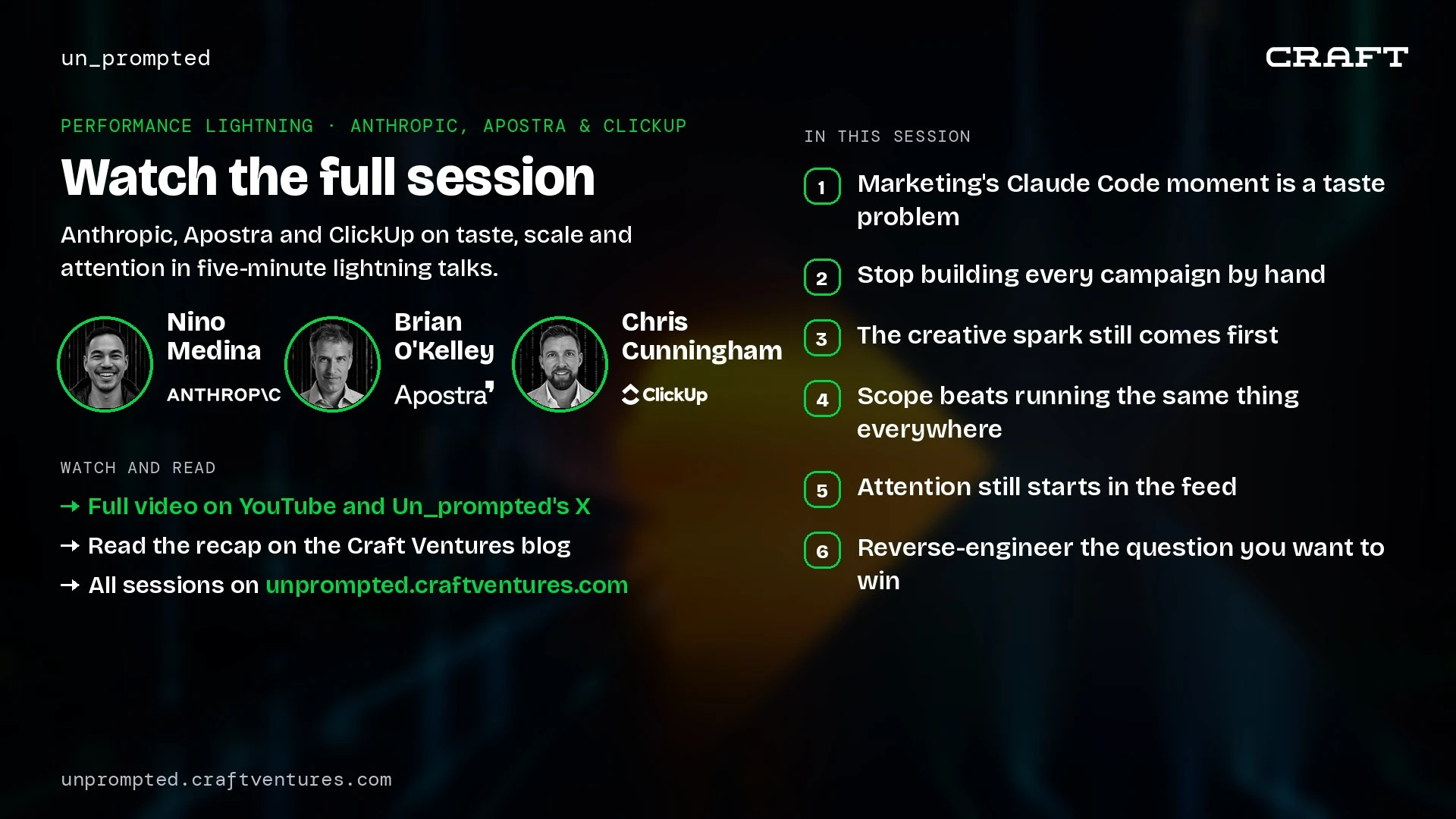
Watch the full session: https://youtu.be/GN_dqtCuOVY
All sessions: https://unprompted.craftventures.com
Follow Un_prompted: X https://x.com/unpromptedcraft · LinkedIn https://www.linkedin.com/showcase/unpromptedcraft/
Read the full recap here.