

A few months ago, Michael Grinich hired a new head of finance at WorkOS. In the interview, Michael asked how many people he’d need on his team. The candidate had run a team of 10 to 15 before.
His answer: “Well, what’s my token budget?”
That exchange captures where a lot of companies are right now. The tools are good enough that one savvy AI-enabled person can do what several used to do. But most companies haven’t changed how they work. People write emails faster and summarize meetings faster, and the company moves at the same speed it did two years ago.
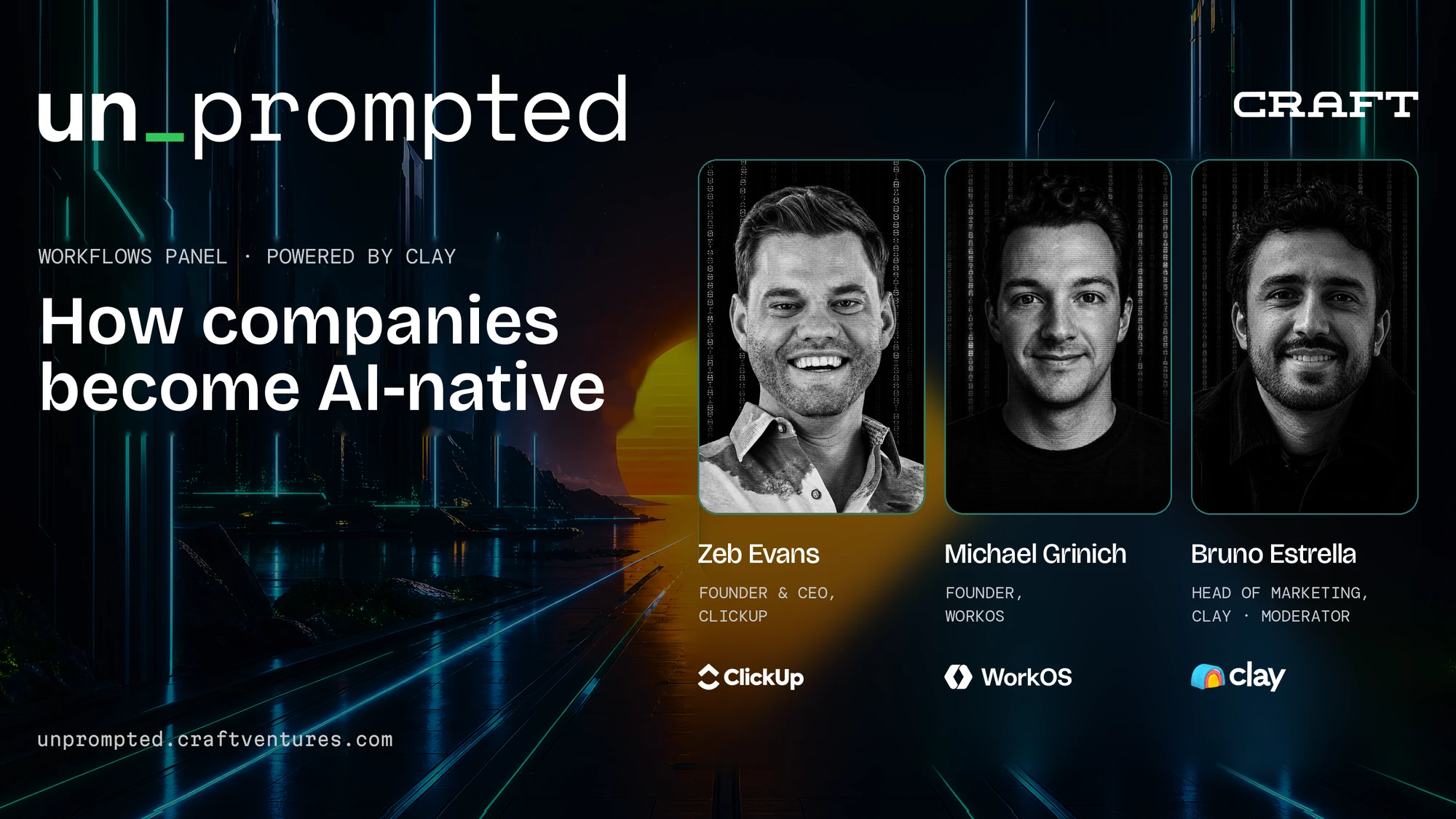
That gap was the subject of the Workflows panel at Un_prompted, powered by Clay. Zeb Evans of ClickUp and Michael Grinich of WorkOS have both pushed their own companies further than most, and Bruno Estrella of Clay, who moderated, has watched the same shift reshape go-to-market. Their answer was consistent: the edge isn’t the tools; it’s how leaders use them, who they back, and the habits they build so that everyone else follows.
Below are the five ideas every founder and operator should take from the panel, and what to do about each.
Who was on stage
Zeb Evans, Founder & CEO, ClickUp
Michael Grinich, Founder, WorkOS
Bruno Estrella, Head of Marketing, Clay (moderator)
ClickUp is the company Zeb founded and still runs, and this panel is personal for us: Aaron was ClickUp’s first Head of Marketing, hired by Zeb at about $4M ARR. WorkOS powers auth and enterprise readiness for a long list of AI companies. Clay is one of the products the Craft portfolio uses most.
1️⃣ The tools are equal now, so leadership is the edge

A two-person startup now has the same models as the largest company in its market. That’s the most hopeful thing about this moment, and Zeb called it exactly that: AI has democratized opportunity and knowledge. The flip side is that your competitors have the same models you do. When the tools are equal, what separates companies is how they lead.
Bruno asked both founders for the single piece of advice they’d give a leader trying to get a company to adopt AI. Zeb didn’t hesitate.
“You’ve just got to lead by doing it... not speak in high-level strokes of ‘everybody adopt AI. Let’s be AI native’... Nobody knows what it is.”
He was candid that he sees the opposite in parts of his own company: leaders telling people to adopt AI without being able to give a single example of how they use it themselves.
A memo telling the company to be AI-native does very little on its own. A leader who shows the team something they built (including what broke) makes trying safe and gives people something concrete to mirror.
Both founders lead this way. Michael turned the WorkOS board deck, which used to take weeks to assemble each quarter, into an app that generates a new deck on demand. Zeb used his own coding time to cut ClickUp’s initial app load by about 35%, from 2.8 seconds to under two.
The point is that the people at the top need to be building, not pontificating. Teams copy what leaders do far more than what they say.
What to do
- Have each leader ship one real workflow with AI this month, and show the team how they did it, including what broke.
- Replace one “be AI-native” message with a concrete example from your own work.
- Ask your leadership team which AI tools they use every week, and start closing the gap yourself.
2️⃣ Find the builders you already have

The change in most companies isn’t driven by everyone at once. It’s driven by a small group who figured it out early and are now doing far more than anyone else.
Zeb sees it at ClickUp: “It’s a huge, massive delta between the people adding incredible value and everybody else.” He has seen single people get 50x to 100x more productive than everyone else, and by his estimate about 15 engineers do around 95% of the work, out of roughly 150.
ClickUp calls these people “builders” and “artisans,” and pays them accordingly. Builders can make things with AI. Artisans can also judge whether what they made is right and worth shipping. That second skill is what compounds. Plenty of people can get a tool to produce something. Far fewer can review it well.
Michael described the same people at WorkOS, CS degree or not: those who use software as a primary tool. “Those people with AI are unstoppable. They can run circles around people that can’t.”
The important part is where they come from. Zeb finds them inside the company, not through hiring. Many engineers, designers, and managers never had the chance or the confidence to build a product, and some of them turn out to be exceptional at it. The role isn’t limited to engineering either; ClickUp has builders who aren’t engineers.
Once you find these people, the job is to keep them. Michael’s advice is to put the early adopters together, give them real resources and executive air cover, and tell them they’re modeling how the company wants to work. Otherwise, as he put it, “They’ll feel alone. They’ll feel ostracized... And the worst thing is they might leave.”
Our read: most companies already employ the people who will lead this shift. The risk isn’t failing to hire them. It’s failing to notice and empower them.
What to do
- List the people already doing the most with AI, in any function, and ask each one what would help them do more.
- Put them together, give them a budget and executive air cover, and celebrate what they ship.
- Make building with AI part of how you pay and promote, not a side project.
3️⃣ Rituals get everyone across the line
Finding the builders gets you started. Getting everyone else there takes structure.
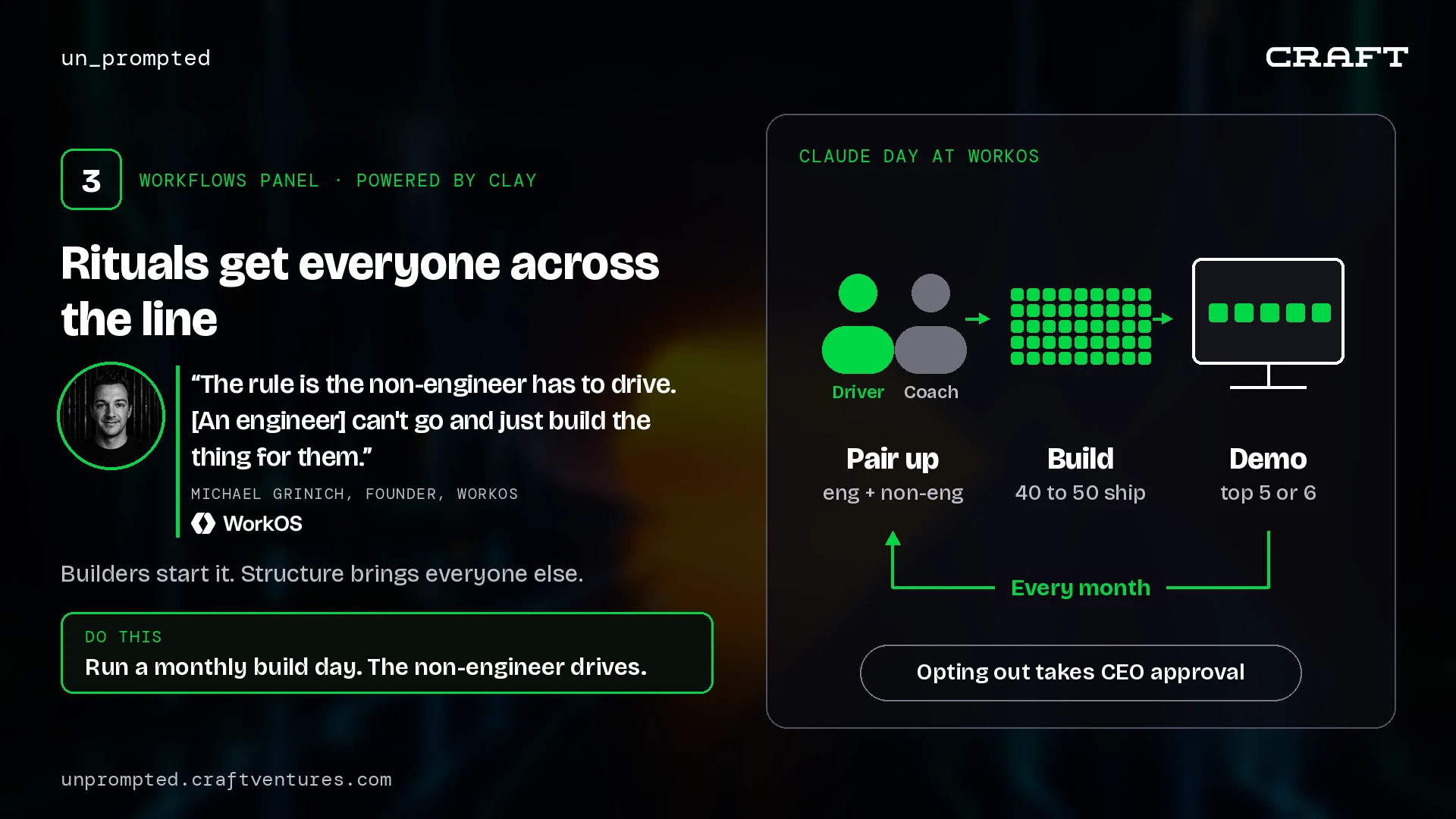
WorkOS runs a monthly build day it calls Claude Day, even though the team uses several tools. Everybody in the company builds something. Engineers pair up with non-engineers, and one rule makes it work.
“The rule is the non-engineer has to drive. [An engineer] can’t go and just build the thing for them.”
That rule does two things. First, it forces non-engineers to learn by doing, and it shows engineers exactly where tools and processes get in the way. The first Claude Day surfaced the basics, like getting people GitHub accounts and teaching the build pipeline. After that, it moved fast.
It’s not optional. Opting out takes CEO approval, “which everyone’s terrified to ask for.” The output is real: roughly 40 to 50 things get built and shipped in a day, and the top five or six are demoed at the company all-hands. The recruiting team built its own tool for scanning candidates. Marketing built analytics tools. Someone built an agent to handle the daily lunch order.
Underneath the ritual is a simple mantra: just try it. Michael repeats it because the models keep changing, and a conclusion from six months ago is out of date. Zeb’s version is the in-person hackathon, where it’s hard to stay a skeptic while you watch a colleague build something real.
Both founders were honest that not everyone will come along. Michael’s view is that people who don’t want to make the change need a respectful way out, because holding the rest of the company back isn’t an option.
What to do
- Put a build day on the calendar this month. Pair engineers with non-engineers, and the non-engineer drives.
- Demo the best builds at your next all-hands, and look at all of them yourself.
- Re-run last quarter’s failed experiments. The models have probably changed since you tried.
4️⃣ Check the Swiss cheese

As more of the work gets done by AI, quality becomes the question. Zeb’s answer is the most memorable image from the panel.
“AI is like Swiss cheese. It’s good cheese. There’s holes in it. And so you have to line up a bunch of Swiss cheese to prevent the holes.”
When people tell him AI doesn’t work, his reply is that they didn’t have another agent check it. The detail that matters is independence. The second check has to be a separate agent with no shared context. An agent reviewing its own work has the same blind spots that caused the mistake. Fresh context means the holes don’t line up.
ClickUp runs councils of models that check almost everything. It costs 15 to 20 times as much as a single pass, and Zeb thinks it’s worth it, because it catches the last-mile problems that make AI output untrustworthy.
The simplest version is free. Start a new conversation for each new task. Too many people stay in one long thread, and the leftover context quietly causes errors.
The panel split on measurement. Zeb sees token use and pull requests track closely with performance at ClickUp. Michael agreed they correlate but said they only tell part of the story. He wants to see “what are people actually building, and then what are they doing when they’re not being watched?” The real signal is whether people keep building in the weeks after a Claude Day. Both views fit together: usage tells you who is trying, and what sticks tells you whether it worked.
What to do
- Add a separate agent with fresh context to check the first agent’s output on one workflow that matters, before it ships.
- Track what people build and keep using, not just token counts.
- Start a new conversation for every new task. Context bleed is one of the easiest holes to close.
5️⃣ Make something agents want

Then the conversation turned outward. Y Combinator’s mantra is “Make something people want.” Michael made a shirt with his own version: make something agents want.
His argument is that agents are becoming customers. Supabase is his example: much of its growth comes from people prompting an AI tool, which then picks Supabase and creates the account itself.
“Not having a way for agents to sign up and use your product will be kind of like not having a website in the late ’90s.”
Think about what that means for your product. Can an agent sign up, authenticate, get the right permissions, and pay without a person filling in a form? For most products today, the answer is no. That’s a roadmap item, not a thought experiment.
Bruno added the go-to-market side from Clay: “Building became cheap, and product marketing became the bottleneck.” So Clay made product marketing a central driver of growth, because every launch feeds adoption and user content, which feeds the next launch.
Zeb added a reminder about the rest of the market. Most of ClickUp’s customers aren’t technical, and for many of them AI still means asking a chatbot what they used to ask a search engine. ClickUp waited to ship its AI until it passed Zeb’s own test: “am I using this thing instead of what else is out there?” Once it did, retention and activation changed.
What to do
- Have an agent try to sign up for your product. Wherever it gets stuck goes on the roadmap.
- Decide how your product handles agents as users: whose identity they act under, what they can touch and how they pay.
- Check whether product marketing can keep up with your release pace. If it can’t, fund it like a growth team.
The thread that ties it together
Put the five ideas next to each other and they tell one story.
The tools are the same for everyone, so the edge is leadership. Leaders go first and show their work. They find the builders who already exist and back them before they leave. They run rituals that get everyone else across the line, and they give people who don’t want to make the change a way out. They build independent review into the process so speed doesn’t cost quality. And they look outward, making sure the agents their customers use can use their product too.
None of it is about buying the right tool. All of it is about changing how a company works, which has always been the hard part.
The reassuring part is that it starts small: one build day, one leader shipping one workflow, one second reviewer on one process. The less reassuring part is the clock. Michael’s reply to anyone who says AI can’t do something: “When did you try it last? 6 months ago? 6 months? That’s like a decade in AI time.”
What to do, right now
If you only do five things after watching this panel, do these:
1️⃣ Go first. Each leader ships one real workflow with AI this month and shows the team how they did it.
2️⃣ Find your builders. List the people already doing the most with AI, in any function, and ask what would help them do more.
3️⃣ Run a build day. Non-engineers drive, engineers coach, and something ships by the end of the day.
4️⃣ Add a second reviewer. For one workflow that matters, have a separate agent with fresh context check the first agent’s output.
5️⃣ Test the outside. Have an agent sign up for and use your product, and fix the first place it gets stuck.
Thank you
Thank you to Zeb and Michael for being so open about how they run their own companies, and to Bruno for moderating. A special thank-you to Clay for powering the Workflows panel, and to all the partners who made Un_prompted possible: LinkedIn, Clay, Goodwin, Amazon Web Services (AWS), HubSpot for Startups, 3FORTY3, and Brickell Digital.
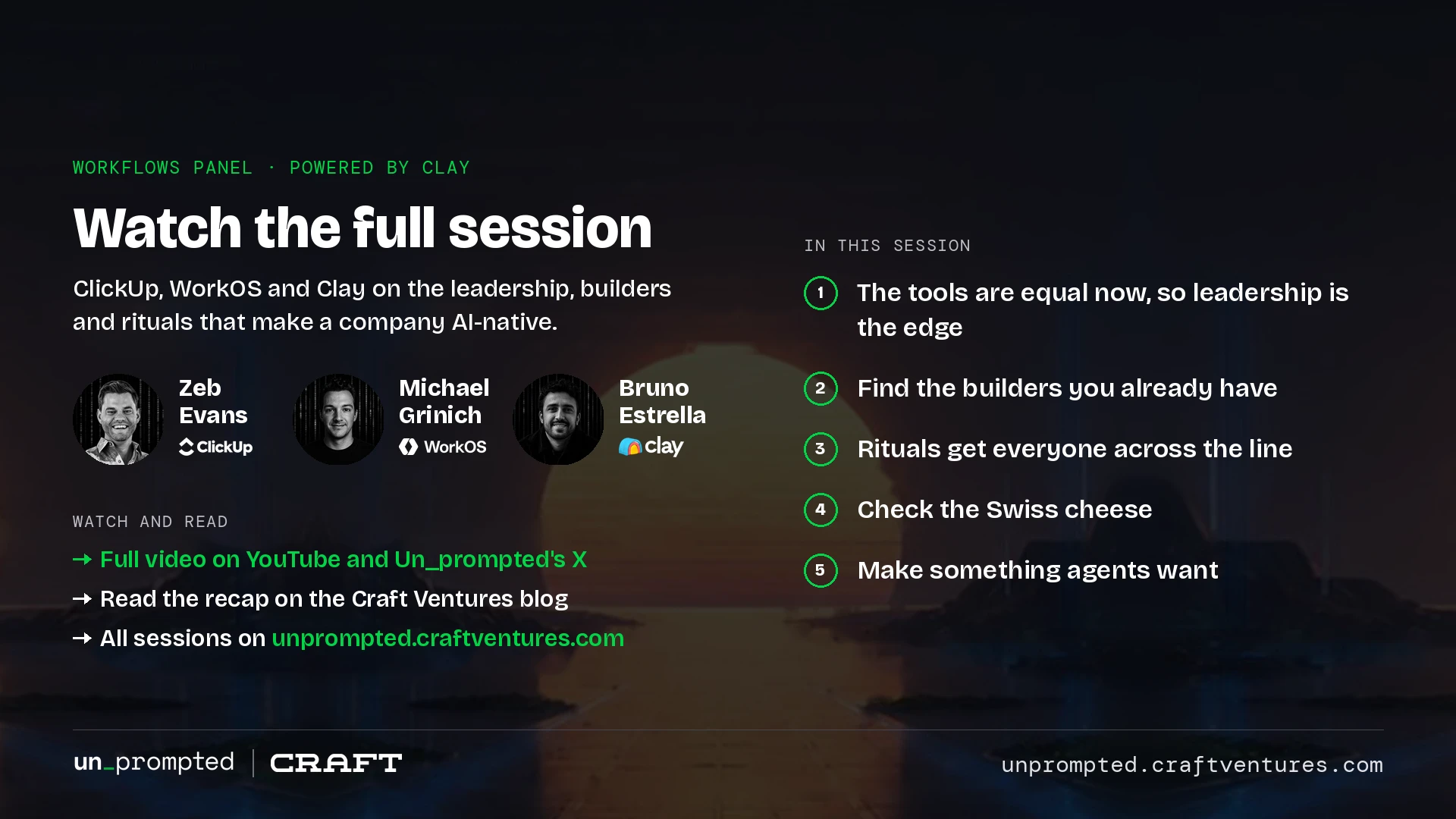
Watch the full session: https://youtu.be/ieZZ16oElPk
All sessions: https://unprompted.craftventures.com
Follow Un_prompted: X https://x.com/unpromptedcraft · LinkedIn https://www.linkedin.com/showcase/unpromptedcraft/
Read the full recap here.