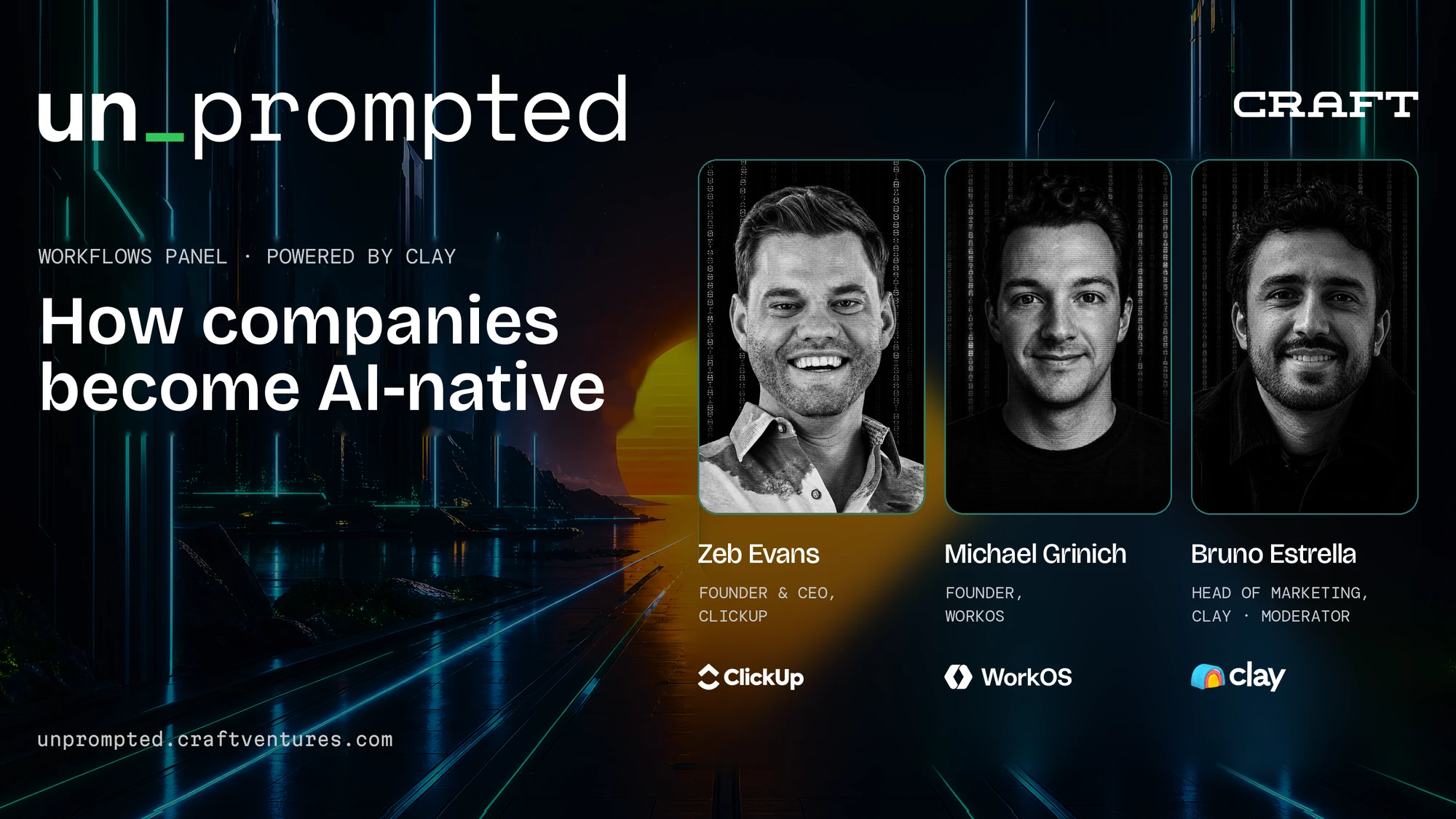


Every CRM, ERP, and HR system you use was designed around one picture: a person at a screen, filling in fields. Jeanne DeWitt Grosser, COO of Vercel, named the problem with that picture plainly.
“None of us ever wanted to work the way Salesforce wanted us to work, or the way Workday wanted us to work.”
Software made people work their way: the salesperson updates the CRM, the engineer commits code, and everyone goes to those systems to find out what’s true. That picture is breaking. Agents now book meetings, take actions and update records, and they do it at a volume no team of people ever could.
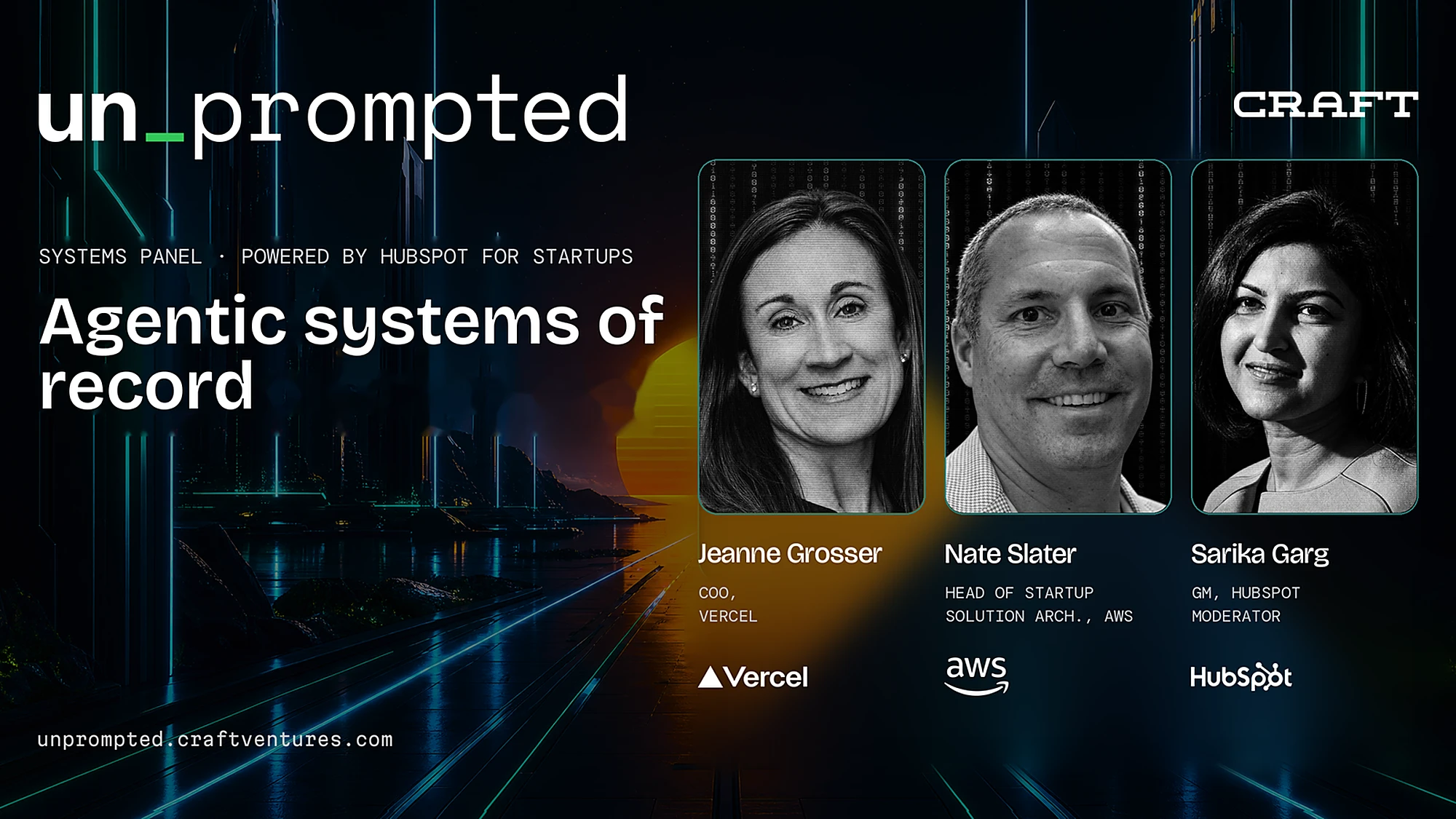
That shift was the subject of the Systems panel at Un_prompted, powered by HubSpot for Startups. Everything else we heard that day depends on what sits underneath: where the truth lives, who can change it, and how an agent finds it. Jeanne DeWitt Grosser of Vercel and Nate Slater of AWS have both had to answer those questions inside their own companies, and Sarika Garg of HubSpot moderated.
Below are the five ideas every founder and operator should take from the panel, and what to do about each.
Who was on stage
Jeanne DeWitt Grosser, COO, Vercel
Nate Slater, Head of Startup Solution Architecture, AWS
Sarika Garg, GM, HubSpot (moderator)
We built the Un_prompted website on Vercel. Nate’s team at AWS works with thousands of startups, which gives him a wide view of how agent-first companies are wiring up their systems. And HubSpot is one of the most common systems of record across the Craft portfolio.
1️⃣ The user isn’t always a person anymore
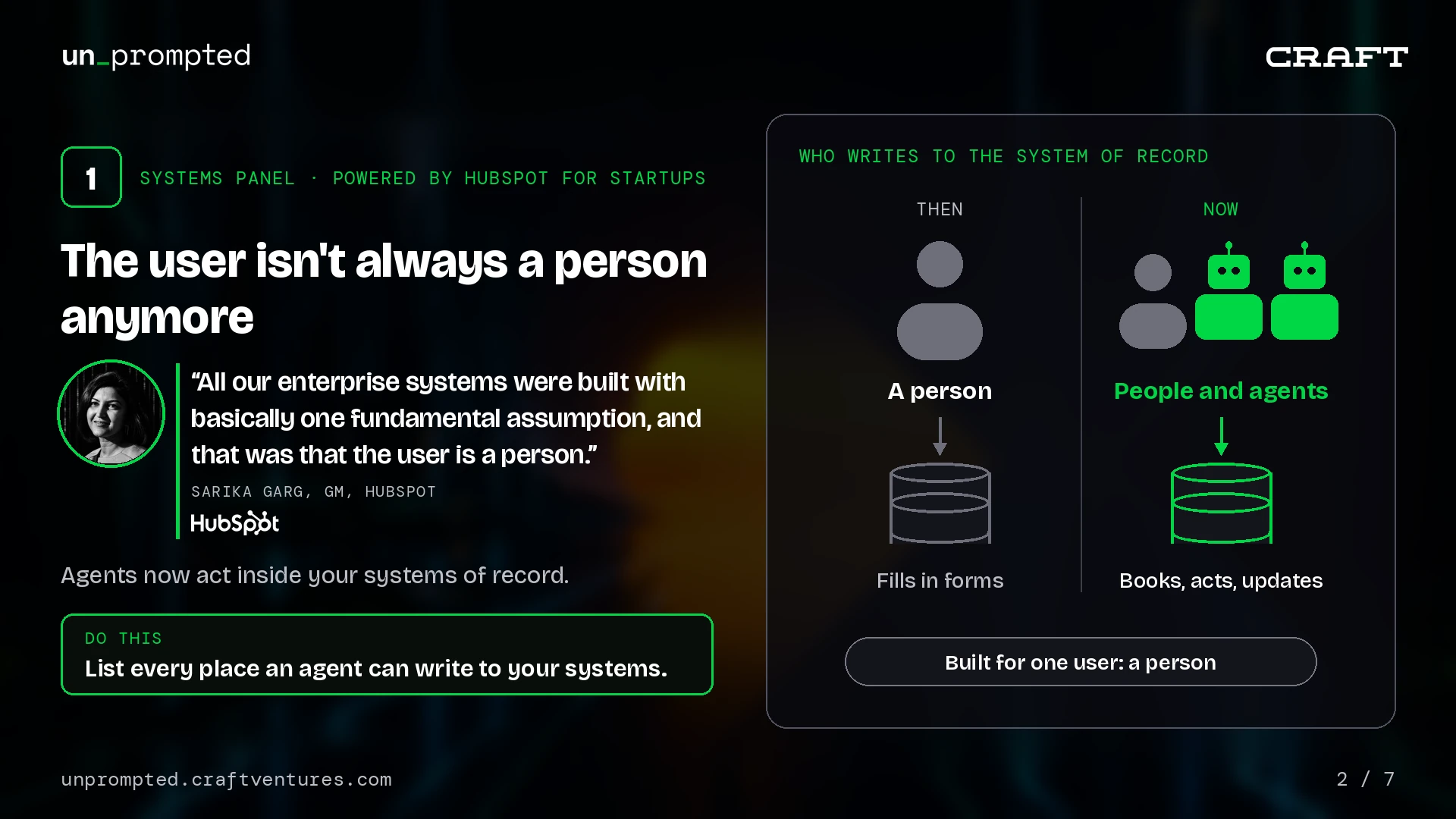
Sarika opened the panel by naming the assumption underneath all of it: “For the last several decades, all our enterprise systems were built with basically one fundamental assumption, and that was that the user is a person.” If agents are now doing the work, what happens to the systems we treat as the source of truth?
Nate described how messy the answer already is at Amazon, where there are several learning management systems and a wiki that might say it was last updated in 2015. Sarika then asked what a system of record even is: “Is it where your data lives? Is it where the workflow lives?” Or is it simply the place a company has agreed to treat as the truth?
Jeanne’s answer was practical. Vercel isn’t betting the CRM, ERP, and HR system disappear, but it has changed how people use them. It runs Salesforce and Workday headlessly: people work in a custom interface and in Slack, and in many cases Vercel writes to both the existing system and a Postgres database, so it’s ready either way.
The reason is the frustration Jeanne named at the top: people never wanted to work the way the software dictated. Nate described startups that now run their entire deal flow through Slack, because the conversation with the customer is already there, and an agent can update the record from it instead of someone typing it into a form.
Our read: the system of record isn’t going away. The front door is. The question is no longer how good your screens are. It’s whether an agent can read and write your records safely.
What to do
- List every place an agent can write to your systems of record today, including the ones nobody approved.
- Pick one workflow people hate doing in a form and let them do it in Slack or chat instead, with the record updated behind the scenes.
- Decide which system is the source of truth for each function, and write it down where your agents can see it.
2️⃣ Permissions are the one thing you can’t get wrong
Sarika listed four things that can break when agents become users: the data model, permissions, interfaces built for people, and seat pricing when 100 users become 10,000 agents. Both panelists feared the same one.
Nate: “I think permissions, obviously, that’s the one thing you really can’t get wrong.”
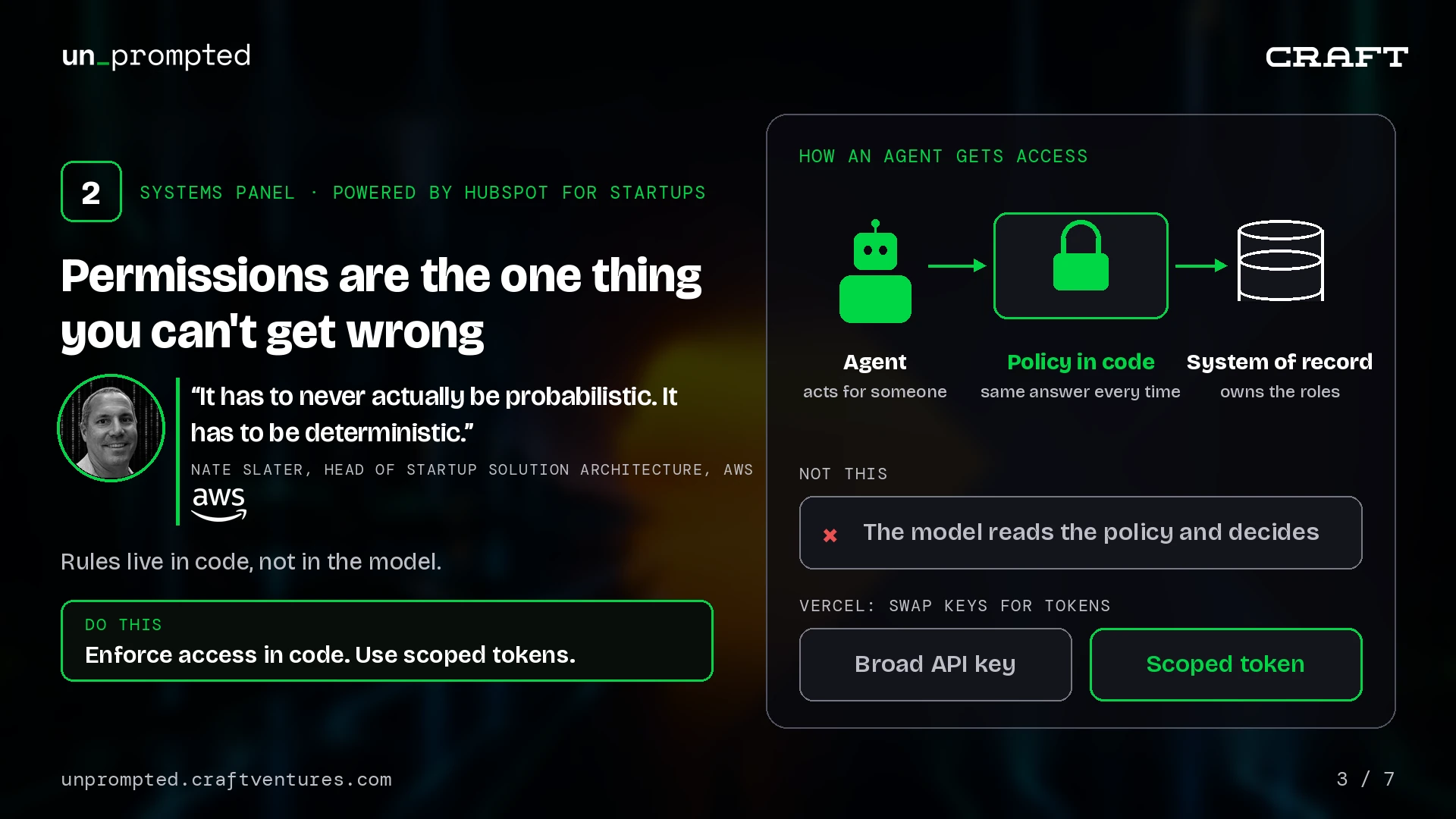
His rule is the most useful line from the panel for anyone building with agents. AWS has been working with policy languages that define what an agent is allowed to do, and the enforcement can’t be left to the model. “You can’t let the LLM read the policy and say, okay, I understand it, I’m going to do this.” The check has to give the same answer every time. And don’t rebuild role-based access inside the agent. Push it down to the system of record, which already knows who can see what.
Jeanne added what Vercel learned the hard way. Sometimes the agent should carry the permissions of the person who invoked it, and sometimes the agent should have its own. Vercel built Vercel Passport to connect agents to a company’s identity provider, like Okta, so two people using the same agent get different results. It also built Vercel Connect, which replaces handing an agent your whole Salesforce or Snowflake API key with a narrowly scoped token that is easy to revoke.
Nate’s warning for founders selling agent products: at his own startup, getting customers to grant access to their systems was by far the longest part of the sales cycle. Plan for it.
What to do
- Move agent permission checks into code, not prompts. If a model is deciding who can do what, fix that first.
- Swap broad API keys for scoped, revocable tokens on every agent connection.
- Budget for security review in your enterprise sales cycle, and have your identity and access story written down before the first call.
3️⃣ Clean data turns questions into answers
When Sarika asked Jeanne what Vercel’s system of record is, the answer wasn’t Salesforce. It was the data warehouse.
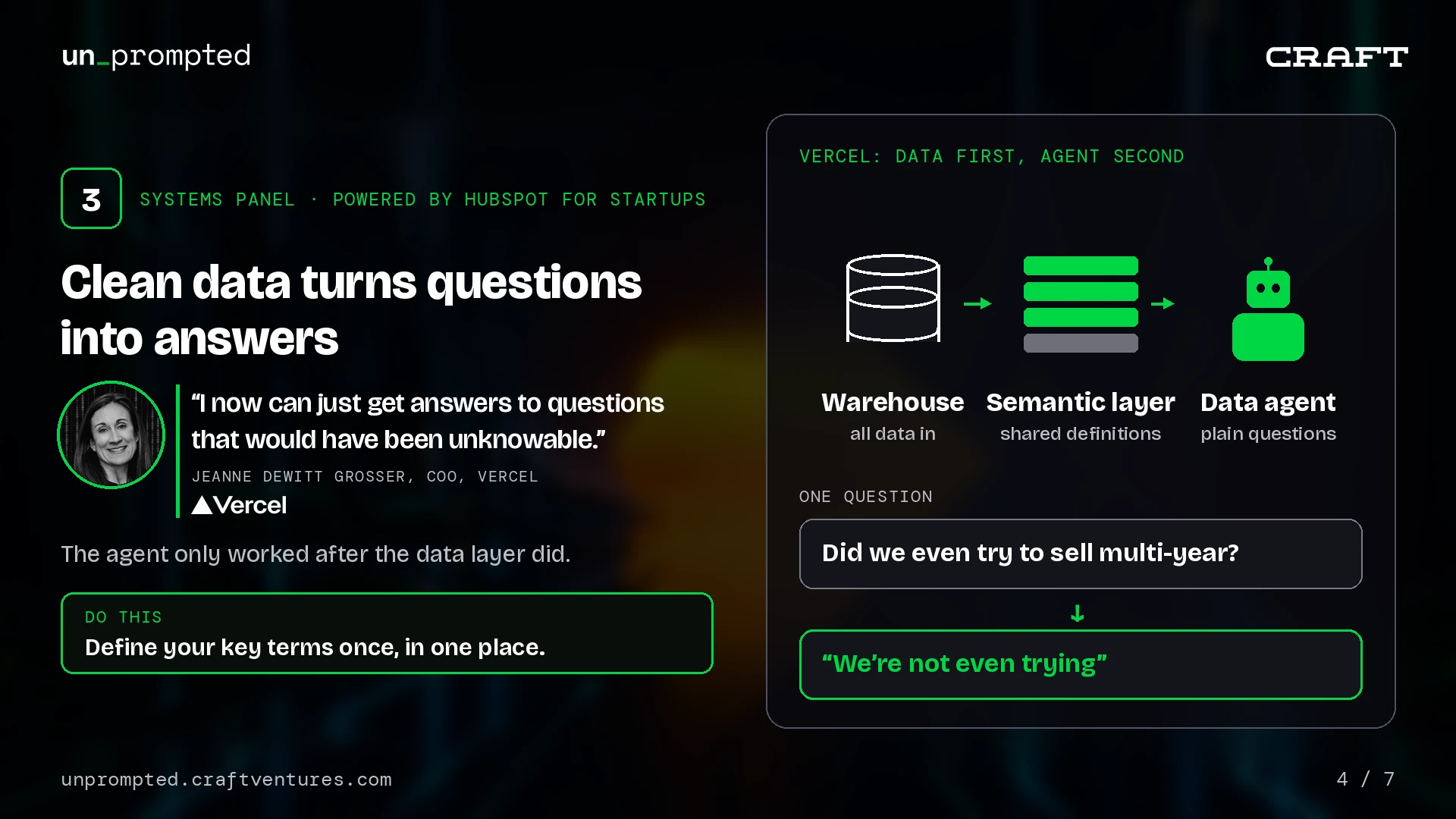
Vercel spent a long stretch building a semantic layer on top of Snowflake and piping much more data into it. That warehouse has increasingly become the place Vercel’s agents sit on top of, including V, an internal agent in Slack that works like a company brain. Jeanne was clear it wouldn’t have worked without the data work first. Her example: if someone in revenue asks about quarterly revenue, the agent has to know they mean fiscal quarters, not calendar quarters. Otherwise two people asking the same question get two different answers.
The payoff is the kind of question nobody could answer before. “I now can just get answers to questions that would have been unknowable.”
Vercel launched a new commit-based contract this year, and it was going well, except that customers weren’t signing multi-year deals. Jeanne asked the data agent to pull every deal closed on that contract, read thousands of call transcripts, and tell her how often anyone even tried to sell a multi-year term. “And you can immediately see, we’re not even trying, right?” Asking the field would have produced the usual answer: that nobody buys multi-year anymore. The data pointed to an enablement and incentive problem.
The same foundation powers Vercel’s sales agents, which take on everything a seller does between calls: research, account plans, agendas, notes, follow-ups, and the next deck. Jeanne described a Monday when she had taken three sales calls with three CTOs by 11 AM, because someone else had prepared every one: “I had to do zero work. I just had to show up and read the doc and execute that call.”
Our read: most teams add the agent first and fix the data later. Vercel did it the other way around.
What to do
- Define your top metrics and terms once, in one place, before you point an agent at them.
- Pick one question your team argues about and have an agent answer it from transcripts and records instead of opinions.
- Map what your sellers do between calls and hand the prep and follow-up to an agent first.
4️⃣ Own the brain or own the usage
Sarika put the big debate to the panel: will systems of record enter a golden era as the home of proprietary context, or will agents become the intelligence and the system of record shrink to a database?
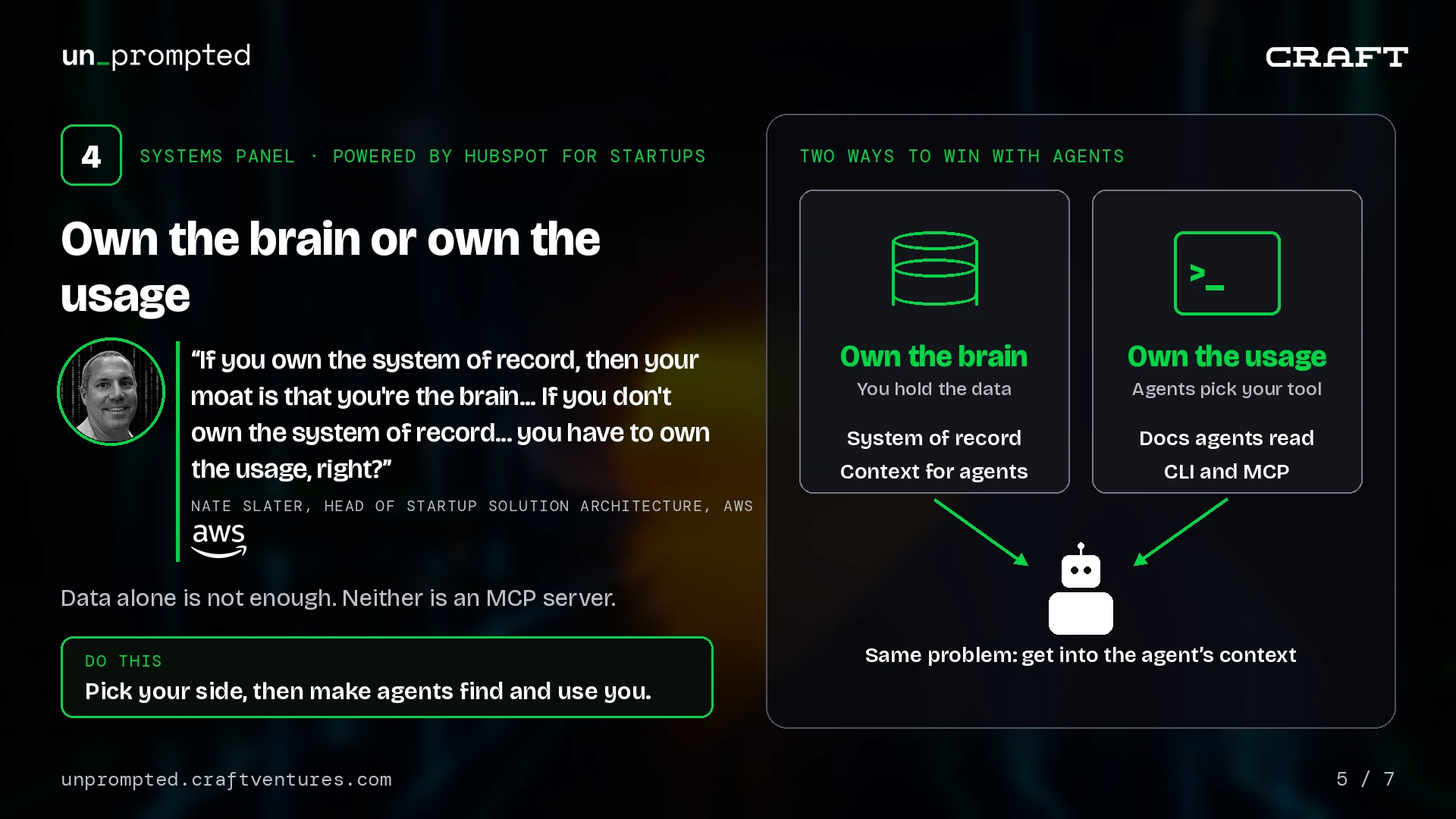
Nate’s answer was both, and he shared a theory one of his solution architects sent him: “If you own the system of record, then your moat is that you’re the brain... If you don’t own the system of record... you have to own the usage, right?” If you don’t own the data, you have to be the tool the agent or model picks for the task.
Either way, it’s the same problem. Having the data isn’t enough if an agent can’t get it into context in a useful way. And exposing a tool as an MCP server isn’t enough on its own either. Amazon has too many APIs to expose them all as MCP tools without overloading an agent’s context. Documentation matters more than ever, because that’s how agents learn what a tool does.
Jeanne gave the go-to-market version. “We also now talk about ALG at Vercel, so agent-led growth, and how you have to think of agents actually as a customer.” That means first-class CLIs and MCP servers, very good documentation, and more content. On the product side, Vercel builds the capability first, then exposes it through a UI for people and a CLI or MCP for agents at the same time. It has paid off. As Jeanne put it, coding tools are “telling you to use Vercel to deploy even if you have no idea what deploying is.”
This also shapes pricing. Jeanne doesn’t think seat pricing is over: “I’m not personally of the view that seats are dead, because humans do in fact still exist.” Vercel prices against every unit where value accrues: usage, a project, an outcome, or a person.
What to do
- Decide which side you’re on. If you hold the data, invest in making it usable as agent context. If you don’t, invest in being the tool agents pick.
- Expose your most common action twice: once in the UI for people, once through a CLI, API or MCP for agents.
- Treat docs as distribution. Agents learn about your product from what you write down.
5️⃣ Company building is agent building
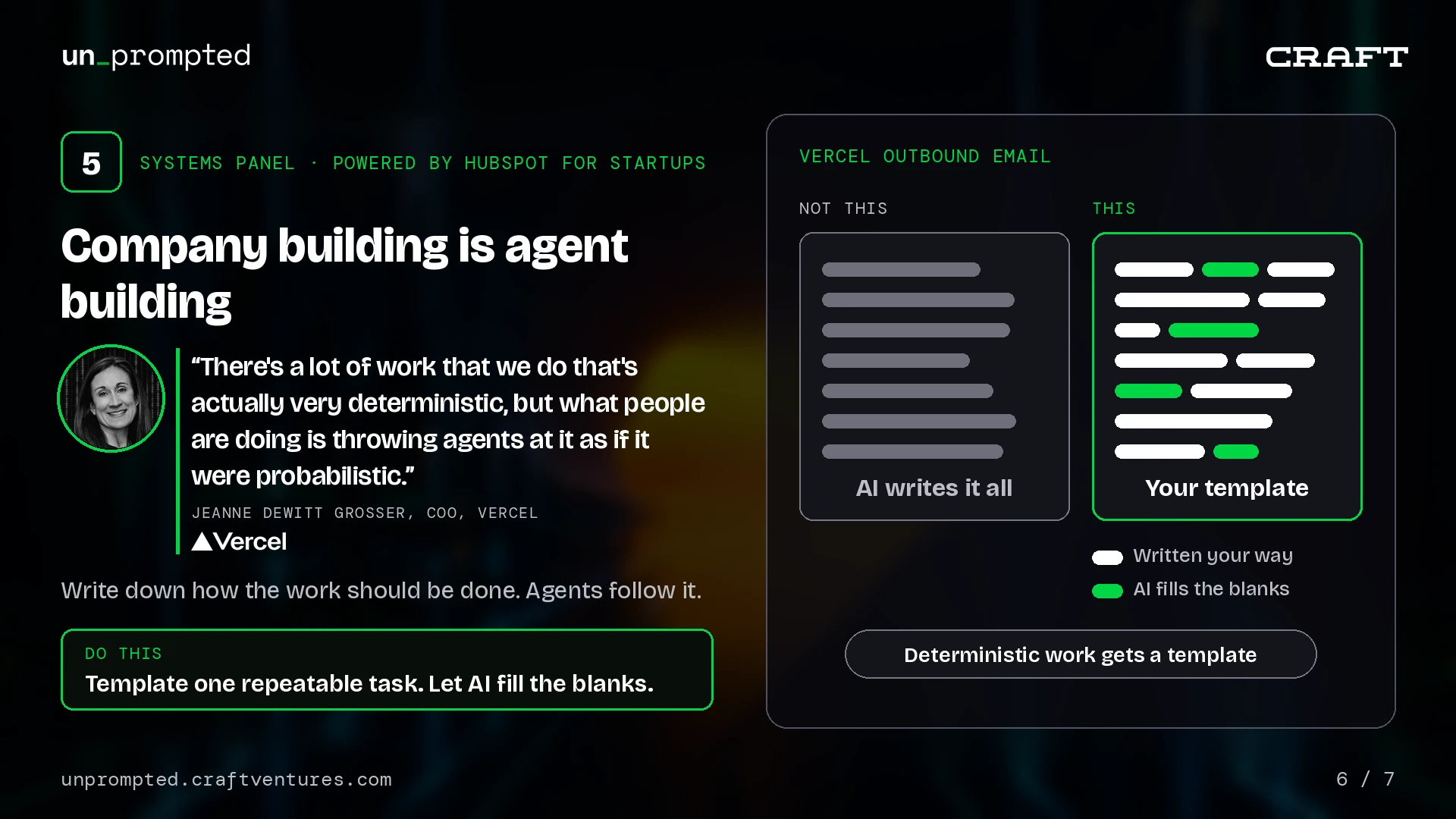
For the last question, Sarika asked for one architectural piece of advice for founders building their company’s operating system. Jeanne’s answer started with a phrase Vercel uses internally: company building is agent building.
Having a clear point of view on how work should be done, and writing it down, is one of the best paths to effective agents.
“There’s a lot of work that we do that’s actually very deterministic, but what people are doing is throwing agents at it as if it were probabilistic.”
Her example was outbound email. Claude will happily write an email to an executive, but not the way her CMO would describe Vercel’s value. “So when we do outbound prospecting we don’t let Claude write at all.” Part of the email is a template written the way she wants it, and Claude fills in the blanks.
Support works the same way. Jeanne said 91% of all support cases that come to Vercel get handled by AI. When a case isn’t, it’s often because the product is broken, which goes straight to engineering, or because documentation was missing. Vercel built a loop that writes the missing docs, and a person checks them before they go live.
The same discipline applies to what you build for yourself. Jeanne’s GTM engineering team only builds when there’s a clear edge from Vercel’s own knowledge, or when Vercel can be customer zero and make the product better. And anything hundreds of sellers depend on is held to product standards: “Someone’s carrying a pager for it.” Nate tells his own builders the same thing about taking a personal tool company-wide: “This isn’t a weekend project, right?”
What to do
- Write down how your best people do one repeatable task, then turn it into a template an agent follows.
- Let AI fill the blanks, not write the whole thing, for anything that carries your voice or your value proposition.
- Hold internal tools to a product bar: an owner, real code quality and someone on call, or keep them personal.
The thread that ties it together
Put the five ideas next to each other and they tell one story.
Your systems were built for a person, and that person now has company. Agents read and write the same records, so the first job is making sure they can only do what they’re allowed to, enforced in code. The second is clean, defined data, because an agent is only as good as its context. The third is deciding where you win, as the brain or as the tool agents choose. The last is writing down how your company works, so agents follow your best practice instead of guessing.
None of this requires ripping out your CRM. All of it requires clarity about what’s true, who can change it and how work gets done. Nate summed up the moment: “we know enough that we can say with confidence that it’s going to be different than what we’re doing today.”
What to do, right now
If you only do five things after watching this panel, do these:
1️⃣ Map the writers. List every agent that can write to your systems of record, and who approved it.
2️⃣ Lock down access. Move permission checks into code and swap broad API keys for scoped, revocable tokens.
3️⃣ Define your terms. Put your top metrics and definitions in one place before you add another agent.
4️⃣ Pick your side. Decide whether you own the brain or the usage, and expose your top action to agents as well as people.
5️⃣ Template the repeatable. Write down how one task should be done, and let AI fill in the blanks.
Thank you
Thank you to Jeanne and Nate for getting into the details most panels skip, and to Sarika for moderating. A special thank-you to HubSpot for Startups for powering the Systems panel, and to all the partners who made Un_prompted possible: LinkedIn, Clay, Goodwin, Amazon Web Services (AWS), HubSpot for Startups, 3FORTY3, and Brickell Digital.
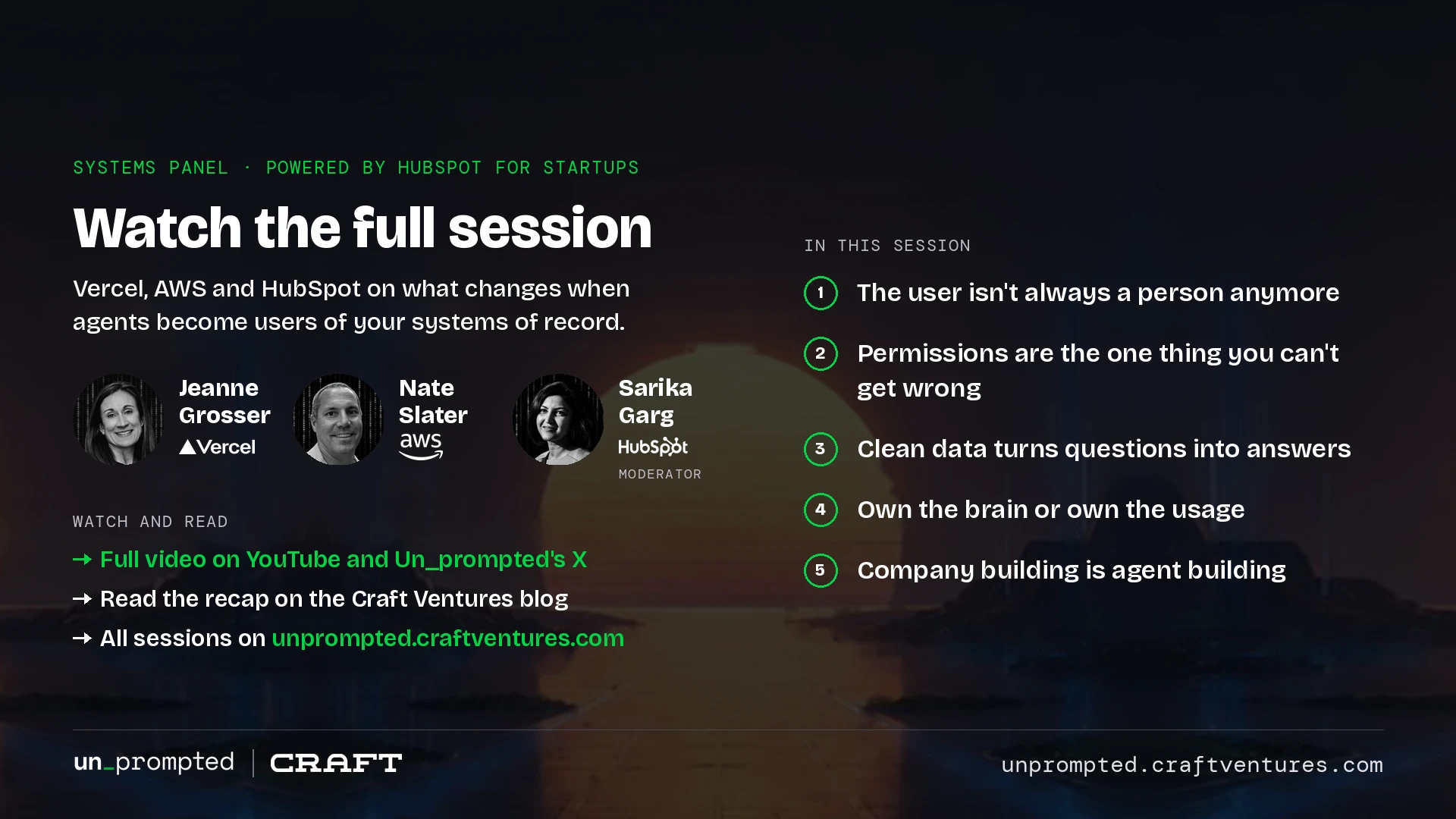
Watch the full session: https://youtu.be/lVLG4lnsHjQ
All sessions: https://unprompted.craftventures.com
Follow Un_prompted: X https://x.com/unpromptedcraft · LinkedIn https://www.linkedin.com/showcase/unpromptedcraft/
Read the full recap here.