

Ask Martin “Gonto” Gontovnikas who reads your website the most, and the answer isn’t your buyer.
“Your web right now, and this is true for Supabase, true for Clerk, true for all, is already used and seen more by agents than by humans.”
Developer marketing has always meant selling to a skeptical audience that reads the docs before it reads the ads. Now more and more of that reading is done by agents: Claude Code adding a library, Codex setting up a tool, a bot testing your newest feature. And the people on the other side aren’t only career engineers anymore. As our host put it when the session opened, there are more developers now than there have ever been, once you count everyone building with tools like Claude Code.
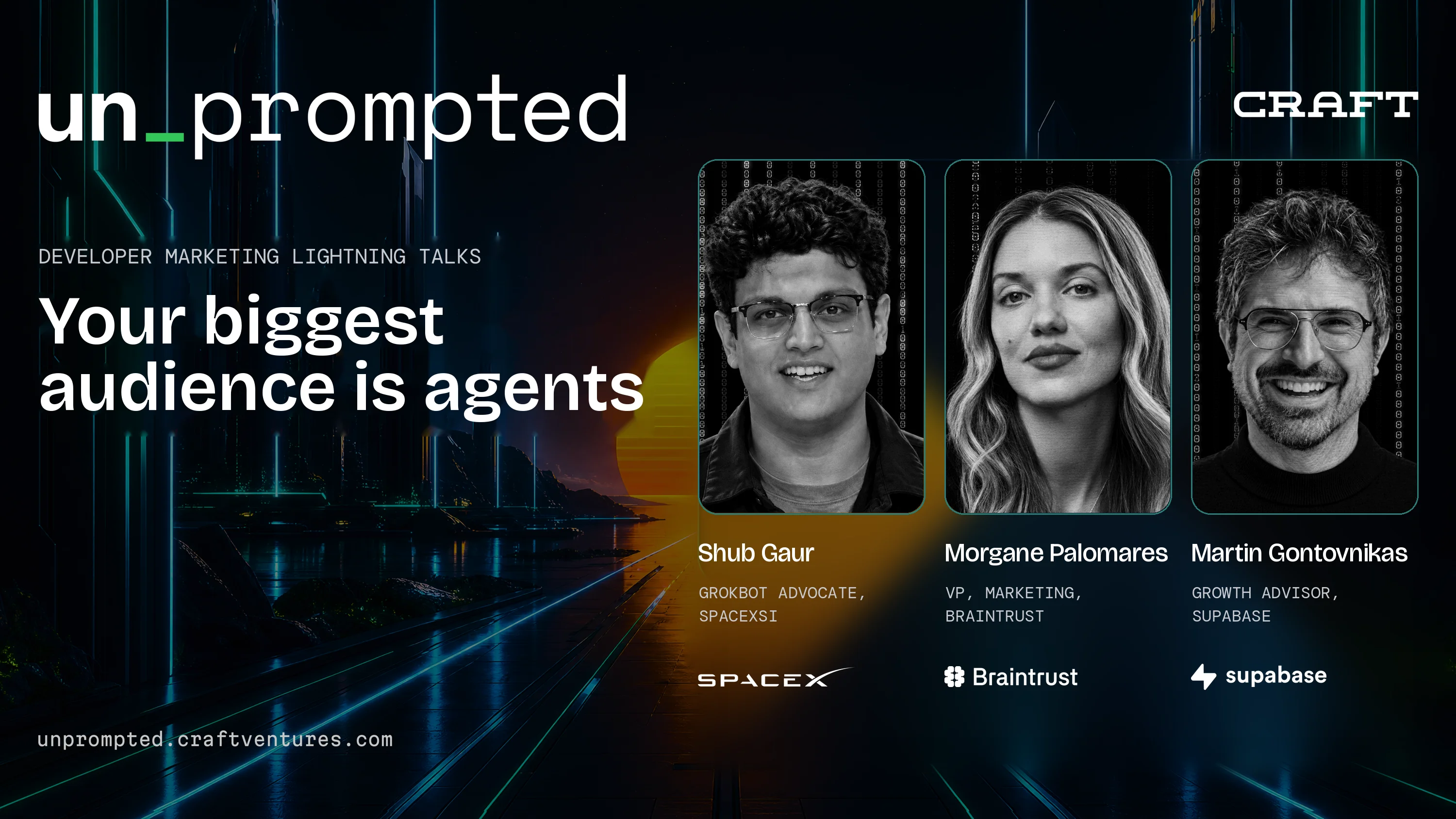
That was the backdrop for the developer marketing lightning talks at Un_prompted. Three speakers, three angles: Shub Gaur of SpaceXSI on bots that own outcomes, Morgane Palomares of Braintrust on why most marketing is now rapid response, and Gonto of Supabase on building your website for agents.
Below are the six ideas every founder and operator should take from the round, and what to do about each.
Who was on stage
Shub Gaur, GrokBot Advocate, SpaceXSI
Morgane Palomares, VP, Marketing, Braintrust
Martin “Gonto” Gontovnikas, Growth Advisor, Supabase
All three sell to developers and to the agents developers now work with. SpaceXSI makes GrokBot, persistent AI agents that each run on their own cloud computer. Braintrust is where teams building AI products evaluate and monitor them. And Gonto, who ran marketing at Auth0, now advises Supabase and other developer companies on growth.
1️⃣ Hand off outcomes, not tasks
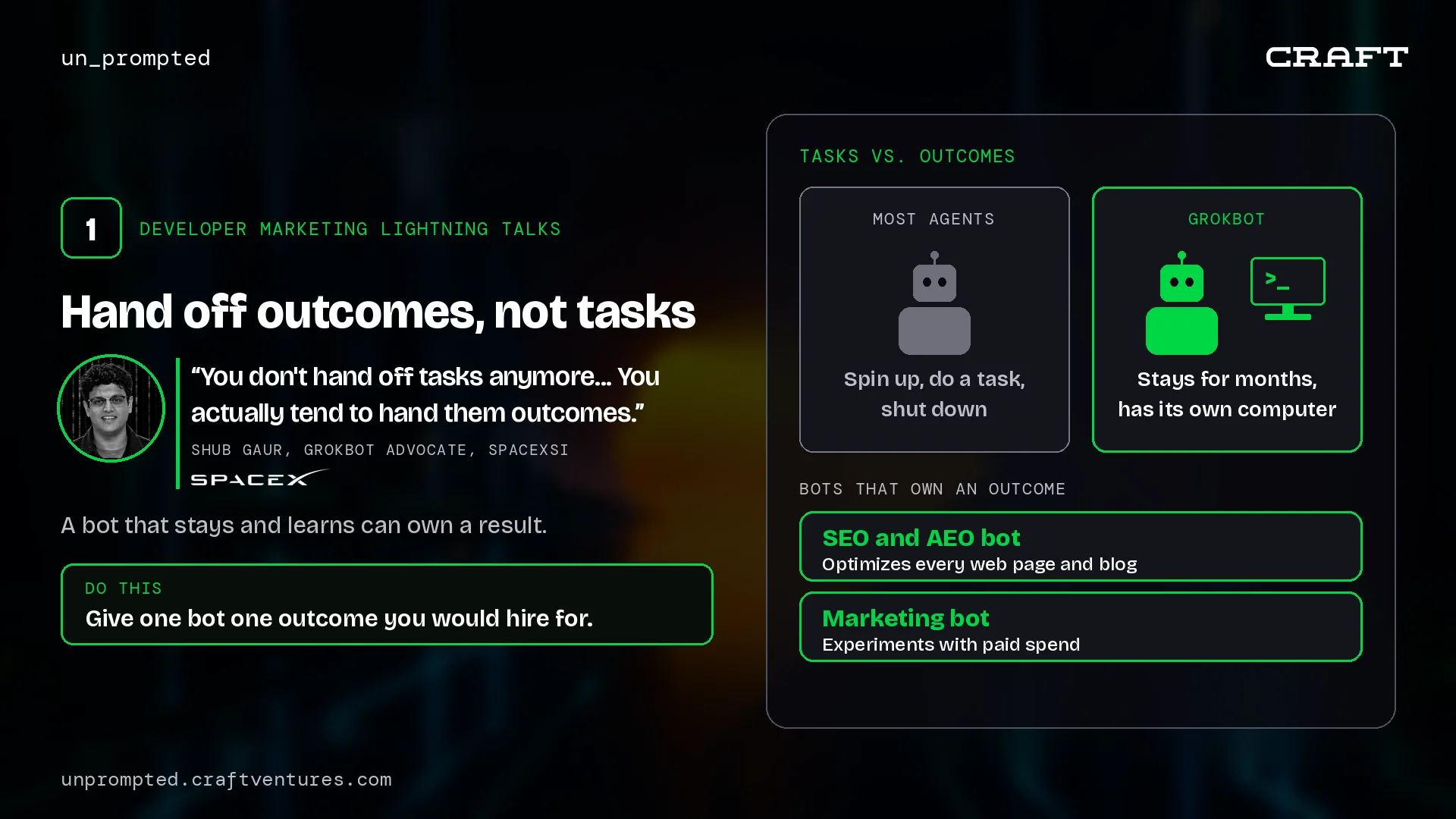
The useful question is no longer which task an agent can do. It’s which result it can own.
Shub started with a quick show of hands on who had used GrokBot, then explained what makes it different. Most of us use agents in an ephemeral way. As he put it: “You spin them up, you complete a task, and then you kind of kill them, and it’s really sad.”
GrokBot keeps its bots around. Most of Shub’s have been running for three or four months, and “they’ve gotten better with experience the same way an employee would.” Each one has its own cloud computer, so it can log in to the tools you use and get far more done than an agent that lives in a chat window.
That changes what you hand over. “You don’t hand off tasks anymore... You actually tend to hand them outcomes.” On his team, an SEO and AEO bot takes every web page and blog post and optimizes it with nearly no human input. A marketing bot experiments with paid spend to make sure it’s being used well.
It shows up in headcount. Shub said he isn’t allowed to share the size of SpaceXSI’s growth and marketing team, but “you’d be surprised with how small it is for such a large company.” The reason: the team can “scale ourselves with an army of bots that complete functions for us.”
What to do
- Pick one result you would normally hire for, like keeping every page optimized for AI search, and give it to one bot that stays on the job.
- Give that bot access to the tools the job needs, the same way you would onboard a new hire.
- Review the outcome, not the steps. Correct it when it gets something wrong, and let it keep learning.
2️⃣ Staff outcomes, not seats
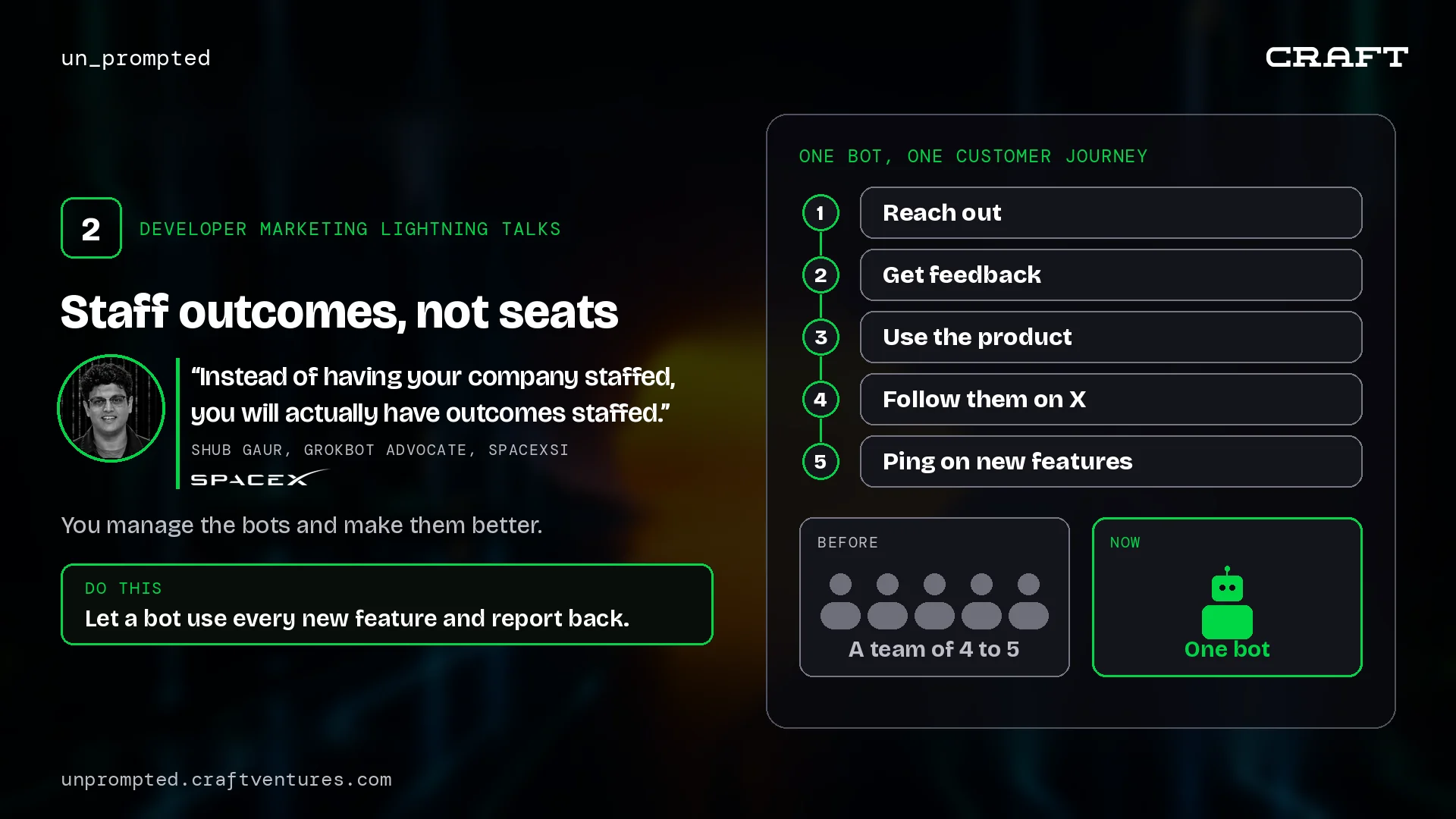
The next org chart is a list of outcomes, each with an owner. Some of those owners will be bots.
Shub’s second point was about stretching outside your role. Everyone has a spike, and everyone has work they’re weaker at or would rather not do. Instead of waiting on a recruiter or chasing someone in Slack for product numbers, you hand that work to a bot.
His favorite example is dogfooding: “Instead of you having to go dogfood everything yourself or rely on the PM or developer to tell you what happened, you can have a bot actually go do that work for you.” The bot signs up with its own email, goes through the product and tells you what shipped, every day or every week.
He also runs a bot that follows a customer journey end to end. It reaches out, gets feedback, uses the product on its own device, follows customers on X, and checks in when they hit an exciting new feature. It covers 50 or 100 people, not hundreds of thousands, but that’s enough insight to shape his next growth experiment. “Previously, this would take me a team of four or five people to actually go and coordinate all this research and handle the full end to end.”
Where it goes next: “Instead of having your company staffed, you will actually have outcomes staffed.” You set a goal, like ad spend that produces a target amount of revenue, and bots iterate on it while you make them better. “So it’s basically managing people, but you’re managing bots to get really cool stuff done for you.”
What to do
- Have a bot sign up for your product with its own email and report what changed after every release.
- Pick 50 customers and let a bot follow their journey from first touch to feature adoption. Read what it learns before your next experiment.
- Write one goal as an outcome with a number, not a list of tasks, and give it an owner.
3️⃣ Most marketing is now rapid response
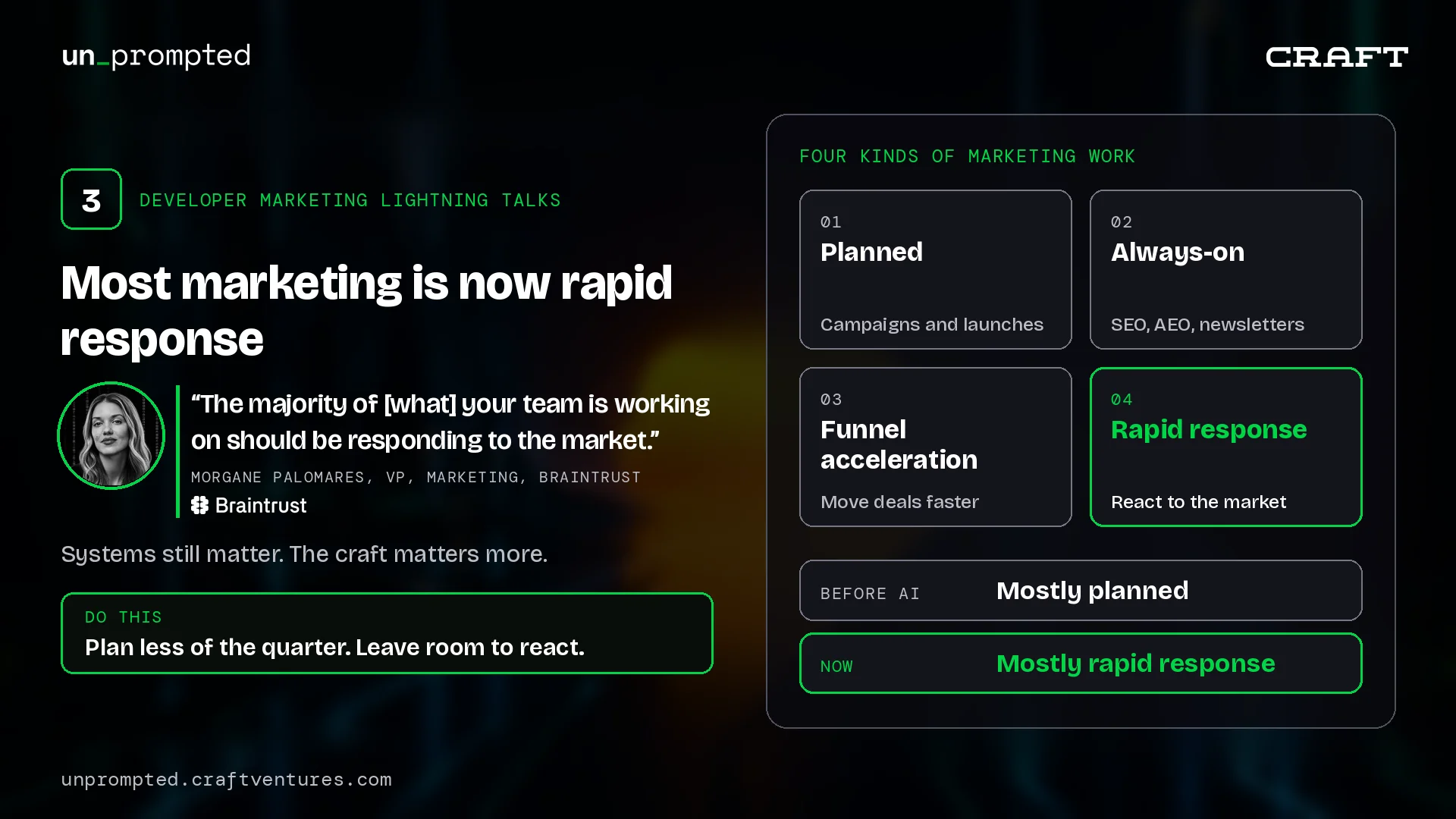
The plan still matters. It’s just no longer most of the job.
Morgane started with how we trained marketers. “The past 10, 15 years, we have been teaching marketers to be system thinkers.” More optimization, more attribution, more ops, more automation. That made sense, because before AI most marketing work was predictable.
She laid out four types of marketing programs. Planned programs are campaigns and launches, and before AI a team probably spent at least three months building them. Always-on programs are the systems work: SEO and now AEO, performance marketing, and newsletters. Funnel acceleration is the push to move deals faster when pipeline is low. Rapid response is reacting to the market right then and there, which used to be rare, saved for a competitor’s misstep or a PR crisis.
Now the ratio has flipped. In dev marketing and AI infrastructure marketing, most of the work is rapid response. “The majority of [what] your team is working on should be responding to the market.”
That doesn’t make systems less important. Morgane said your team still needs to understand them and be efficient with the tools you give them. “But really, you want your marketers to be excellent at the craft of marketing.” For her, that means knowing your audience so well you can whisper the perfect thing to your buyer, and know what to say, what to have a perspective on, and when to stay quiet.
What to do
- Sort last quarter’s work into planned, always-on, funnel acceleration, and rapid response, and see how much was actually reactive.
- Leave real room in the plan for what the market does next, not only what you scheduled.
- Hire and train for craft: deep audience knowledge, a point of view, and the judgment to know when not to post.
4️⃣ Let your team drop everything
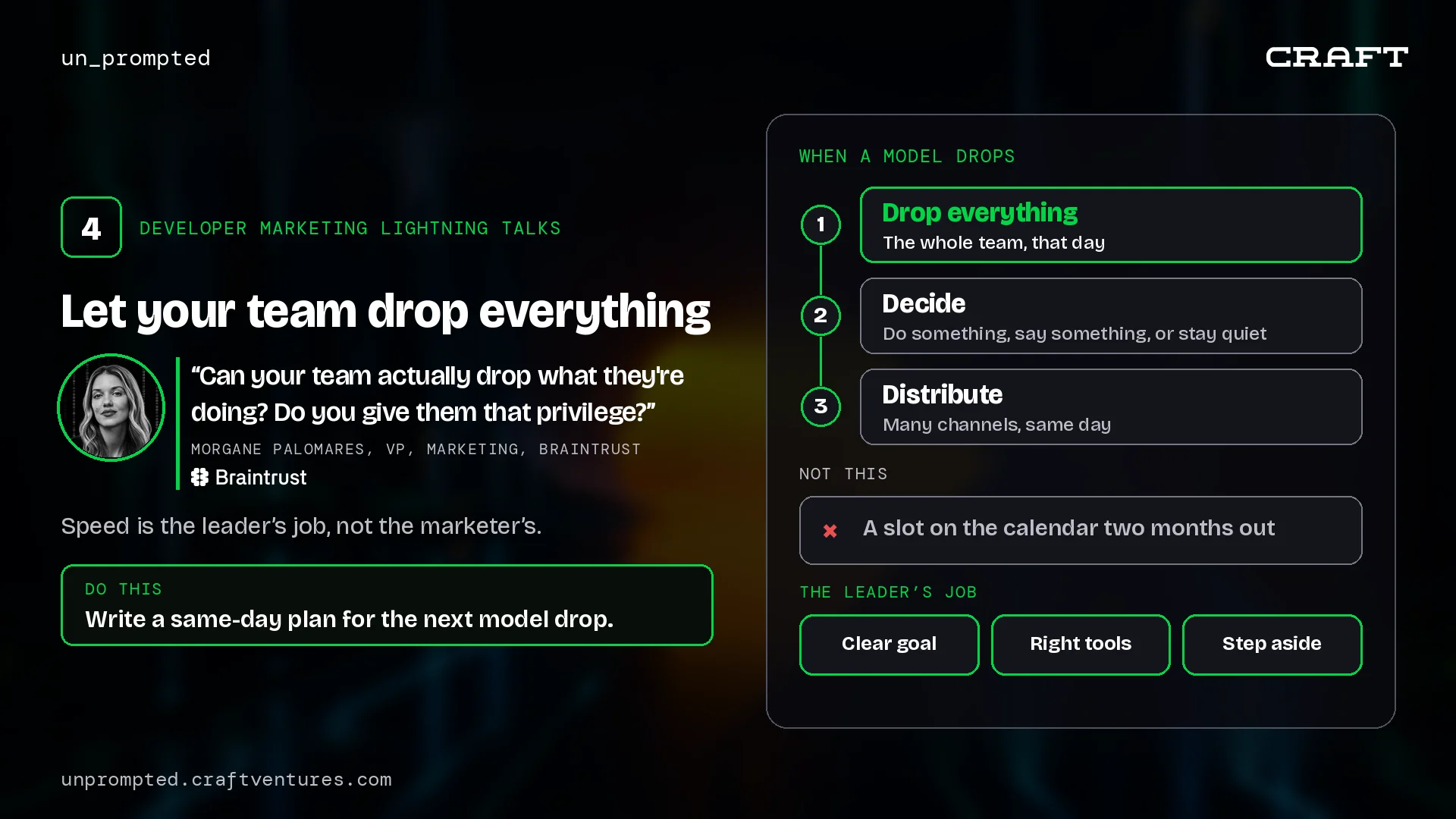
Speed is a leadership decision, not a marketing skill.
Morgane’s example is one every AI company lives with. When a new model drops, she said, that should be the moment “your entire team stops what they’re doing that day and figures out if your company can do something about it, can say something about it, or should shut up.”
Once you decide to act, you have to get the message out in many places, and “that cannot be something you slot into the editorial calendar two months from now.” If your post goes out a week later, “you should be fired, in my opinion, in today’s version of marketing.”
Then she turned it on the founders and leaders in the room: “Can your team actually drop what they’re doing? Do you give them that privilege? Do you set that that’s the expectation of what success looks like for them now?”
And do they have the tools? “Can they pump out an animated video within three hours?” If not, she said, “that’s actually your job. It’s not the marketer’s job.” Make the expectation clear, set the team up in the right environment, and then get out of their way.
What to do
- Write a same-day plan for the next model drop: who decides, who writes, who designs, and where it goes.
- Tell your team in writing that dropping planned work to respond to the market is part of the job, not a failure to plan.
- Close the tool gap so the team can turn around a short video and a post in hours, not weeks.
5️⃣ Build your website for its biggest reader
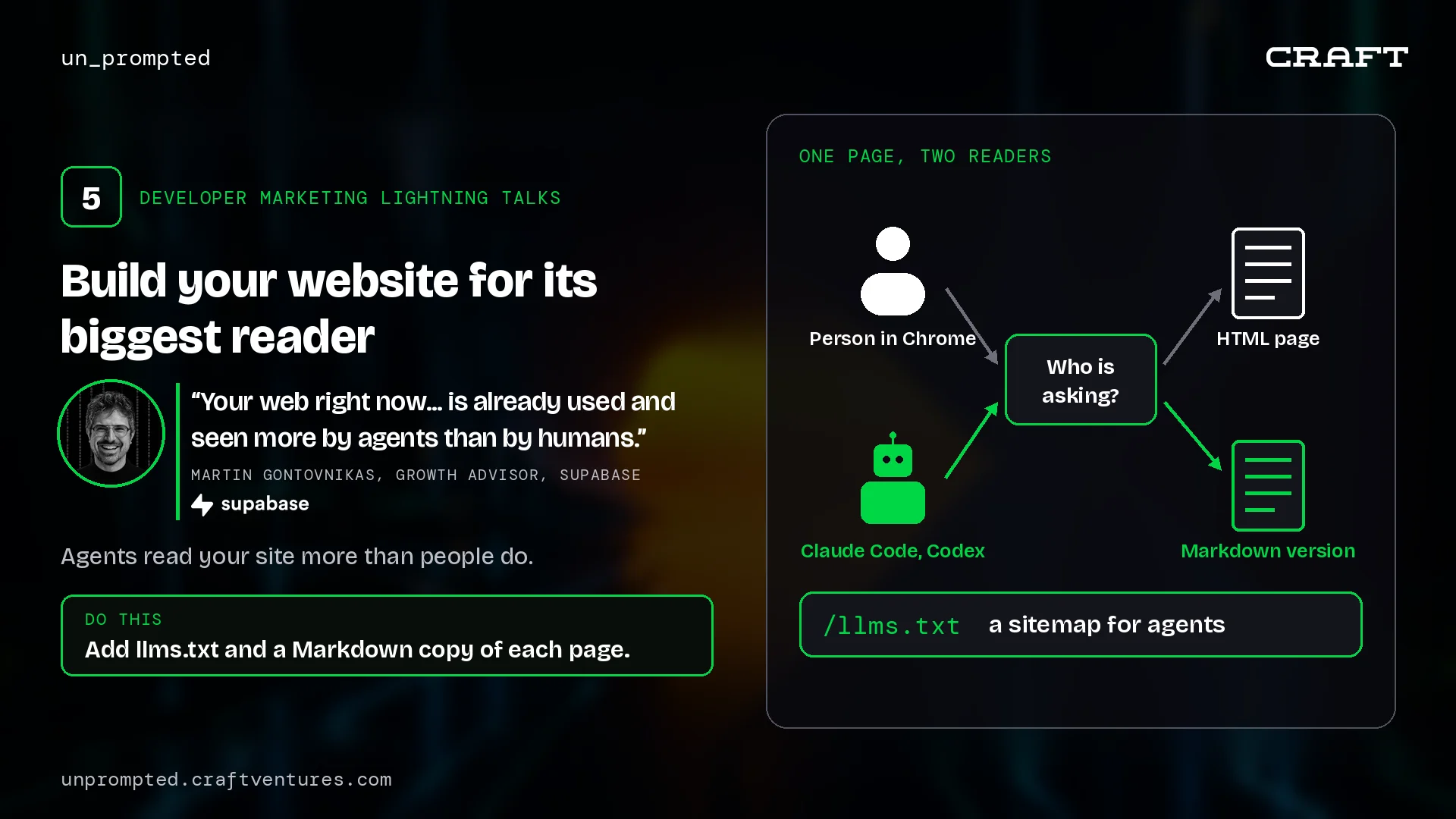
Your website now has two audiences, and the bigger one doesn’t browse the way you do.
Gonto’s talk was about making websites and apps AI native, which he defined simply: “it’s a website and an app that the agent can discover and use more.”
His first step is llms.txt, which he called a new sitemap that most companies now use for agents. It’s a Markdown file that links to the most important pages, so Claude Code, Codex, or ChatGPT can see everywhere it can go. Supabase, for example, publishes one.
Second, every page on your site should have a Markdown version that can be served to agents. Ask an agent to read Supabase’s database page and it gets the same content as clean Markdown, explaining what the product does, what the agent should care about, and why. The site decides which version to serve by checking who is asking. A person in Chrome gets the normal page. A request from Claude Code or Codex, or one that asks for Markdown, gets the Markdown version.
Third, an MCP server that lets an agent do everything a person can do from your dashboard.
His closing line is the one we opened with. Your site is already read more by agents than by people, so “you need to make it easier for agents to consume your web, since they are the ones that are consuming it the most.”
What to do
- Publish an llms.txt that links to your most important pages and docs.
- Serve a Markdown version of every key page, and return it automatically when the request comes from an agent.
- Check how much of your traffic is already agents, and treat that number like any other audience metric.
6️⃣ Swap the sign-up button for a prompt
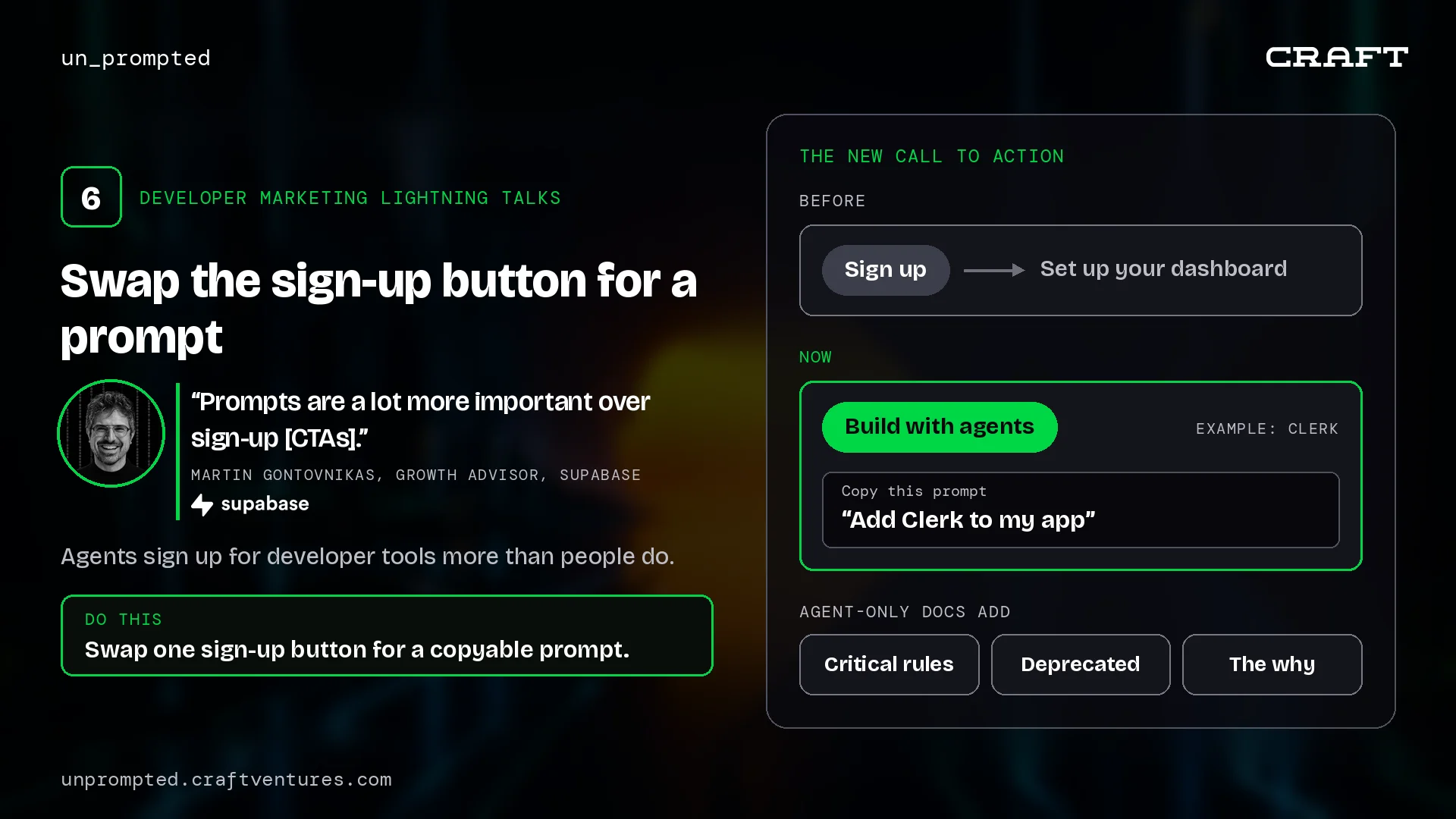
For developer tools, the first user is often the agent. Write your first call to action for it.
Gonto pointed out that for a developer tool, the agent now signs up for the product more often than a person does. His example was Clerk. The old call to action was a sign-up button that sent you to a dashboard. The new one says “Build with agents.” Click it and you get a prompt to copy, like “add Clerk to my app.” Paste it into your coding agent, and the agent guides you on how and when to sign up.
As he put it, “prompts are a lot more important over sign-up [CTAs].” Onboarding is changing the same way. It used to walk you through setting up a dashboard. Now, “lately I’ve built a lot of onboardings to customize a prompt.” The onboarding explains the product’s features so it can build a better prompt, specialized on exactly what you need.
Docs get the same treatment. Clerk’s Next.js quickstart is a five-step guide for people. Agents need more than the steps, because they sometimes take the wrong one or use something deprecated. So the agent version also covers “what are the critical rules that it should follow, what are things that are deprecated that it shouldn’t use, and why.”
What to do
- Add a “Build with agents” option next to your sign-up button that copies a ready-made prompt.
- Turn onboarding into a prompt builder: ask what the user is building and hand back a prompt made for it.
- Write agent versions of your top docs with the critical rules, the deprecated patterns and the reasons behind them.
The thread that ties it together
Put the three talks next to each other and they tell one story.
Shub hands bots whole outcomes and spends his time making them better. Morgane wants marketers free to drop everything when the market moves, because most of the job is now responding. Gonto builds the website, onboarding and docs for the agents that already read them most.
Agents are now on both sides of developer marketing. They help you do the work, and they’re a big part of who you’re talking to. The teams that win will staff for outcomes, move the same day and make their product easy for an agent to find, read and set up.
What to do, right now
If you only do six things after watching these lightning talks, do these:
1️⃣ Hand off one outcome. Give one bot one result you would normally hire for, and the tools to get it done.
2️⃣ Let a bot dogfood your product. Have it sign up with its own email and report what changed after every release.
3️⃣ Audit your calendar. Sort last quarter’s work into planned, always-on, funnel acceleration and rapid response.
4️⃣ Write the model drop plan. Decide now who does what the day the next model ships, and give the team permission to drop everything.
5️⃣ Ship llms.txt and Markdown pages. Make your site easy for agents to read, and serve them the Markdown version.
6️⃣ Add a “Build with agents” prompt. Put a copyable prompt next to your sign-up button and in your onboarding.
Thank you
Thank you to Shub, Morgane and Gonto for packing so much into one short session. And thank you to the partners who made Un_prompted possible: LinkedIn, Clay, Goodwin, Amazon Web Services (AWS), HubSpot for Startups, 3FORTY3, and Brickell Digital.
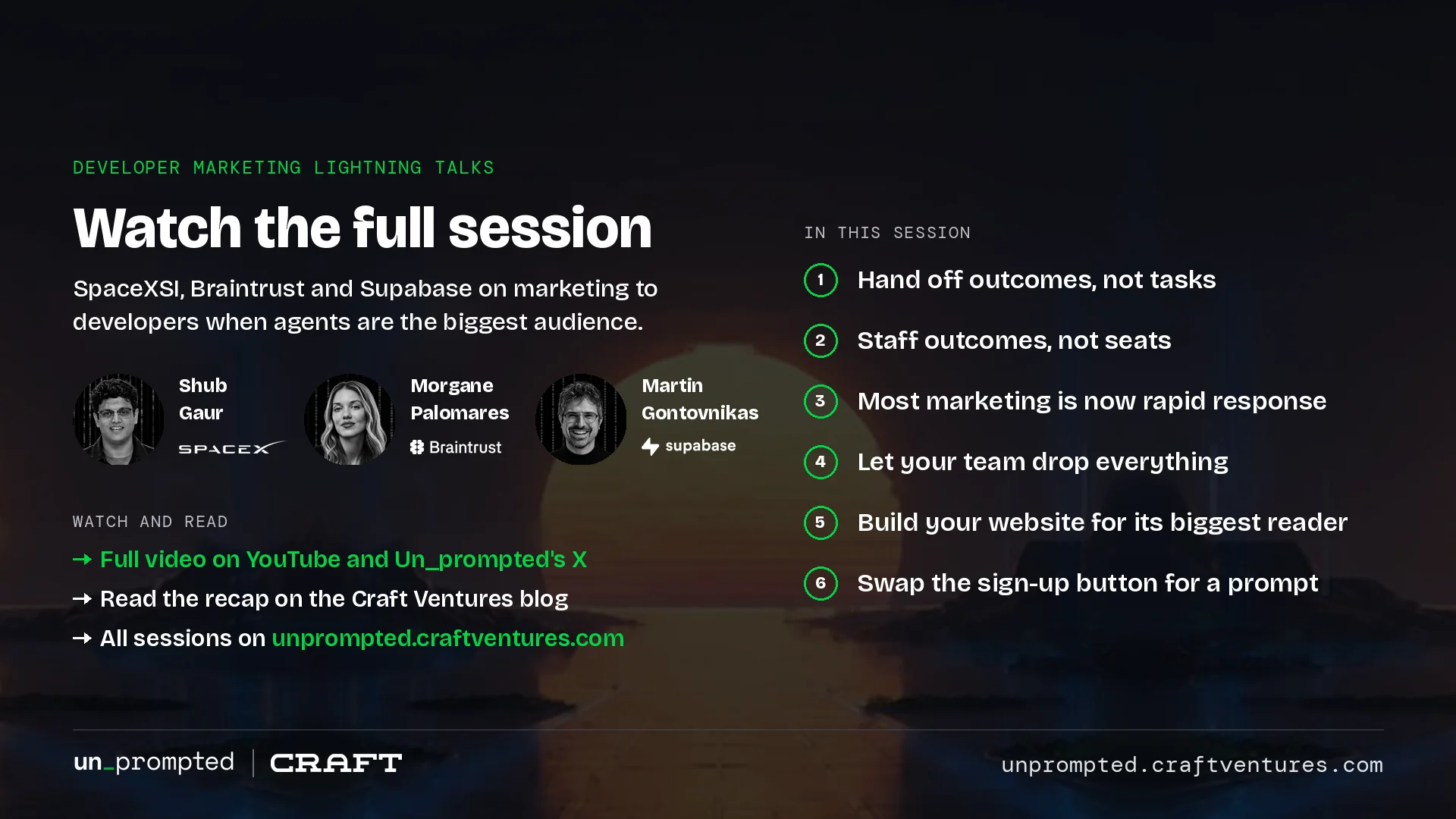
Watch the full session: https://youtu.be/hvgkgs6YCL8
All sessions: https://unprompted.craftventures.com
Follow Un_prompted: X · LinkedIn
Read the full recap here.